


While Israel was deep in the war with Iran, Eurovision delegation representatives gathered in Vienna to film the “postcards,” the short clips that introduce the singers before their performances in the contest. Contestants from the various countries filmed in a local studio against a green screen with the Austrian production team.
Only Israel’s representative was far away, unable to board a plane because the skies were closed. The Israeli delegation requested, and received, special permission to set up the same studio in Israel, with the same green screen and the same Austrian production elements, so that Noam Bettan would have a postcard just like the other countries.

That story, in effect, illustrates Israel’s situation in this year’s Eurovision Song Contest in particular, and in recent years in general: overcoming every technical difficulty or boycott attempt on its own in order to take part in the European song competition. With two weeks to go until the Eurovision final, the Israeli delegation is warming up behind the scenes.
Relations with the participating countries
In recent years, Israel has faced isolation by some of the contest participants because of the ongoing war and political issues. This year, Israel may experience a similar situation, especially given the delegation’s absence from pre-contest events that could have helped build ties.
Yoav Tzafir, the delegation’s director, told ynet that “before Eurovision, there were many parties with contestants from different countries. Israel did not fly because of security issues, so no ties were formed with the other participants.”
Those missed connections affected Israel this year not only at the artist level but also among delegation officials. During the war with Iran, the traditional heads of delegation meeting was held, and Israel could not attend that either because the skies were closed. That meeting could have helped develop dialogue with some delegations.
“There are a few that make background noise, like the Swedish and Finnish delegations. It exists every year,” one Israeli delegation source said. “But our connection with most delegations exists.”
Tzafir also finds reason for optimism.
“I can say that Noam told me he corresponded with the French representative and she was very nice to him,” he said.
The Belgian representative has also welcomed Israel warmly, despite Belgium being considered a leading anti-Israel voice. In an interview, Belgian singer Assila said she “understands the controversy surrounding Israel’s participation, but for me Eurovision is one big musical family that remains united around music.”
Heavy security
One of the issues most preoccupying the Israeli delegation, aside from the music, is security. Anyone who expected “friendly” Vienna to allow the Shin Bet, which is responsible for the delegation’s security, to lower the level of alert was mistaken.
According to sources, the number of delegation members is similar to previous years. However, some were surprised to learn that the security arrangements will also remain at the same significant scale as last year’s contest, even though the war in Gaza has ended and Austria is considered relatively supportive of Israel.
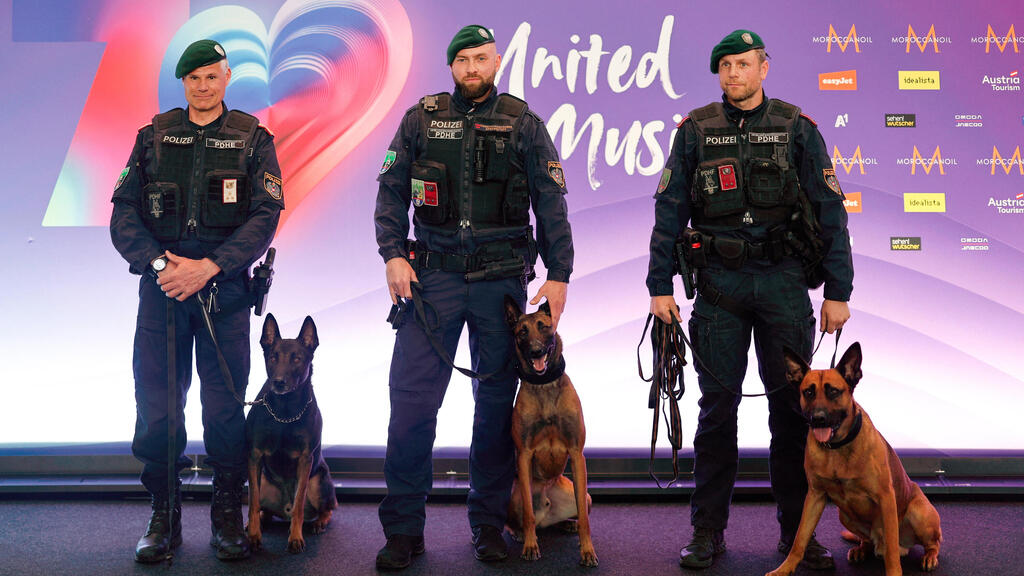
Security personnel in Vienna ahead of the Eurovision
(Photo: Lisa Leutner/ Reuters)
“This is indeed Austria, which is friendly to Israel, and it’s true that the war in Gaza is over, but absurdly the hatred of Israel has grown,” Tzafir said. “At least according to the preparation we were given, which I cannot elaborate on, this is a challenging security year for us.”
Another delegation source said: “In previous years, we felt very safe with the Israeli security team. They know how to focus on the significant threats, and according to the briefings we received, this year nothing is being taken lightly. They expect demonstrations and unpleasant incidents for us.”
One of the traumatic events for the Israeli delegation last year took place during the turquoise carpet, the first event that effectively marks the start of Eurovision week. During the event, Palestinian flags were raised, and one person made a throat-slitting gesture toward Yuval Raphael, prompting the Israeli delegation to file a police complaint. As of this writing, the delegation has not received any update on what became of it.
“We know similar things can happen in Vienna too,” one delegation source said. “But we are not giving up on participating in the turquoise carpet. Come on, we got through Malmö. We’ll get through Vienna too.”
The Israeli delegation is also preparing for boos during Bettan’s performances at Eurovision, and for Palestinian flags to be raised while he is on stage.
“We’re talking with Noam,” Tzafir said. “The truth is, he is a strong guy. He has mental strength, he is cool and he is coming to give everything on stage. He is as determined as can be, and he will know how to deal with it.”
At a fan event in Israel, you said the boos are good for the delegation.
“We don’t like the boos, and they are not fun for any of us. We don’t control them, and we don’t want them to happen. But I am saying that if they are already happening, they give us drive and make us more goal-oriented. And separately, as a television editor, I think that when the audience at home sees an artist absorbing boos, the emotion goes toward him, and that can bring votes.”
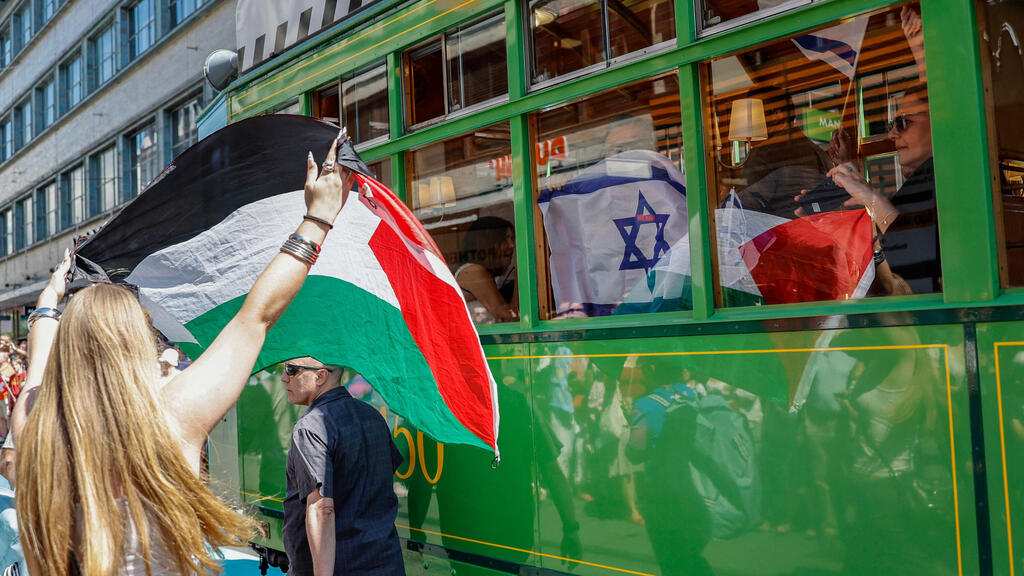
The 2025 contest
(Photo: Fabrice Coffrini/ AFP)
The new rules
For Eurovision’s 70th year, the European Broadcasting Union wanted to avoid dramas that could lead to political crises between countries. For months, it wrestled with how to handle the question of Israel’s participation in the contest, a political hot potato in which every step in either direction drew harsh criticism. During the war in Gaza, there was a real threat of expulsion.
Attorney Ayala Mizrahi handled a meeting in London alone and managed to postpone the decision until the winter months. During that time, Israel worked quietly behind the scenes, including by setting up a special team at the President’s Residence, planning a special visit by the chairman of Austria’s broadcasting authority and receiving backing in the form of a statement by Germany’s chancellor, who said that if Israel were expelled, his country would withdraw from the contest.
After all of that, the decisive meeting was held in Geneva in December, with Kan public broadcaster CEO Golan Yochpaz and Mizrahi representing Israel. The discussion took place against a stormy backdrop, with no fewer than four countries threatening to boycott the contest if Israel participated: Spain, Ireland, Slovenia and the Netherlands.
The European Broadcasting Union struggled with how to square the circle, ensuring Israel’s participation while also giving something to the countries angry at Israel politically. That is how a new package of rules was established and passed along with the vote on Israel’s participation in the contest. And as expected, the rules are all anti-Israel and are intended to weaken Israel in the competition.
The European Broadcasting Union headquarters in Geneva (EBU), illustration
(Photo: Fabrice Coffrini/ AFP)
First, it was decided that juries would return to voting in the semifinals in order to weaken the power of the audience at home. The reason is clear: Israel leads in the public vote, and the EBU feared that this reflected unusual mobilization by Jewish communities across Europe. Another rule intended to weaken Israel is the reduction of the public’s voting power: each phone will be able to vote 10 times instead of 20.
Tzafir is confident that these rules will only increase the motivation of Israel’s supporters.
“I know Jewish communities support us very much,” he said. “It would not be accurate to say that we manage their support for us or organize it. We are in good contact with them. And I’ll tell you something else: It doesn’t really matter whether we are in contact with them or not. The support of Jewish communities across Europe has become organic.”
The obsession of the countries boycotting Eurovision did not end with their nonparticipation. It went further when they announced they would not broadcast the contest at all this year. In Spain, for example, this will be the first time since the 1960s that it will not broadcast the competition. In Slovenia, the public broadcaster decided to air Palestinian films as a protest during the contest.
The performance
Bettan will perform “Michelle,” the song he wrote alongside Yuval Raphael, Tzlil Klifi and Nadav Aharoni. The Israeli delegation is keeping several surprises under wraps ahead of the first rehearsal, which will take place this Sunday.

(Photo: Reuters)
It is already known, however, that Lihi Freud, the dancer featured in the music video, will dance alongside Bettan. Freud’s participation indicates a desire to connect the video to the stage performance. But while the video includes dozens of dancers, the Eurovision stage allows only up to six participants, including the artist himself.
Israel likes to surprise with different stage elements, as it did with Noa Kirel’s waterfall and Yuval Raphael’s chandelier. For that reason, Tzafir traveled with Shai Bonder to Romania to closely monitor work on what he described as the “complex” element that will appear on stage this year.
Aiming for victory
Despite the rule changes, the Israeli delegation is aiming as high as possible: victory. Yes, you read that correctly, victory.
“We are aiming for first place,” said a source familiar with the details. “We see what is happening in the countries facing us, who our competitors are, and we know what Noam is capable of. Victory is definitely the place we are aiming for and want to reach.”

Noam Bettan and the Eurovision 2026 dance team
(Photo: Nitzan Livnat)
But before victory, Bettan, who at the time of writing is ranked sixth in the betting odds, faces the first semifinal on May 12, which will be broadcast on Kan. Bettan, song No. 10, will compete for a place in the final against Moldova, Sweden, Croatia, Greece, Portugal, Georgia, Finland, Montenegro, Estonia, Belgium, Lithuania, San Marino, Poland and Serbia. Alongside the competing countries, Italy and Germany will also present their songs on stage for the first time, though they automatically qualify for the final.
“No one is even thinking about a scenario in which we do not qualify from the semifinal,” a Kan source said. “That is evident in all of our work. Our preparation is truly aimed at winning the contest. This is not some fantasy.”
According to the schedule that has been set, it seems the Israeli delegation at least believes it will get through the semifinal easily, since a media interview day in Vienna has been scheduled for the day after the semifinal, meaning they are completely confident Bettan will get through.
Dreaming of Eurovision in Israel, fearing Eurovision in Finland
Israel is torn between what it wants and what is realistic when it comes to Eurovision 2027, meaning next year’s contest.
As noted, the goal is victory and bringing Eurovision to Israel.
“We will do everything to host Eurovision in Israel,” one delegation source said. “Of course, we will act in full dialogue with the European Broadcasting Union if we win. We will not voluntarily propose moving Eurovision from Israel under any circumstances. But we will need to make sure we do not face a Ukraine scenario, in which Ukraine hosted in Liverpool because of the war.”
The Israeli delegation is closely watching the betting table, where Finland is currently starring. That is precisely the scenario the Israeli delegation fears, given the tense situation with the Finns and the concern that Israel would have to go there next year.
“If the Finnish contestant does win, it will be very challenging for us,” one source said. “True, we got through Malmö, but the levels of hatred toward us keep reaching new highs, and we will need to discuss these issues very seriously if we get there.”
The Israeli audience
The European Broadcasting Union announced in recent days that 95,000 tickets have already been sold for all nine Eurovision shows, including the various rehearsals, the two semifinals and, of course, the final.
The EBU also revealed the 10 countries from which the most tickets have been sold: first is host country Austria, followed by Germany, Britain, Switzerland, the United States, France, Australia, Czechia, Slovakia and the Netherlands. The same Netherlands, of course, is not participating this year in protest over Israel’s participation.
Although Israel is not among the top 10 countries in ticket purchases, a sizable supportive crowd is expected to arrive to cheer for Bettan.
“In the past three years, I think the pro-Israel audience understands the meaning of this and mobilizes for the event, precisely because of all the hatred against us around it,” Tzafir said.
In WhatsApp groups of Eurovision fans, supporters are also organizing an event in support of Israel, but they are taking precautions and not publishing its location out of concern for security incidents.