

Long before Katy Perry became one of the best-selling pop stars of her generation, an eight-acre estate was built in Los Angeles that would eventually drag her into a legal battle involving elderly nuns, a restaurateur, the Catholic Church, the Vatican, millions of dollars and, ultimately, a death in court.
The house was built in 1927 on Waverly Drive in the Los Feliz neighborhood for Earl C. Anthony, who had made his fortune through radio stations and car dealerships. Architect Bernard Maybeck and interior designer Harold Grieve created a sprawling estate with more than 30,000 square feet of living space, because apparently that was how successful car dealers lived in the 1920s.

In the 1950s, the estate was sold to Daniel and Bernadine Donahue. After Bernadine died in 1968, Daniel sold the property for $600,000 to the Sisters of the Immaculate Heart of Mary. The sisters purchased it in 1971, when Perry was still 13 years away from being born, and turned it into their convent.
For decades, the sisters lived there and maintained the property with money earned through teaching. But their numbers gradually declined. By 2011, the convent had gone from 52 sisters to only five, and the Archdiocese of Los Angeles removed them from the estate and began planning its sale.
In April 2014, the archdiocese reached a deal to sell the property to Perry for $14.5 million. She reportedly planned to turn the former convent into a private mansion for herself, her mother and her grandmother, a relatively straightforward celebrity real estate purchase that would soon become anything but straightforward.
The nuns had made their own deal. They agreed to sell the property to Los Angeles restaurateur Dana Hollister for $15.5 million, with Hollister hoping to convert the convent into a boutique hotel. The sisters may have taken vows of poverty, but they still managed to negotiate a higher price than the archdiocese.
Their opposition to Perry was not purely financial. Sister Catherine Rose Holzman had researched the singer and found an interview in which Perry joked about selling her soul to the devil. Holzman was appalled, although Perry had only joked about doing it rather than actually producing the relevant paperwork.
“In selling to Katy Perry, we feel we are being forced to violate our canonical vows to the Catholic Church,” Holzman said. She later put it even more bluntly: “Katy Perry represents everything we don’t believe in. It would be a sin to sell to her.”
Another sister, Rita Callanan, also examined Perry’s work. “I found Katy Perry and I found her videos and, if it’s all right to say, I wasn’t happy with any of it,” she said, delivering what may have been the most restrained pop-music review of Perry’s career.
In January 2015, the nuns sent a cease-and-desist letter to Archbishop José Gomez, who had arranged the sale. Hoping to avoid a prolonged battle, Gomez organized a meeting between Perry and the five remaining sisters on May 26, 2015.
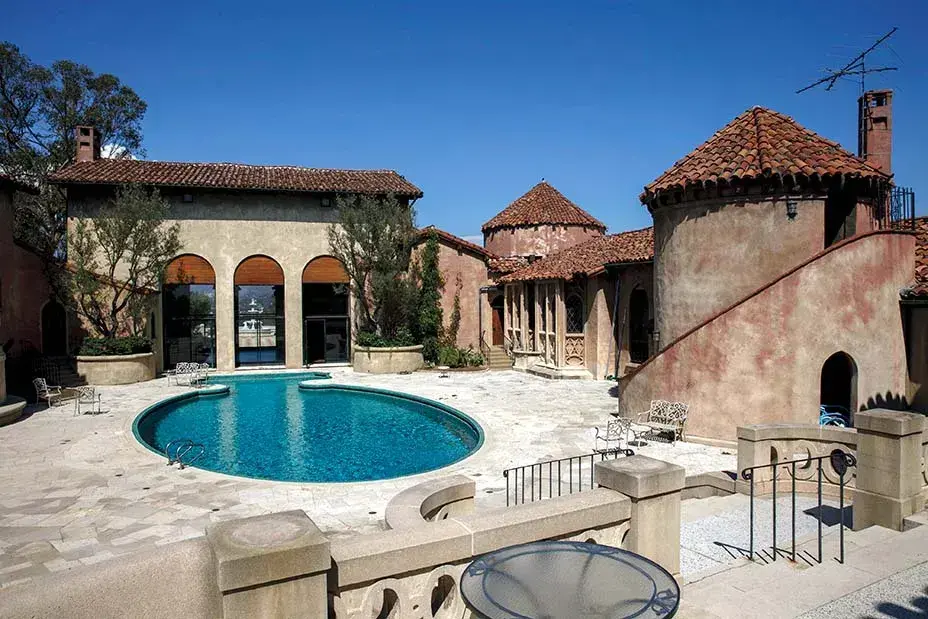
The Los Feliz nunnery
Perry tried to reassure them that she had not, in fact, sold her soul to Satan. She showed them the word “Jesus” tattooed on her wrist and explained her religious upbringing. Her parents were Pentecostal pastors who raised her under strict Christian rules. As children, Perry and her siblings listened almost exclusively to gospel music, called deviled eggs “angeled eggs” and were reportedly forbidden from eating Lucky Charms because the word “luck” reminded their mother of Lucifer.
Perry had also begun her career as a Christian singer under her birth name, Katy Hudson. Her debut album sold fewer than 200 copies, after which she changed direction rather dramatically and found commercial success with songs including “I Kissed a Girl.”
To further demonstrate her spiritual credentials, Perry sang “Oh Happy Day” for the sisters. Unfortunately, she had to pull out her phone to find the lyrics.
“She pulls out her phone to get the words for ‘Oh Happy Day,’” Callanan recalled. “I was looking at my attorney thinking, what on earth?”
The sisters applauded politely, perhaps because even a bitter property dispute has limits on acceptable awkwardness. Holzman later summarized the meeting: “She was nice. She told us why she wanted the property and then sang a song and left.”
The meeting did not change their minds. But Perry’s pop videos and Satan joke were only part of the dispute. The deeper fight concerned control of the property and the money from its sale.
For most of the convent’s history, the sisters had funded and operated it independently. In 1992, when their numbers had declined to 35, then-Archbishop Roger Mahony wrote to the Vatican proposing that the archdiocese provide financial support, with the condition that the estate could not be sold without church approval.
Documents cited in accounts of the case indicated that the sisters continued paying for the estate’s maintenance themselves. They argued that the archdiocese wanted control of a property it had not supported and feared that they would never receive the proceeds from its sale.
Those suspicions were sharpened by the archdiocese’s enormous financial obligations arising from the clergy abuse scandal. In 2007, the Archdiocese of Los Angeles agreed to pay $660 million to more than 500 victims of sexual abuse by clergy.
Holzman alleged that the convent money would help cover that settlement rather than support the remaining sisters. The archdiocese maintained that the proceeds would be used to care for them.
The estate also had its own troubling history. Between 1991 and 2008, Archbishop Mahony sent three priests facing molestation allegations to stay at the convent. All three were arrested there and later received prison sentences. It was not exactly the sort of detail likely to strengthen the sisters’ confidence in the archdiocese’s stewardship.
The battle now had Perry and the Catholic hierarchy on one side, with the nuns and a Los Angeles restaurateur on the other. Anyone expecting the Catholic Church and the convent’s sisters to form the natural alliance had clearly underestimated the unifying power of Southern California real estate.
In July 2015, a court rejected Hollister’s attempted purchase, calling it a bad deal. Although she had offered $15.5 million, only $100,000 was reportedly in cash, while Perry was prepared to pay $10 million upfront.
Perry and the archdiocese then sued Hollister for interfering with their agreement. Perry’s lawyers accused the restaurateur of taking advantage of vulnerable elderly nuns and malevolently persuading them to oppose the church, though the sisters’ previous experiences suggested that little persuasion may have been necessary.
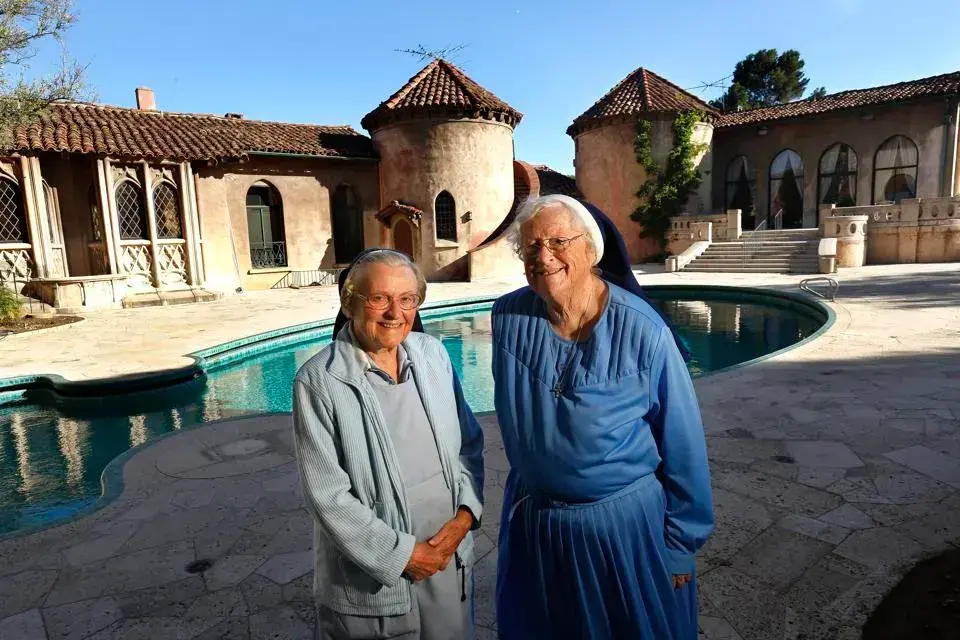
Sister Catherine Rose Holzman (L) and Sister Rita Callanan
(Photo: Mel Melcon/Los Angeles Times)
A court found Hollister liable for malice and fraud. She was ordered to pay $3.47 million in compensatory damages to the archdiocese and $1.57 million to Perry. Further punitive damages of $6.6 million to the archdiocese and $3.3 million to Perry brought the total to nearly $15 million.
Hollister, who had tried to buy the convent without having enough cash to complete the purchase, also lacked enough money to pay for not buying it. She filed for bankruptcy.
Holzman and Callanan accompanied her to bankruptcy court. Before entering one hearing in March 2018, the 89-year-old Holzman appealed directly to Perry.
“Please stop,” she said. “It’s not doing anyone any good except hurting a lot of people.”
During the hearing, Holzman collapsed and died.
Archbishop Gomez said he was saddened by her death. Callanan later accused Perry of bearing responsibility, saying the singer had “blood on her hands.” There is no evidence that Perry caused Holzman’s death, but the accusation ensured that an already bizarre property dispute acquired its darkest and most enduring detail.
With Hollister bankrupt and Holzman dead, it might have appeared that Perry was finally free to buy the convent. But one more authority still stood between a pop star and her dream mansion: the pope.
Under Catholic rules, property sales above a certain value required Vatican approval. Rome eventually agreed to the transaction on the condition that Perry or the archdiocese provide a replacement for the estate’s house of prayer, which was still used by priests.
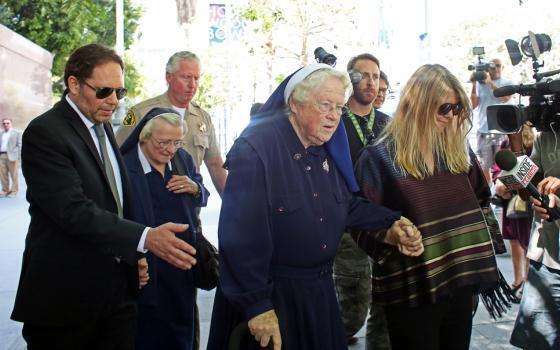
Srs. Catherine Rose Holzman, second left, and Rita Callanan, center, are escorted by businesswoman Dana Hollister, right, out of Los Angeles Superior Court
(Photo: AP)
A property called Chateau Emmanuel in the Eagle Rock neighborhood was considered as a replacement, but that plan collapsed after opposition from local residents. At that point, after years of litigation, millions of dollars in judgments, one bankruptcy and one nun’s death, the deal simply stalled.
Perry never bought the convent. The estate was later listed for $25 million.
Callanan said she had been left penniless and remained locked in conflict with the archdiocese, which she accused of entering her apartment and taking documents. The church denied wrongdoing in the broader dispute.
What began as Perry’s attempt to purchase an unusually large Los Angeles home became a saga involving religious vows, competing sales, alleged clergy-abuse finances, accusations of Satanism, a gospel performance assisted by a smartphone, the Vatican, a bankrupt restaurateur and a nun who died in court.
In the end, almost everyone lost something. Hollister lost millions and declared bankruptcy. The surviving sisters lost control of the home they had maintained for decades. Holzman lost her life during the legal battle. Perry lost the property.
The convent, meanwhile, remained standing, still waiting for someone to buy it without first triggering an ecclesiastical and legal catastrophe.