

When Rose Feldman wants to explain where she came from, she looks through her phone for a photo from the not-so-distant past. For a moment, it is hard to connect the young woman with flowing hair sitting in the room with the girl staring back from the screen: covered from head to toe, her head wrapped in a burqa-like covering.
She rarely allowed herself to be photographed in those years, but that rare image says a great deal about the world she came from. To outsiders, they were known as the “Taliban cult” or the “shawl women.” For Rose, it was simply life itself: the world in which she grew up after her family joined the cult.

Today, as she volunteers for national service at a boarding home for children removed from their families — a home very similar to, and located near, the one where she herself spent her later teenage years — Rose can define more clearly than ever just how abnormal the place she grew up in really was. “Everything was very detached. We moved all the time from place to place,” she says.
The cult, built on a sophisticated system of control by multiple authority figures who frequently change, is constantly evading the authorities. School was out of the question. From the moment her family joined the cult, when she was 8, she stopped studying.
‘The shock of my life’
Rose’s life was defined by wandering: from Jerusalem to Tiberias and from there to Bnei Brak, often at night, in order to evade the authorities. Sometimes they slept in cemeteries and at the graves of righteous figures. Every so often, someone would be added to or removed from the family.
“At one point, I was raising a baby who was not even connected to our family,” she says. What sounds absurd now felt almost self-evident to her at the time. “I was mature from a young age,” she says, because she always knew she had one purpose in life: “They teach you to prepare to be a mother. That is the role. That is what a woman is supposed to do in the world.”
One of her friends was already engaged at 11. Rose was told she was engaged — to a man she did not know and had never even met — when she was 14, two weeks before the planned wedding. “Relatively late,” she says. “He was in Jerusalem and I was in Tiberias,” she recalls. Although she had been prepared for that moment throughout her short life, when it finally arrived she was mainly “in the shock of my life. Just stunned.”
Rose was brought to Jerusalem, to the place where the wedding was supposed to take place. But the ceremony never happened. Moments before it began, police raided the site and arrested everyone present. Rose was taken to a police station and from there to an emergency center. Afterward, by court order, she was formally removed from her home and transferred to a boarding school.
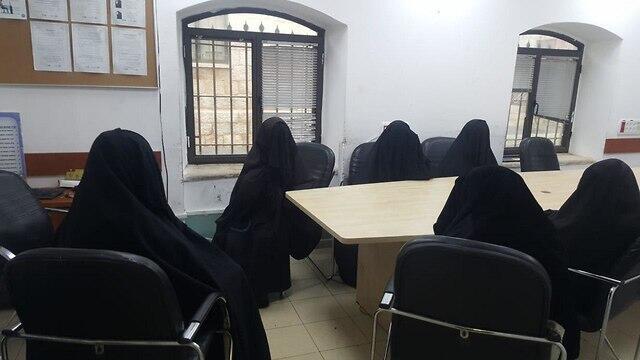
At the police station, after Rose’s wedding was stopped at the last minute
(Photo: Police)
Our meeting takes place at the Or Shalom family home where she has volunteered for the past two years as part of her national service. Just two years ago, she was living as a resident in a very similar home, after moving between two other boarding schools. Two weeks ago, Feldman was named one of the outstanding national-civil service volunteers at a ceremony held at the President’s Residence.
“Rose brings with her deep understanding, extraordinary sensitivity and a rare ability to turn her life story into a source of strength for others,” the prize citation said, also noting her decision to stay with the children during the most recent rounds of fighting. “She serves as a role model for the children and as proof that it is possible to grow out of hardship, dream far and give back to society.”
For her, service at the boarding home is an opportunity to give back to the place that gave her safe ground and allowed her to choose a life different from the one laid out for her. It is also a deeply personal closing of the circle. “The children are my heart,” she says. “When a child chooses to share something with me, it is worth everything. It is the most meaningful thing I could have done.”
The psychological control and prohibitions: ‘You’ll go to hell’
The police raid on Rose’s child wedding was dramatic and traumatic, but it was far from the happy ending of the story. As the cliché goes, you can take the girl out of the cult, but you cannot take the cult out of the girl.
Another four years would pass before Rose decided, in a single phone call, that she was not going back. Reaching that moment required enormous patience and acceptance from the staff at the last boarding school where she was educated — an Or Shalom family home operated for and supervised by the Welfare Ministry. Eventually, because of the seeds planted during that period, and very much because of Rose herself, she decided to begin a new life.
When she first arrived at the emergency center, straight from the police station, Rose trusted no one. As far as she was concerned, the police officers, and later the welfare workers who received her at the center, were not on her side. Far from it. “This cult is so closed, and they teach you that anyone who does not belong to it is not good, because they are not like us,” she says. At first, she made no eye contact with anyone and even refused to eat. The cult had implanted in her the belief that every outsider was an enemy who might poison the food. “I was afraid of everyone,” she says.
At first, she was moved to a Haredi boarding school for girls, and then to another boarding school. She had good relationships there, she says, but “they did not manage to get me out of the place I was in.”
She remained closed off, continued to wear the shawl and kept the cult’s customs, which included many food prohibitions and a complete avoidance of eye contact with men. Even the presence of the house father, or of an inspector from the Welfare Ministry, would cause her to cover her face with a veil and escape to the bedroom.
“They taught us that if a man sees even your hand, you will go to hell with him,” she says. “For me, that was more important than anything, even if it meant missing a meal, because there were staff members who would not let me eat in the room.”
Throughout her years in boarding schools, she was certain her stay there was temporary, only until the court order expired when she turned 18. “My biggest dream was to go back to my mother, to go back to the cult,” she recalls.
Just before time ran out, at 17 and a half, Rose was transferred to the Or Shalom boarding school after her previous boarding school was closed by order of the Welfare Ministry. There, too, she made it clear to the staff that her stay was temporary. Members of the cult stayed in constant contact with her through a cellphone that had been smuggled into the boarding school. The psychological control continued to leave its mark.
The turning point: ‘I said I’m not leaving at night’
At Or Shalom, she says, they did not try to fight her clothing or customs. Instead, they tried gradually to find a crack through which change could enter. At this point, Nechami Cnaan joins the conversation. Cnaan, an Or Shalom staff member, managed the boarding homes in the Ashkelon area at the time. “She did not give up on me,” Rose says. “She could have let me finish my time at the boarding school and go on my way, but she was there for me, no matter what and no matter the hour.”
The relationship developed slowly. Rose repeatedly made clear that she intended to return to the cult the moment she could, but Cnaan describes how, as the date approached, the pain and hesitation began to show.
“I could really see her body shrinking in on itself, and it broke my heart,” Cnaan says. “It was like watching a train heading into the abyss. But there was something stubborn in her that said, ‘I have no choice. That is where I am going back.’”
As part of her efforts to help Rose just before she returned to the cult, Cnaan urged her to agree to travel with her to a meeting at the Israeli Center for Cult Victims in Tel Aviv. Not because she expected Rose to change her mind, but so she would know where to turn for help in the future.
“I told her: I understand. You are going back to the cult. I respect your decision. But in case in five or 10 years you wake up one morning and say, ‘Enough,’ there will be one place in the world that you know you can go to.”
Thanks to one question from the social worker at the center for cult victims, Rose says, the crack opened. “She asked: ‘Would you want your children to go through what you went through?’” Rose recalls.
“I immediately answered: ‘No.’ Then she asked: ‘Do you know that if you go back, you will become pregnant and have children, and that is what will happen to them?’” She knew, but she was still convinced she had no choice but to return: because that was how she had been raised, because those were the expectations, because the cult had made sure to stay in contact and keep the pressure on.
And yet, during the next phone call from the cult “handler,” the man assigned to stay in contact with her, something unexpected happened. “He wanted to arrange for someone to come pick me up at night and take me back to the cult,” she says. Then, in a split-second decision, she chose to set a boundary.
“I told him that Moses told Pharaoh we are not thieves, and therefore we will not leave at night, so I am not leaving at night,” she says. He tried to argue with her, and for the first time in her life, she did not give in. She ended the call. That phone call became the turning point, after which she understood she was capable of saying “no.”
“I did not expect that plot twist,” Cnaan admits. “It felt very fragile. It was not clear whether it would hold.” But once it became clear that this “no” marked the beginning of a real break from the cult, the boarding school quickly mobilized and asked the Welfare Ministry to allow Rose, exceptionally, to stay for another year. The period that followed was difficult. “Harder than the period before,” Cnaan says.
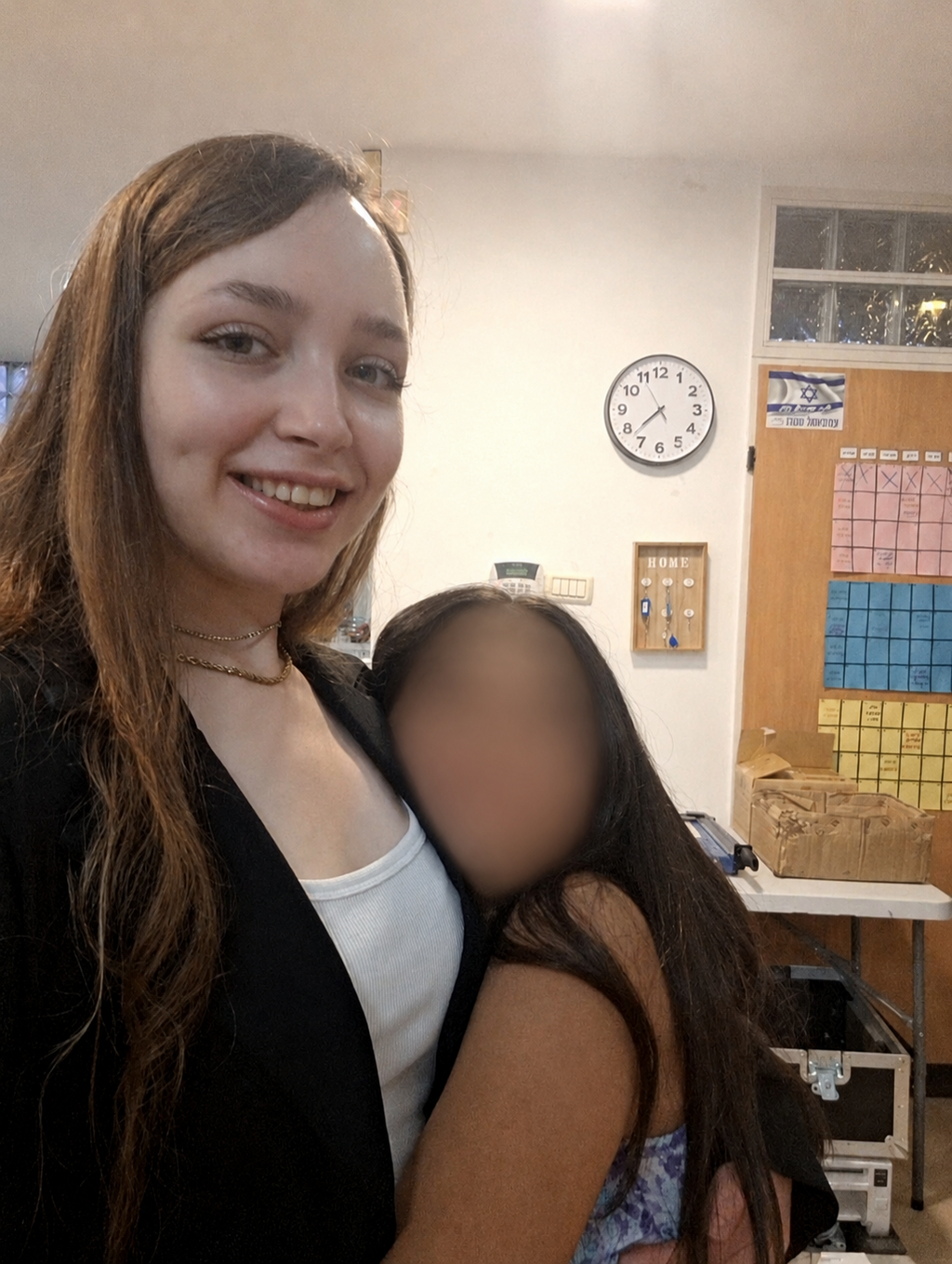
Rose Feldman with one of the girls at the boarding school
(Photo: Courtesy)
“Suddenly, I also felt emptiness,” Rose says. “On the one hand, everyone around me was excited with me and encouraged me, and on the other, I asked myself: What now? Who do I have in the world? Before, my big dream was to go back there, to my mother. Suddenly, I had no dreams. I remember lying in bed a lot, sad, unable to find strength.”
Peeling off the layers
“Like a chick hatching from an egg,” Cnaan says, describing the careful process of leaving the cult and, at the same time, building a new life. The first stage was parting from the “Taliban” clothing.
Rose set herself a goal: by Passover Seder night, when she was supposed to eat with a host family, she would peel off the layers. She did it slowly and carefully. First, she removed only the head covering. Later, she went with a counselor from her previous boarding school to buy new clothes. They were still very modest — a long shirt and buttoned skirt — but already more like the clothes worn by an ordinary Haredi girl. Gradually, she began to disconnect from other prohibitions.
“In the cult, everything is forbidden and forbidden and forbidden. You don’t even eat eggs, for example. And suddenly, I was eating an omelet. It was a period of new beginnings, but also of great difficulty.”
In the single year she had left at the boarding school, Rose had to learn everything she had not learned, and had not wanted to learn, before. “The most basic things,” she says. “Taking a bus, going to the grocery store. Skills of 12-year-old children.”
“The most complicated thing was helping her learn how to choose,” Cnaan says. “She did not understand the concept. What does it mean to make decisions? She was so used to being controlled, to having decisions made for her. The psychological control was over every layer of life: what to think, what to do, what to eat, what to wear, what to put into your body. We wanted her to have the possibility of choosing for herself, to understand what was good for her and what was not.”
Toward the end of that year, Rose again had to choose. She received an exemption from military service, and several possible paths now stood before her. At first, she considered a preparatory program for people leaving the Haredi world, but when a counselor at a boarding school near the one where she had grown up suggested that she volunteer for national service with the children, she felt it was the right direction.
During her service, according to Bat Ami, the organization that accompanies Rose and the other national service volunteers at the boarding school, Rose showed extraordinary commitment. “During the war, she slept at the boarding school for two weeks, even though she had the option not to come,” says Hodiya Hassan, the national service coordinator who accompanies Rose on behalf of Bat Ami.
When Rose describes the things that helped her choose her new life, she talks first about music. “I remember being on dish duty at the boarding school, with a song playing in the background, and saying to myself: Whoever is singing this must have grown up in a boarding school.”
She was right: It was a song by the duo Guy and Yahel, who grew up in a boarding school. Later, with the help of her boarding school counselor, she contacted them and was invited to one of their shows. Today, as a counselor herself, she knows how to make similar gestures for the children at the boarding school where she volunteers. “Music is a big part of my life. It gives me comfort.”
Do you ever think about where you would be today if not for that phone call from the handler?
“I would probably be married with several children, stuck in some hole, under someone’s influence. Nechami says she thinks I would have gotten out of there eventually.”
First published: 02:00, 07.05.26