

I’m an ant. One that climbed onto a robotic vacuum and rode it for fun. She feels invincible, this ant. Crushing everything beneath her. Queen of the house, queen of the world - not just any ant in a robot vacuum; she’s a force of nature now. And that’s basically how a person like me feels, having the sheer pleasure, entirely justified, of driving the “Eitan.”
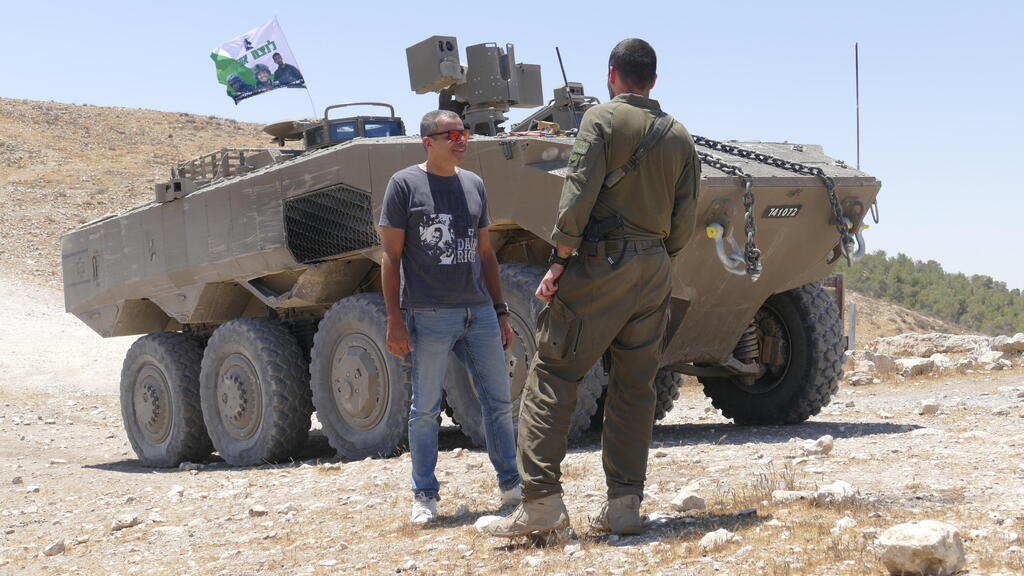
There should be a proper definition of “Eitan” here, but since I couldn’t find an exact one, in short, the Eitan is the IDF’s new armored personnel carrier, a vehicle every operational unit wants a piece of, or several. Honestly, I wouldn’t mind having one parked in my driveway, just to settle the force balance with the neighbors.
The APC of Dreams
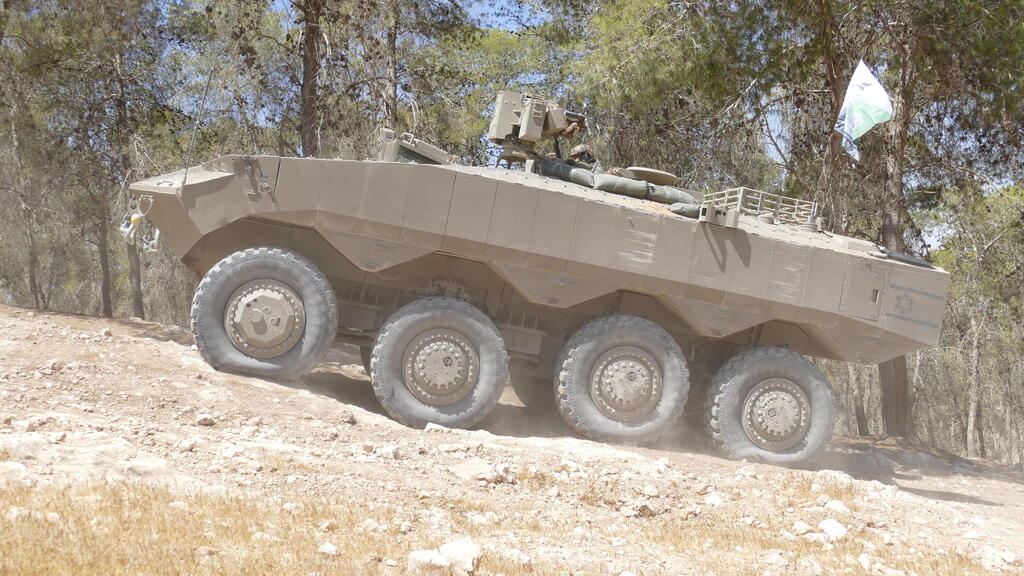
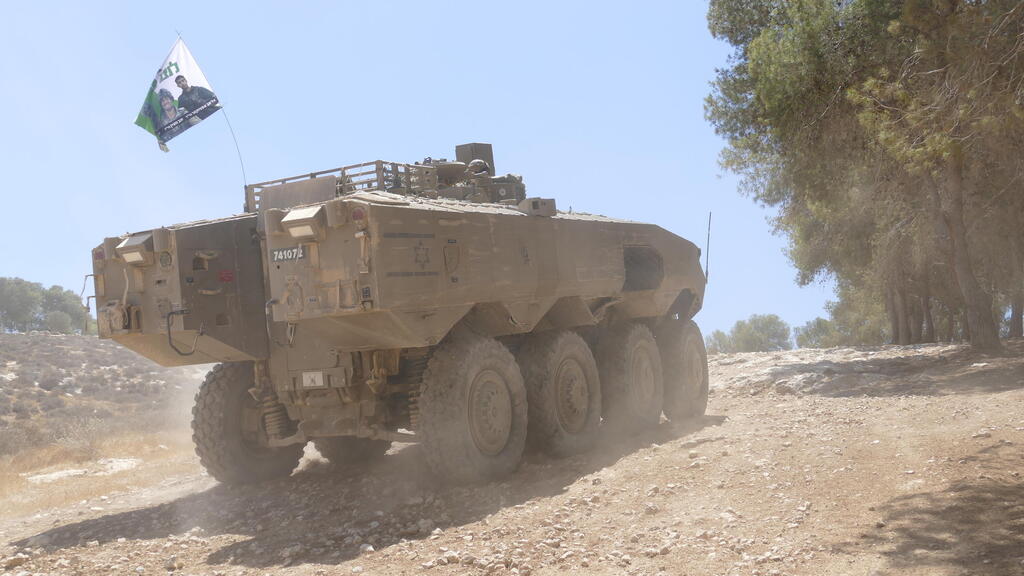
The Eitan is an unprecedented statement of intent. Fast, heavily armored, offensively capable, the kind of thing our top brass wishes the Chief of Staff had but doesn’t quite. In short, everything a dream APC should be, assuming you dream of APCs. It’s not tracked; it moves on eight giant wheels (four on four is child’s play; this is eight on eight), rather than iron tracks. Yet, despite all that, it can climb over any obstacle, pit, boulder, hill, ridge chain, while passengers inside could, theoretically, keep knitting.
(Photo: Nir Ben Zaken)
“I’ve never seen a wheeled armored vehicle move this fast. And it’s not clear whether it’s just an armored car or an APC,” summarizes Lt. Col. A, deputy commander at the IDF’s Operational Mobility School. “On the road, it’s a vehicle, big, massive, but at the end of the day, a vehicle. A jeep on steroids.”
Lt. Col. A threw out a few names of armored vehicles that crawl, but the Eitan, an Israeli development, isn’t like them. If we must compare, beyond the robotic vacuum analogy, start with the American Stryker, also a wheeled APC but light, only six wheels, which the IDF passed over in favor of its own development.
(Photo: Nir Ben Zaken)
Without fully knowing what exactly would be developed or how it would be used. But this is the IDF, the same army that, during Operation Protective Edge, sent soldiers in the American 60-year-old M-113s on impossible missions, ending with incidents in Shuja’iyya and public criticism, which accelerated the development of a new, improved domestic APC. Eventually, it was named after that operation: Eitan.

(Photo: IDF Spokesperson)
War Star
“At first it was very boutique, very special, and different, we didn’t really know how to handle it,” admits Capt. L, commander of the heavy company in the operational mobility unit, probably the person closest to the Eitan in Israel, who trained on it from the first trial and fell in love. This winter, they might even get married. “Its first operational use was on October 7, and its strength, speed, combined with relatively high protection, made it the ultimate tool for raids and casualty evacuations. It became the star of the war, the perfect vehicle for missions requiring massive power in minimal time in high-threat zones,” L says.
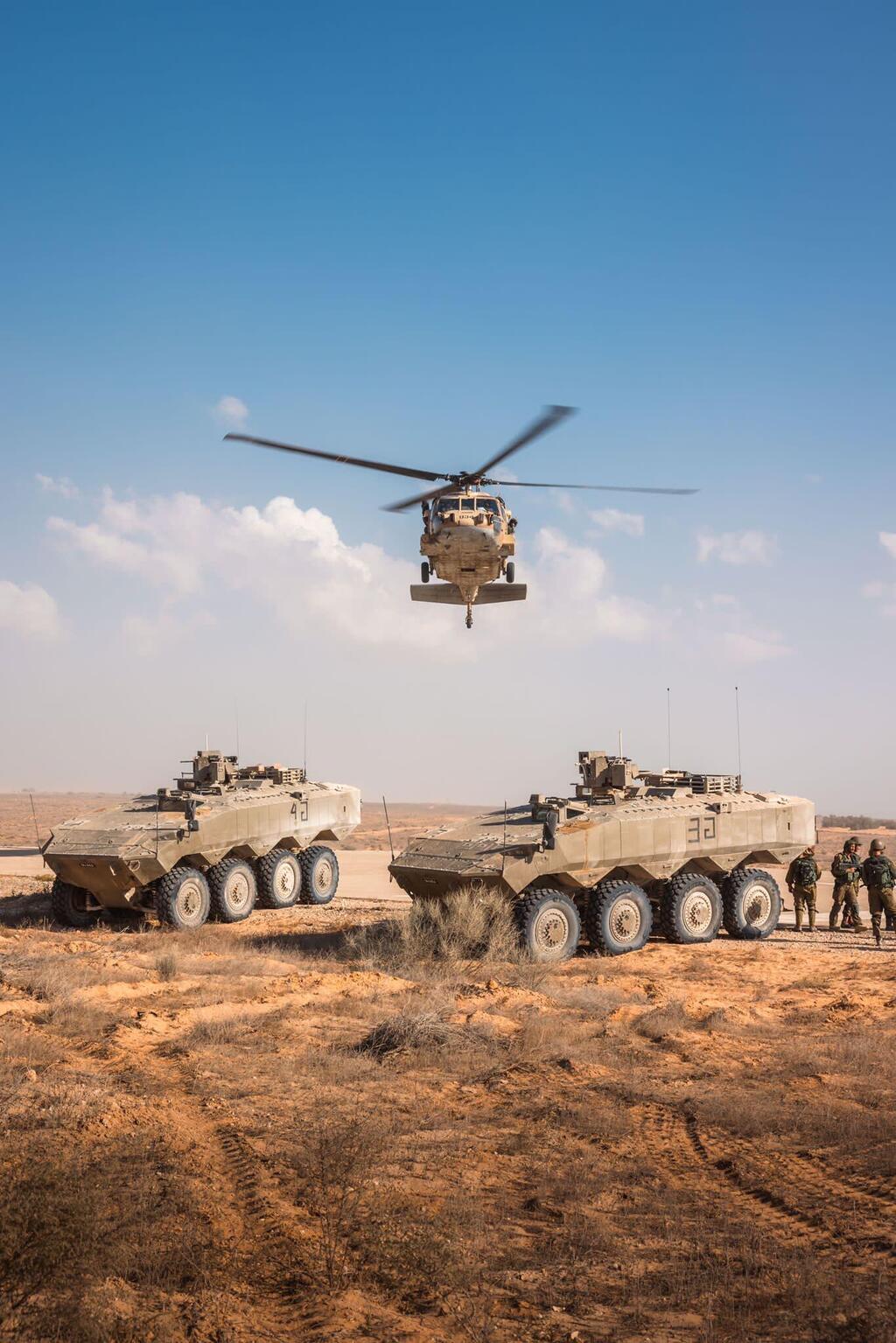
This vehicle rescued Fernando Simon Merman and Luis Herr, held by Hamas, one dark night in the heart of Rafah. Surrounded by dozens of soldiers and under fire during the breach, the two were loaded into the Eitan, which carried them, 37 tons of steel, 750 hp, top speed 90 km/h, all the way to the extraction helicopter. Later, it also carried rescued hostage Noa Argamani.
But enough name-dropping, most of the time the Eitan executes grayer, equally urgent missions, mainly casualty evacuation and troop transport to precise hostile targets. Only it does so, like no vehicle before it, fast. “During Protective Edge, evacuating a casualty could take 90 minutes from injury to helicopter. A long process of field medics and evacuation squads,” says Capt. L. “With the Eitan, you don’t need all that. It can reach a casualty quickly with armor, medics and everything necessary. The last evacuation I did, a headshot wound, took ten minutes from impact to oxygen in the helicopter. It saved a life.”
Rapid Evacuation
“This ability to reach casualties so fast with everything required is a game-changer. On rough terrain at 60–70 km/h, you’re the fastest and strongest in the sector,” clarifies Lt. Col. A. “When an average, trained convoy moves at 30 km/h at night, the Eitan can average 70 km/h. Insane compared to what we knew. The local ops at Shifa Hospital pushed this capability to the limit: eight Eitans, with Shayetet 13 (the IFF’s naval commando unit) operators, arrived a minute and a half early.”
Its wheeled design, while a major strength, is also a vulnerability; tires can be punctured. But the Eitan has an automatic inflation system, and with eight tires, it can handle a few punctures. No spare wheel - each replacement costs around 20,000 shekels.
(Photo: IDF Spokesperson)
After the first week of fighting and clearing surrounding towns, the Eitan became the preferred ride for soldiers on all fronts. But it was only during the Gaza maneuver that it truly proved itself, delivering troops to exact points, protecting them, with passive and active armor, from mines, and returning fire when needed. “We reach the wounded quickly, the 669 squad lands the helicopter, and the casualty is onboard in minutes. We evacuated 224 documented casualties in the first three months of combat,” L says. Lt. Col. A stresses these were complex, life-threatening cases, and any delay could have been fatal.
Where’s the Radio?
Perhaps the best part about the Eitan is: I can drive it! You could too. Anyone with a basic driving license has the foundation to sit behind the wheel, facing five large touchscreens that consolidate input from ten day-and-night cameras and 34 computers.
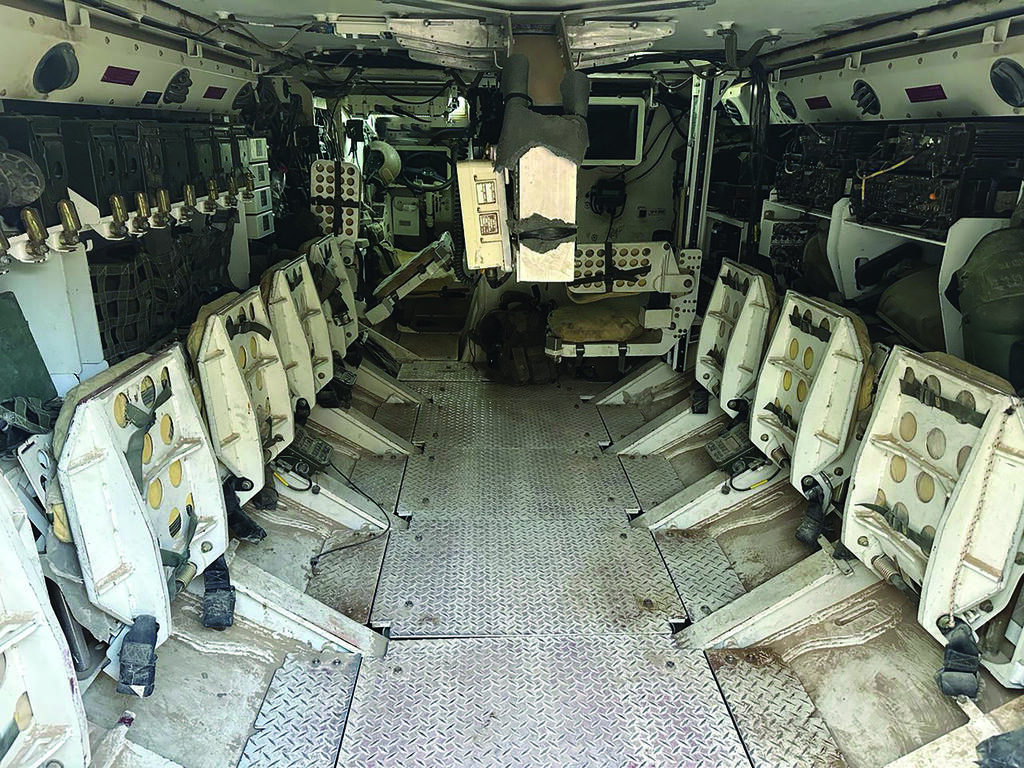
The inside of Eitan
(Photo: Nir Ben Zaken)
Like all modern off-road vehicles, there are terrain modes: gravel, mud, sand and self-recovery. Wide visibility compared to tracked vehicles, near-panoramic windows, thermal cameras for night. Human-centered design is evident, with more control options than any standard car. Still, the padding could be better, seat adjustments improved, and there’s no Pioneer radio. On the other hand, the AC works flawlessly, freezing cold!
Seven gears, handbrake on a side lever, six differentials locked by default. Just strap on a helmet, hit the gas, and feel 37 tons of sheer mass respond almost as nimbly as a tiny Kia Picanto.
Driving a Rolls-Royce
All that power comes from a 16-liter, V8 twin-turbo diesel from MTU, owned by Rolls-Royce. “Yes, you could say we’re driving a Rolls-Royce,” L admits. It allows the Eitan to accelerate over rough terrain. From this height, in the armored cage, all terrain feels almost small, 70 km/h feels like 30, and no slope or obstacle is unconquerable. “It gives you a Superman feeling,” confirms Lt. Col. A, especially on steep, boulder-strewn training slopes.
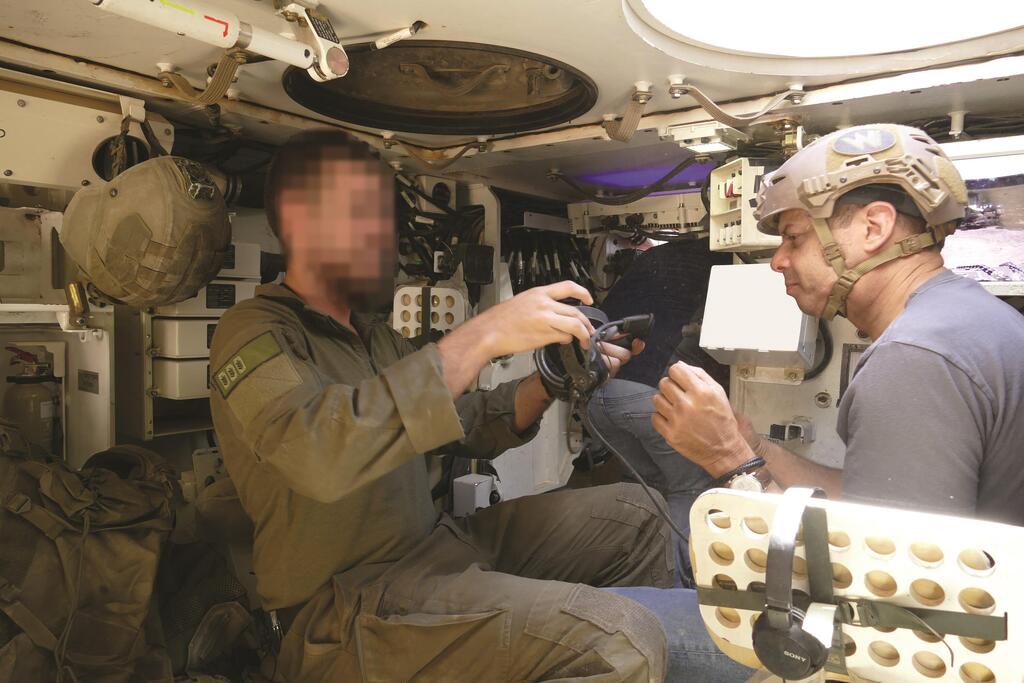
(Photo: Nir Ben Zaken)
“You must read the terrain correctly. Overconfidence can flip the vehicle; it has happened,” he warns. “Because it can do everything, it demands responsibility and foresight.”
But not me. Not today.. Not while L, the commander, is sitting behind me shouting directions over the radio, I take a pleasant 50 km/h run, nearly taking us over the edge. It takes time to grasp the scale of the vehicle and the implications of turns, especially with casualties onboard.
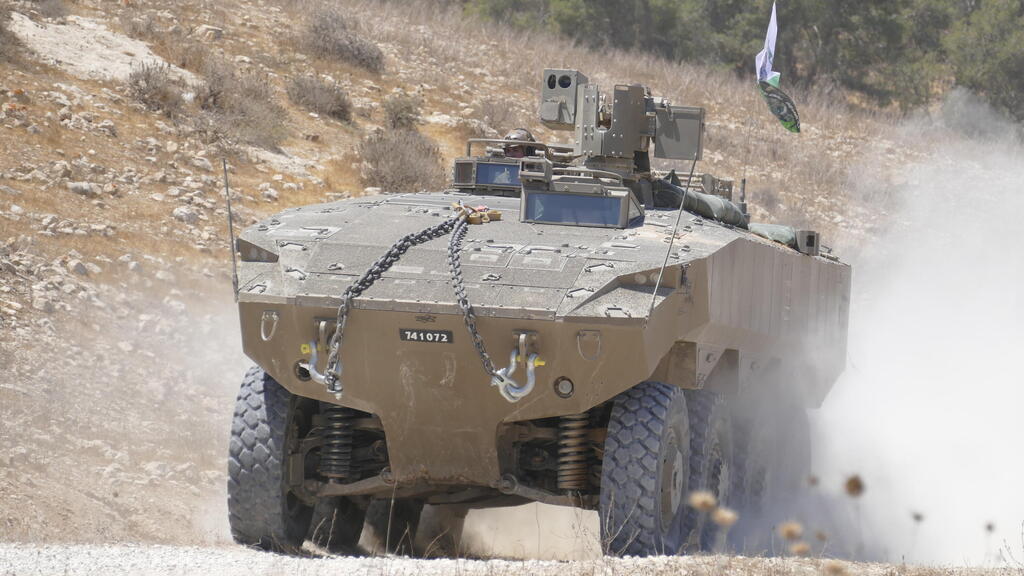
(Photo: Nir Ben Zaken)
Drivers learn this over a six-week course at the Operational Mobility School. The number of trained drivers grows with production, which hasn’t yet met demand. “Currently, there’s a waiting list, everyone wants one,” says Lt. Col. A. Senior officials also want them for off-road travel; it’s armored, not a Humvee or Tiger. I signed up too, despite parking headaches and fuel costs. With moderate driving, around 2,000 RPM, it consumes roughly 2 liters/km, and a 730-liter tank allows for family trips north. Lt. Col. A reassures me, “In the APC world, a 1:1 fuel ratio is normal.”

(Photo: Nir Ben Zaken)
So yes, I’m intrigued. One can hope. More than that, one can hope that someday, the IDF will have a surplus of Eitans because there are no more casualties or soldiers to transport. Sometimes, you know, it’s time to turn back and go home. Even the Eitan, I checked, has a reverse gear.