

For more than half a century, when someone in Kibbutz Nir Oz needed an ambulance, Giora Zehavi was one of the people they could count on. Zehavi completed his Magen David Adom ambulance driver course in 1973 and spent the following decades serving the community, part of a small group of drivers and medics who took turns keeping the ambulance stationed at the kibbutz and ready for an emergency.
Nearly three years after Oct. 7, 2023, Zehavi is again putting on his MDA uniform, returning to ambulance work and helping rebuild the emergency infrastructure of a kibbutz where roughly one in four residents was killed or abducted during the Hamas-led attack. “We’re pioneers here, rebuilding the kibbutz,” he said.
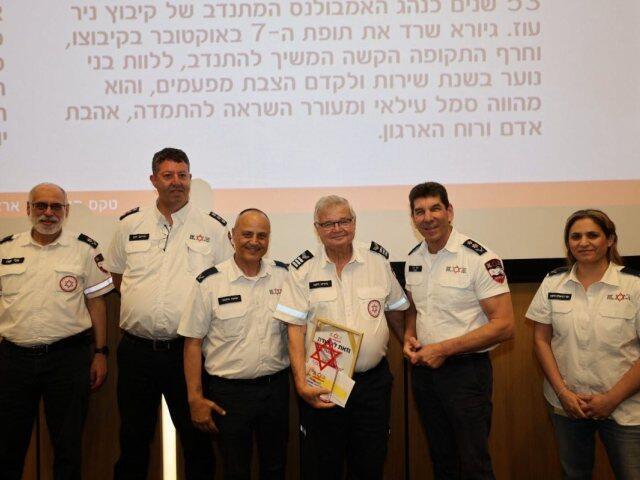
Zehavi’s connection to Nir Oz stretches back even further than his years with MDA. He arrived in 1965 with a Nahal group from the Hashomer Hatzair youth movement and became a member of the kibbutz. When MDA began looking for volunteers to train as ambulance drivers, particularly in communities close to the border, Zehavi volunteered.
“At the time they were looking for people who would volunteer to take an ambulance drivers’ course and staff ambulances in the communities, especially the communities near the border,” he recalled. “In the beginning, most kibbutzim had ambulances stationed there, and we had a very small team of drivers and medics who took turns being on call.”
By the eve of Simchat Torah in October 2023, Zehavi had already spent decades answering those calls.
That evening, the MDA Negev dispatch center contacted him and asked whether he could take responsibility for an ambulance stationed in Nir Oz. Zehavi, who at the time was staying with his partner in nearby Kibbutz Magen, immediately agreed.
He even asked whether he should take the ambulance with him to Magen or leave it at Nir Oz, just a few minutes away. He was told there was no need to move it. Hours later, on the morning of Oct. 7, that decision took on an entirely different meaning.
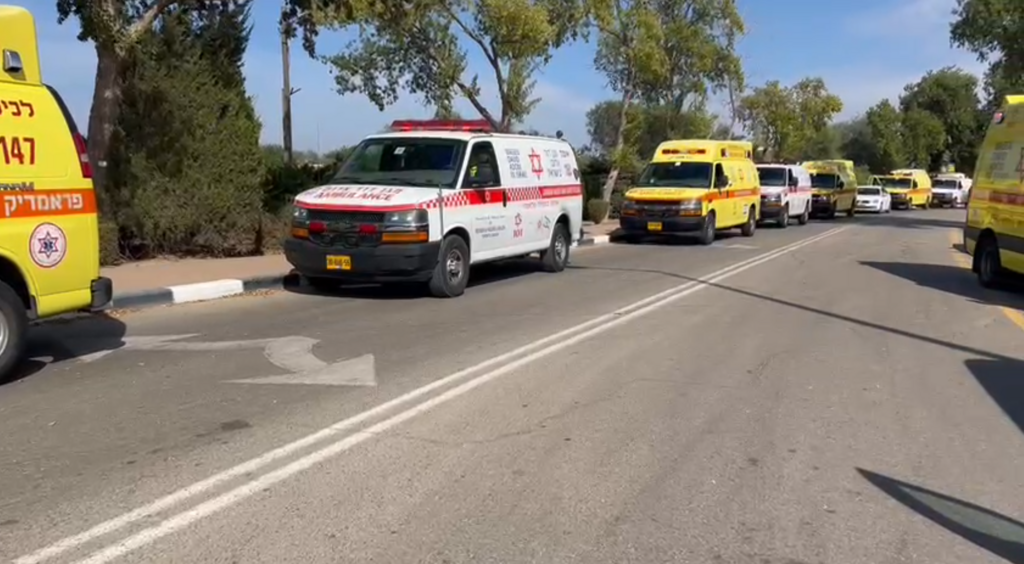
Magen David Adom ambulances on the morning of October 7
(Photo: MDA)
According to Zehavi, one of the first things the invading terrorists did in Nir Oz was destroy the ambulance and other emergency infrastructure. “The first thing the Nukhba terrorists did was blow up the ambulance,” he said, adding that they appeared to know where essential facilities and equipment were located inside the kibbutz.
Zehavi was meanwhile trapped inside a safe room in Magen with his partner. Through Nir Oz’s internal communication network, they could hear what was happening only a few kilometers away.
They could not reach anyone. “We heard everything that was happening in Nir Oz over the internal communications,” he said. “Of course, we couldn’t help.”
Some of the words he heard remain with him. “‘He died in my arms.’ ‘We’re choking from the smoke, the safe room is burning.’ ‘Come rescue us, come rescue us.’ ‘He died in my arms,’” Zehavi recalled. “But we couldn’t help.”
For a man whose instinct for more than 50 years had been to respond when someone called for medical assistance, that helplessness was among the most painful parts of the day. “That was the hardest thing,” he said. “That we couldn’t do anything. We weren’t allowed to do anything either.”
Residents in the surrounding communities had been instructed not to leave their safe rooms amid the attack. Zehavi believes that being in Magen that morning may have saved his life.
“I have a feeling that if I had been in my own home in Nir Oz that day, I wouldn’t be talking to you right now,” he said. “My house in Nir Oz was completely destroyed and burned.”
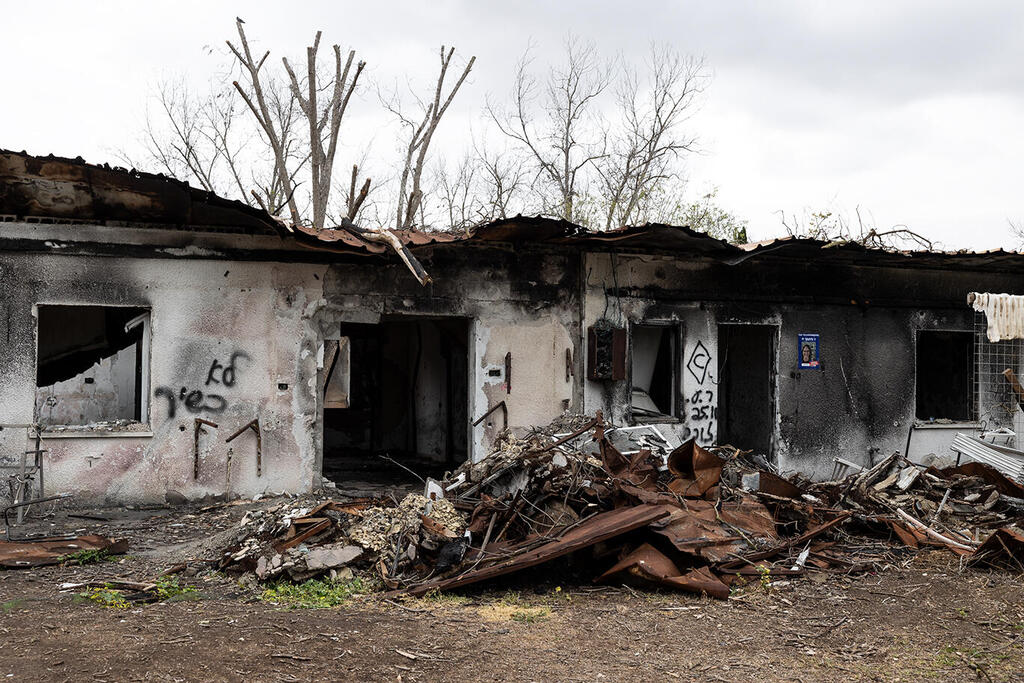
The destruction in Nir Oz
(Photo: Noam Elgart)
The scale of the catastrophe soon became clear. Dozens of Zehavi’s friends and neighbors in Nir Oz had been murdered or abducted. Magen David Adom itself lost seven of its personnel on Oct. 7, while additional members of the organization were killed over the course of the war. For Zehavi, however, there was never much doubt about where he ultimately belonged.
After Oct. 7, the surviving Nir Oz community was evacuated. Zehavi spent an extended period in Kiryat Gat, living far from the home and community that had defined most of his life.
He found the displacement deeply difficult. “From my perspective, it was always about going back,” he said. “There was no other way.”
He described the period in Kiryat Gat, where members of the community lived in a 12-story building, as one of profound disconnection. “Not living at home, being completely disconnected,” he said. “And now we’re here, pioneers, rebuilding the kibbutz.”
On June 6, Zehavi and his partner moved into a new home in Nir Oz.
The community is still far from what it was before the massacre. Zehavi said that about 23 kibbutz members are currently sleeping there regularly, while the population can rise to between 100 and 130 when members of a pre-military academy and a Hashomer Hatzair group staying at the kibbutz are included.
For Zehavi, rebuilding Nir Oz means more than reconstructing houses. It also means restoring the systems that allow a community to function and protect its residents. One of his goals is to establish a functioning local emergency medical team so that Nir Oz can once again have an ambulance stationed inside the kibbutz. “I don’t want to be the only one,” he said. “I want at least another two or three people with me.”
A young woman from the Hashomer Hatzair group living in Nir Oz has recently completed paramedic training at Ben-Gurion University, he said, giving him hope that a new team can gradually be assembled. “I hope that slowly we’ll be able to establish a team here,” Zehavi said.
The same process is underway with other lifesaving equipment. After the evacuation, defibrillators that survived the Oct. 7 attack were taken from Nir Oz to Kiryat Gat. Zehavi is now helping return them to the kibbutz as residents come back.
Three defibrillators have already been installed. “We’re slowly beginning to build a team with young people,” he said, including former military medics and people with medical training from youth movements. “Slowly, we’re stabilizing the situation.”
Young volunteers have become an important part of that process. Zehavi continues to work with participants spending a year of national service in Nir Oz before entering the military. He sees their energy and initiative as part of the kibbutz’s future.
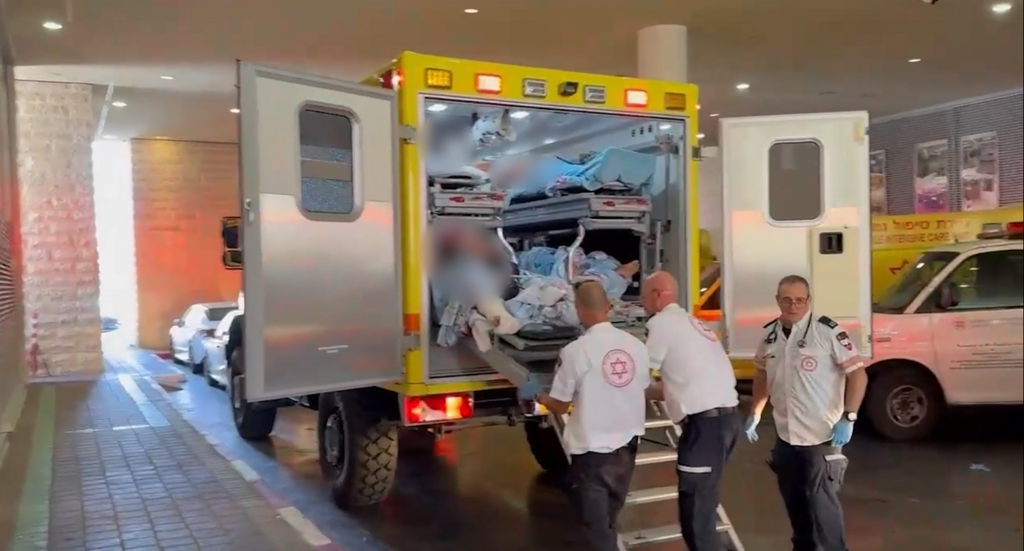
MDA paramedics
(Photo: MDA)
“We pass on to them whatever we can, and we rely a great deal on their initiatives,” he said. “They’re young, energetic people.” Then he added, with characteristic determination: “Together we will rebuild Nir Oz. Nobody is going to stop us.”
His own return to MDA has also been gradual. Before Oct. 7, Zehavi had continued volunteering at MDA stations in Be’er Sheva and later in Tzohar, often stepping in when additional help was needed.
“Because I’m already veteran enough, I didn’t stand in line to get shifts,” he joked. “When they needed me, they called me.”
After the massacre, he took a break. Recently, he has begun volunteering again at the MDA station in Tzohar. He is not yet working regular ambulance shifts, but remains in constant contact with the regional station and keeps first-aid equipment for emergency responders in his car. “If they need something, I have equipment,” he said. “I do the best I can.”
His earliest journeys in an MDA ambulance after Oct. 7 were not ordinary emergency calls. They were funerals. “In the first times, we accompanied funerals from the funeral home in Rishon Lezion to the cemetery in Nir Oz,” Zehavi recalled. “That was a very difficult experience.”
Along the route, however, he also remembers seeing something else. “We saw the beautiful, good people of Israel along the roads,” he said.
Today the ambulance once destroyed in Nir Oz has become part of a larger mission for Zehavi: restoring the ability of the community to care for itself.
After 53 years with MDA, the veteran driver is again working toward the same basic goal that brought him to the organization in 1973: making sure that when someone in Nir Oz calls for help, someone is there to answer.