

When Bill Eddy was 13, he was given the dubious title of “the quietest kid” in his middle school newspaper. The paper was published once a year, and everyone looked forward to titles such as “most likely to succeed” or “most popular student.” For Eddy, however, the title he received felt like the worst he could have been given—although deep down he admitted he was indeed a quiet child. He tended to avoid people, and like many shy kids, he was left to observe the dramas of his classmates from the sidelines, alone.
Later in life, he taught himself how to approach others and how to fall in love, and this week he is celebrating 40 years of marriage. But back in those middle school years, he mostly learned to observe the boys and girls around him, watching romantic relationships form and fall apart from a distance, and noticing early warning signs. In a kind of private game, he enjoyed guessing which couples would form and which would break up.

Gradually and almost inevitably, that hobby—studying relationships—became his profession. Today, Bill Eddy is the founder of the High Conflict Institute in San Diego. He is also a family law expert, senior family mediator, social worker, and lecturer at Pepperdine University School of Law. Over the years, he has written numerous books that serve as guides for anyone seeking a deeper understanding of human behavior, all centered on relationships and conflict.
“They can be great friends, good employees, loving partners—but when conflict arises, they have a need to control the other person. They see everyone as adversaries, and those facing them need to be prepared for hostility and anger.”
In his new book, “Five Types of People Who Can Ruin Your Life”, Eddy introduces readers to five common personality disorders: borderline, narcissistic, paranoid, antisocial, and histrionic. But in order to move beyond theory and explain why this knowledge matters not only to professionals like himself, he also provides examples of how these personality patterns appear in workplaces and on social media, and especially in relationships, divorce, and family life.
It may all sound overly theoretical, overly psychological. But before the interview, while reading his new book, I found myself, much like 13-year-old Eddy, quietly observing the people in my life—the partners I’ve had, and even myself—trying to see who fits into which category.
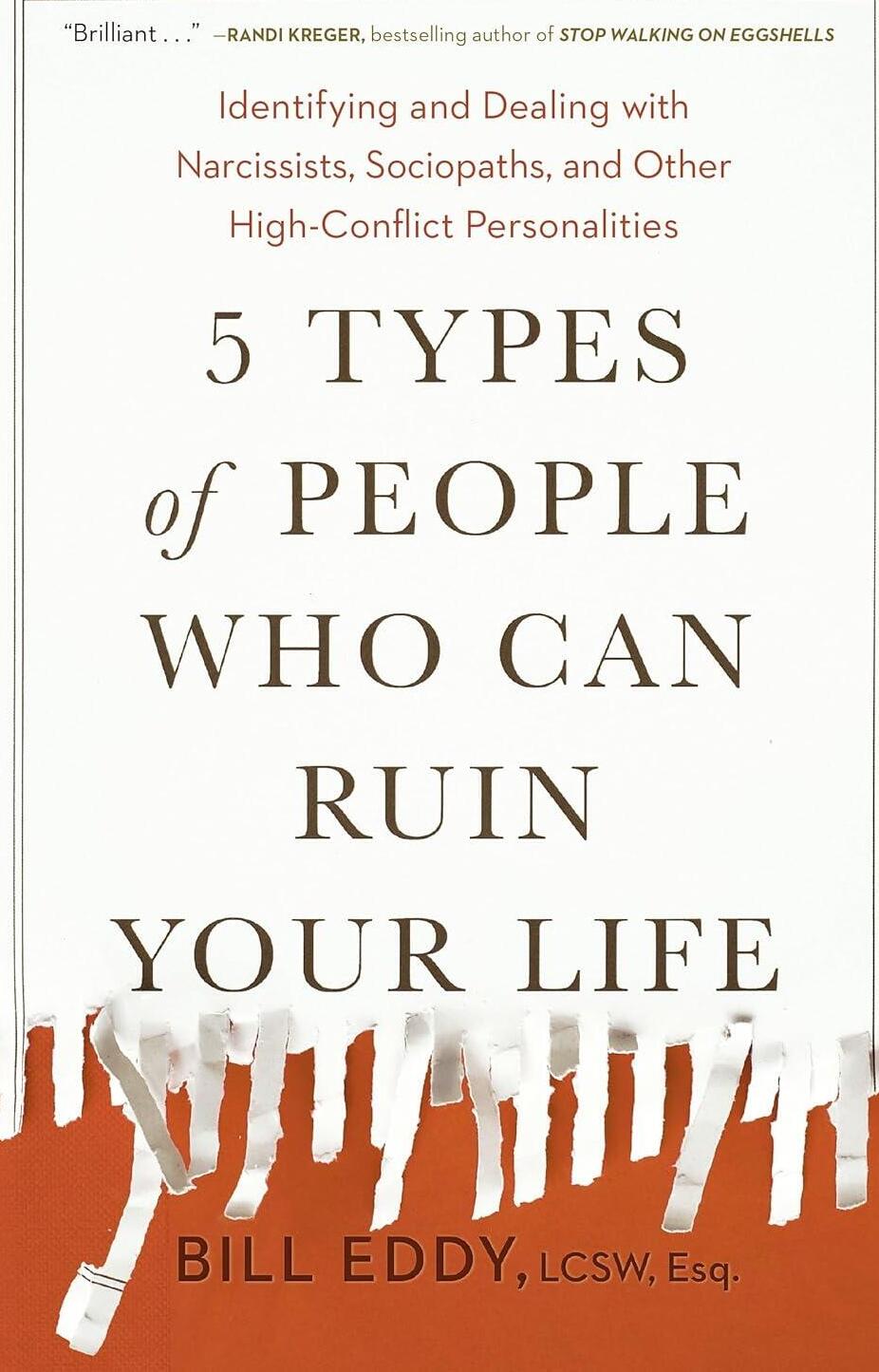
5 Types of People Who Can Ruin Your Life: Identifying and Dealing with Narcissists, Sociopaths, and Other High-Conflict Personalities
(Tarcher)
What made you become interested specifically in personality disorders?
“I started my career as a therapist and a volunteer mediator,” he says in an interview we conduct over Zoom. “I enjoyed conflict resolution and decided to become a lawyer. For two years I represented clients in family court. What I discovered was that many of the people who come to court have personality disorders. Sometimes it’s just one partner, sometimes both. In those cases, the court discussion revolves around things like alimony, custody, parenting—but the real issue is the personality disorder. I spoke about personality types with judges, other lawyers, mediators, therapists—but it seemed no one really understood what I was talking about.”
'These people get stuck in anger'
Eddy decided to write a book on conflict for professionals in the field. Following its publication, he began receiving numerous inquiries from people dealing with conflicts at work, in relationships, in families, even with authorities, neighbors, and on social media. He realized there was a demand for this knowledge not only among professionals, but among everyone. That is how his new book was born. “Everyone needs to understand different personality types—not to judge or label others, but in order to better manage interactions with these kinds of people,” he explains.
What is the most important message you are trying to convey through the book?
“The basic idea is that people with these personality disorders have a different operating system than most people, and they respond to conflict differently. They can be great friends, good employees, loving partners—but when conflict arises, they have a need to control the other person. They see everyone as adversaries, and the person facing them must be prepared for hostility and anger.

Narcissism
(Photo: Shutterstock)
“There is no point in trying to make them see what is wrong with their behavior, and no point in arguing about things that already happened. All we can do is set boundaries for the discussion and steer the conversation toward the future, because these individuals carry unresolved issues and emotions from the past.”
Eddy explains that people with personality disorders did not go through the normal psychological process of coping with grief, loss, or pain, and therefore their recovery process becomes stalled. Most of us, when experiencing loss or trauma, go through five stages—denial, anger, bargaining, depression, and acceptance. But in people with personality disorders, the process gets stuck at anger. This stagnation prevents them from moving forward in life on an interpersonal level. Their anger is constant background noise that distorts everything they hear.
That is why, Eddy says, focusing on emotions draws us into their emotional whirlwind. The correct approach is to shift attention toward the future. For most of us, the past is like a minefield. A healthy emotional recovery process gradually defuses those mines over time, allowing us to move through life with fewer disruptions. For people with personality disorders, every step on a raw nerve can trigger an explosion.
When a person with a personality disorder argues with us, they are not really arguing about what is happening between us, but about unresolved issues from their past—making any attempt to reach resolution largely futile.
How do we recognize such a personality?
“People like this are repetitive. They exaggerate stories or distort facts because reality is mixed with a fantasy in their mind. They have a narrower behavioral pattern than most people. They talk a lot because they are trying to convince others that their version of reality is true. They jump to conclusions, justify things based on emotion, tend toward exaggeration—so minor things become, in their eyes, catastrophic. This also makes them predictable.”
'Wait at least a year before getting married'
People with such disorders do not experience the same relief and recovery that about 90% of people do. In his book, Eddy presents the "90% rule," suggesting it as a practical guideline for identifying personality-disordered behavior. Try recalling an unusual reaction from someone you know and honestly ask yourself whether 90% of people would react that way: physical or verbal violence, lying, extreme emotional reactions, or repeated legal action against others.
What’s the problem with simply staying away from such people?
“People with personality disorders don’t want us to know negative things about them, so they block your radar. They are charming at the beginning of a relationship, promise love and excitement, tell you how good it feels to be with you, and make grand gestures like roses and promises.”
So what do we do?
“You should wait at least a year before making commitments like marriage, having a child, or buying a home together. That time allows us to become more aware of problematic behavioral patterns. In movies and television it’s easier to recognize these types, and many of the characters we enjoy watching are like this because they are intense and compelling."
“These people are highly intense and can quickly pull us into a very close—often too close—relationship. Time allows us to see the signs, because their conflictual behavior is mostly revealed in close relationships such as friendships, marriage, and also with their children, even after the children grow up.”

(Photo: ShotPrime Studio / Shutterstock)
So isn’t it better to avoid close relationships with people who have personality disorders?
“No. It doesn’t mean you can’t work with them or even marry them. It just means you need to be aware there will be bumps along the way. You need to know how to handle them, set boundaries, think through your options, and not get swept up in their emotions. You must respond correctly to misinformation and manage the relationship instead of letting it manage you. You need empathy, attention, and respect. And if we say that 90% are not like this, it means 10% of people we encounter in life have a high tendency toward conflict. We cannot avoid them.”
In relationships, Eddy suggests moving slowly and observing over time what happens when you ask for space, whether jealousy is excessive when you spend time with friends without your partner, and whether they isolate you from your social circle. “People need to be able to be both together and apart. Every couple finds its own balance, but it won’t work if one or both partners cling too tightly.”
Reflecting on the intense characters we see on television, I try to understand what is happening culturally around people prone to conflict. Why are we seeing more of them in public disputes and reality TV? Beyond our fascination with them, Eddy explains, one cultural shift is decreasing reliance on family and community, and increasing mobility.
In the past, we lived closer to the people who knew and loved us, and social circles were much tighter. This allowed those around us to warn us about problematic individuals—not because they were formally identified as such, but because they had personal experience with them. That closeness also prevented outsiders from easily entering families and communities, acting as a kind of filter. Today, that filtering system is far less effective.
“We deal with strangers on a daily basis,” Eddy warns, “through social media and the internet. This communication format allows people to present a better version of themselves than they really are—whether through appearance, generated backgrounds, or the stories they choose to share.
“All of this means we don’t really know each other well enough. But we are social beings, and we want closeness. We want friends and partners. People make us happy. But if we understand that 10% of people are like this and are predictable, and we begin to recognize behavioral patterns, we can decide how close we want to be to each person, and better manage our relationships—and our lives.”