

Age 25 is usually an excellent age for a professional swimmer. By then, he has gained enough experience, and his physical condition is typically at its peak. In 2002, Eithan Urbach was preparing for another intense season. He was 25, with two Olympic finals behind him, the only Israeli swimmer to have done so twice. Then, during one of his practices at the Wingate Institute, amid the Sisyphean swimming in which all one sees is the bottom of the pool and the athlete is alone with himself, he began recalculating his path.
When he got out of the pool, he told his coach, Leonid Kaufman, the man with whom he had also begun his career, with finality: “Leonid, that’s it. I’m done with swimming.” Just like that, in a few words.
But Kaufman was not surprised. The coach was the only person who knew the Israeli swimmer in all his strengths and flaws.

“Leonid understood immediately,” Urbach says. “It was typical of me to think in the water during practice, and I reached the conclusion that I had already achieved everything I wanted in swimming, and I had no chance of advancing toward new goals, like an Olympic medal, which is the real thing. So why torture myself with illusions?”
That was how Israeli swimming parted ways with the man who made history and became the first blue-and-white swimmer to reach an individual Olympic final, only two years earlier, at Sydney 2000.
Eithan Urbach was the most-covered swimmer in the Israeli media. Almost weekly, items were published about his training, especially in ynet's parent newspaper Yedioth Ahronoth. He received the kind of attention usually reserved for an entire soccer team, an extraordinary thing for his sport.
There were good reasons for it. Professionally, he was a trailblazer who wrote several extraordinary chapters in the history of Israeli swimming. At the same time, he was considered a colorful personality, served as the face of several commercial companies at a time when that was far less common and spoke his mind directly in statements that were anything but routine.
“Those who tried to label me a ‘model’ or a ‘party boy’ did so at their own peril,” he says today at 49, 24 years after his final pool session at the Wingate Institute. “In simple terms, I was a dedicated swimmer who gave everything to the last drop. Ask my coach, who still coaches the national team today.”
‘Eithan was a legend’
Urbach first thought he would begin his sports journey as a basketball player for Maccabi Haifa. “Unfortunately, we were late to the first practice, and I immediately understood from the people running the program that I would not become a basketball player,” he says. “My parents looked for an alternative and chose a swimming class. Maccabi Haifa was then a leading club in the sport. I'm still grateful for the path my parents set me on.”
Urbach, the son of gynecologist Dr. Yaakov Urbach and Esther, a nurse, was about 12 at the time. “My mother even chose to work night shifts so she could take me and my sister Michal, who joined the class, to the pool. Later, we began waking up at 5:30 a.m. to get to practices. That would be the hour that accompanied my career. It soon became clear that my physique was well-suited for swimming.
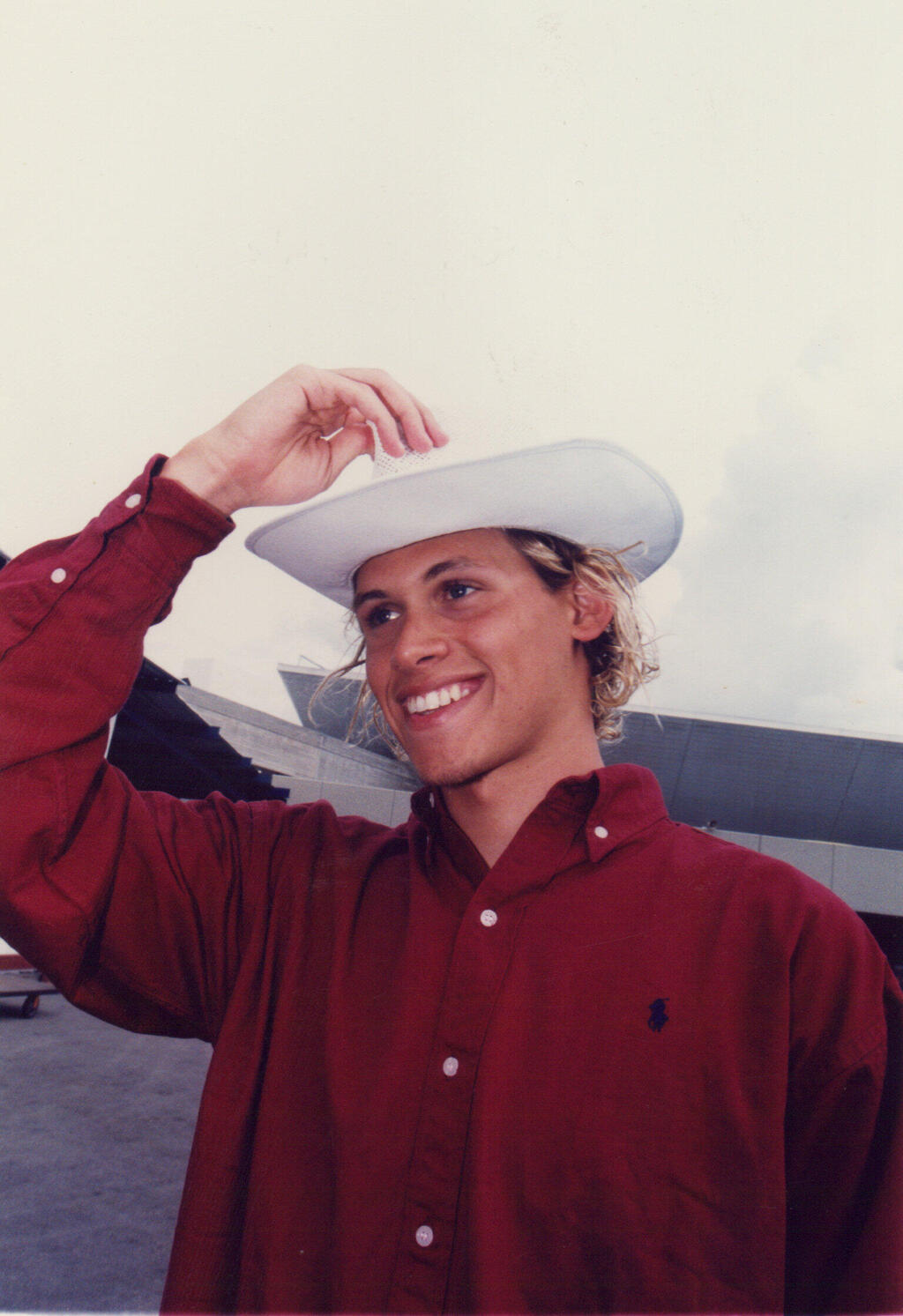
Served as the face of several commercial companies at a time when that was less common
(Photo: Reuven Schwartz)
He began competing in national meets, and Kaufman spotted his potential. “At 16, I was invited to the Wingate Institute, and it was decided that I would join the swimming boarding school. It was a significant period for me because, for the first time, I left home. As it later turned out, I also did not return,” he says.
“Eithan was a legend, and not only because he was the only Israeli swimmer in two Olympic finals,” Kaufman says today. “He was not an ordinary swimmer, but one you had to know how to reach. He certainly was not a swimmer who could swim and train like a robot.”
The “first Urbach miracle” happened in 1994, at the European Junior Championships in the Czech Republic. Before that, he had stood out in freestyle and was supposed to represent the national team in that event, but then Kaufman had a flash of insight.
“Coach Leonid looked at the statistics pages and told me: ‘I see that your freestyle time ranks you 15th going into the championships. By contrast, in the 200-meter backstroke, you are ranked seventh. What do you think about putting everything into backstroke instead of freestyle?’ If Leonid says it, that means he knows. I made the switch, but even in my wildest imagination, I did not expect what actually happened.”
Urbach continues: “A backstroke swimmer does not see the swimmers ahead of him. I was very surprised to touch the wall first in the final. Not bronze, not silver, straight to gold. I was almost in shock.” Everyone was. It was Israel’s first medal ever at the event.
And here is a story that shows just how unexpected the achievement was: “Before the medal ceremony, the organizers asked for the Israeli anthem, ‘Hatikvah,’ so they could play it at the ceremony. The Israelis apologized because they had not brought a tape. No one thought any of us would finish first. They began urgent searches in the Jewish community and at the Jewish Agency to see whether anyone had a tape. In the end, they found one. I remember standing there, moved, and singing loudly, Eretz Tziyon v'Yerushalayim'.”
“It was amazing", Kaufman says. "Only seven months earlier, he had not been Israeli champion in any event, and suddenly he was the first Israeli European champion. Later, it would become clear that this was typical of a special swimmer, in this case Eithan.”
Urbach adds about that competition: “There was something crazy at the start of our stay there. For the first time, we shaved our heads for the races. We walked around the city, and people who thought we were neo-Nazis called the police. We understood they wanted to arrest us, and only after we showed our passports to the officers did they let us go.”
That was Urbach’s breakthrough. “In 1997, I already traveled with the senior national team to the European Championships in Seville,” he says. “As with the juniors, Israel arrived at that championship without ever having won a medal before. I reached the 100-meter backstroke final with the best time, and from all the excitement, my face went numb. I overcame it through willpower, swam well and brought home the silver medal, Israel’s first at the senior level.”
Before that came the 1996 Atlanta Olympics. For the first time, Israel’s medley relay team managed to secure its place in the Games. Urbach, who had established the 100-meter backstroke as his main event, was considered a leading candidate to be part of it. But then Eran Groumi, who had already retired, decided to return to competition to fight for the right to be the backstroke representative. Although Urbach already dominated the event, he was far from thinking he would settle the contest between them easily.
In the end, the Swimming Association decided on a target race in which the winner would go to Atlanta. Groumi, who swam one heat before Urbach, finished in 58.00 seconds. Though it was unlike him, Urbach became tense. He missed the red markers in the pool meant to help backstrokers orient themselves in the water, slammed into the wall and bled from his face.
That was what he needed to reset. Urbach gathered himself during the race, and when he reached the finish, he looked anxiously at the clock and saw 57.71. A ticket to his first Olympics. Groumi, who had competed in the previous Olympics in Barcelona, had been defeated.
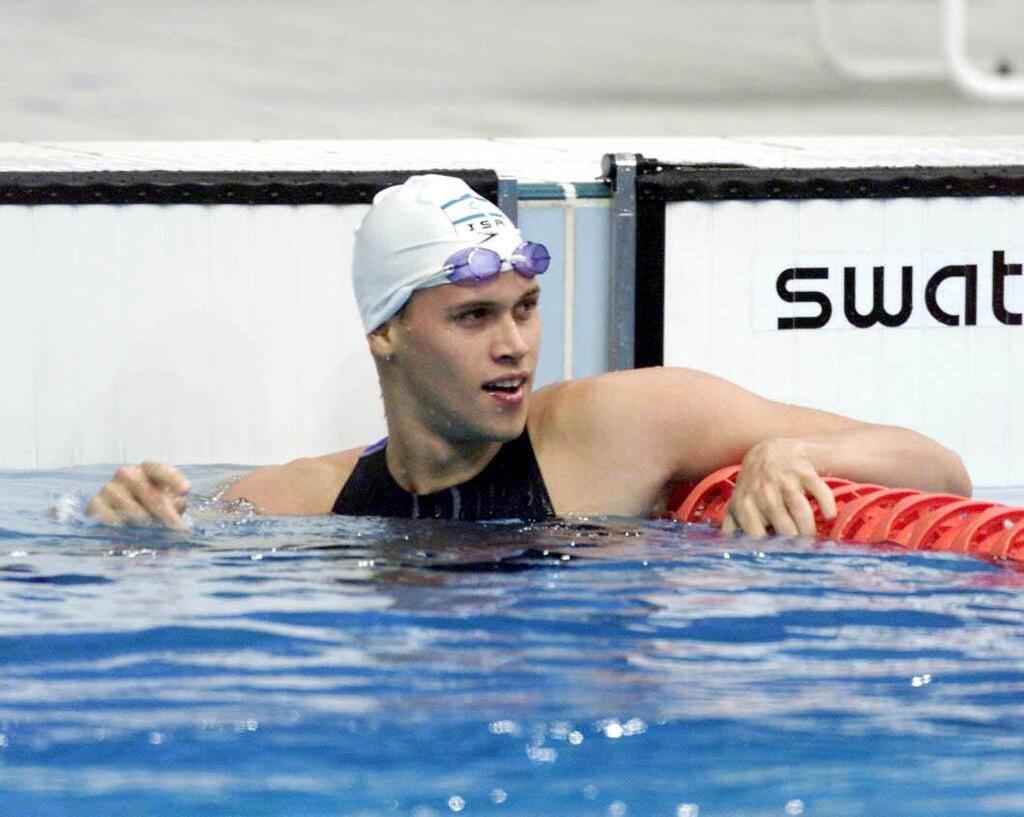
'I was surprised to touch the wall first in the final. Not bronze, not silver, straight to gold. I was almost in shock'
(Photo: Yosi Rot)
The quartet that traveled, Vadim Alekseyev, Dan Kutler, Yoav Bruck and Urbach, did not merely take part in the Games, but reached the first Olympic final in the history of Israeli swimming. It ended with eighth and last place, but also with plenty of pioneering glory. For Urbach, it was only the warm-up.
Between 1998 and 2000, Urbach had two major competitions planned on the fifth continent. In the first, the 1998 World Championships in Perth, he reached the 100-meter backstroke final and finished seventh in 55.97, after qualifying fifth from the semifinal in 55.62.
The race at the Olympic pool in Sydney in 2000 was a remarkable repeat. In the semifinal, Urbach’s true test while facing expectations to deliver Israel’s first individual swimming final, he swam superbly and qualified fifth with an excellent national record of 55.31. In the final, he swam relatively slowly, 55.74, and finished last, although his ability was worth a better placing. Still, it was a historic achievement.
Kaufman is convinced the excitement hurt Urbach’s race when his hand touched the lane of one of his competitors. Urbach himself attributes the eighth-place finish to an energy drop after he secured the goal for which he had trained in the preceding years: reaching the long-awaited final.
‘Swimming is a hard, exhausting sport’
As noted, his fame also reached beyond sports. As it was known at the time: “the weekly Urbach item.” Today, Kaufman, 67, in his second term as national team coach, says: “Unlike the vast majority of swimmers, Eithan used to express his opinion on various issues, including in training. A swimmer, in principle, needs to be quiet and do what he is told. Eithan wasn’t that kind of swimmer."
“Still,” Urbach says, trying to lower the flames from those days, which of course ceased to be relevant after his retirement, “even if there were arguments, Leonid and I were still together."

During his reality TV days
(Photo: Adi Orni)
After completing business administration studies at Reichman University in Herzliya, Urbach opened a swimming school at a country club in Holon.
Now he can explain: “Swimming is a hard sport, one that often demands mental ability because the training repeats itself. I can say that, overall, I handled the practices well. Sometimes there were three a day. It is exhausting, but I have no complaints.”
Kaufman adds: “Eithan was not a robot who did everything he was told. An example? He went to study at Auburn, Alabama, one of the leading swimming colleges in the United States. In the middle of his second year, he turned to the people there and told them: ‘It was good and interesting, but I’m done. I’m going back to Israel.’ The fact is, he came back to train with me.”
Ben, 8, Maor, 6, and Gal, 4, the three sons of Urbach and his wife, Rita, who works in high tech, are still young but are already warming up to swimming. They may begin their regular sports training with him. "They know swimming is a hard and challenging sport, and they will make their own considerations. Whatever they choose, I will respect it."
Did you tell them about waking up at 5:30 a.m.?
“It’s tough, especially over a long stretch. If one of them chooses swimming, they will have to get used to it. At this stage, before they have begun an organized career, they enjoy swimming.”
There was major progress in Israeli swimming in the 2000s. Yakov Toumarkin finished seventh in the 200-meter backstroke in London, Anastasia Gorbenko has excelled at the world and European championships, but we still have not come close to an Olympic medal. Do we not have the talent for it?
“I’m confident someone will reach that level eventually. After all, producing a medalist from a pool of thousands is far more realistic than from just dozens, or even a few hundred. The talent is out there and can be found. It’s not predetermined.”