

He is at the counter of his family’s café, which, like so many others, has never closed. Not even for a day. Because the war never arrived here. “When Assad fell, we thought that all would fall. That it would be a butchery. And instead, nothing happened,” says Ahmad al-Rabt, 32, who, to dodge the draft, after graduating took a master's degree, then a PhD, and then another PhD. And yet, he never criticized Assad.
"We were afraid," he says. "We feared losing everything. But now, I look around, and the truth is that the only thing we have lost is time: it is all in shambles. Syria is stuck in the 1970s. And is it to defend this misery that we condoned so many deaths, so much cruelty? What did we defend?” he says. “Looking around is tough,” he says. “But looking inward is even tougher.”
"Peace requires compromise. Especially in a country like Syria. Where everyone has a gun. In 1945, Italy did not execute all those connected to Mussolini."
The Al-Nawfara Café has been located in the most Instagrammed spot of Damascus for over three centuries. Just next to the Umayyad Mosque. The spot of the selfies, of the influencers, of the friendly journalists called to praise a sophisticated and cosmopolitan capital, with its limestone streets, the arched windows, the iron lanterns, the blooming jasmines, its evenings of bars and cocktails: the only spot we have seen, under Assad.
All around, it is a different Damascus. With two random hours of electricity. The bakeries with long lines for subsidized bread. Immediately sold back for a few pennies. In the souks, you no longer find silk, gold, mother-of-pearl, but knick-knacks made in China. The mats that shade from the sun are jute sheets with the UN logo. They are aid packaging. The pound is so worthless that banknotes are not counted: they are weighed. Even the areas defined as upscale are actually like the others. With these tall, austere apartment buildings reminiscent of Soviet suburbs. Gas stations that are a tank and a funnel.
More than upscale areas, you have upscale houses. Scattered here and there. Automatic gates behind which you glimpse Mercedes and Maseratis: then, once you turn the block, you are back to ramshackle houses of brambles and concrete. And you sense that some of Assad's crook lives there.
A year after Assad vanished without a word on December 8, 2024, fleeing to Moscow, Damascus is still dazed and searching for meaning. All of Damascus. Both the one that was for Assad and the one that was against Assad.
Gallery
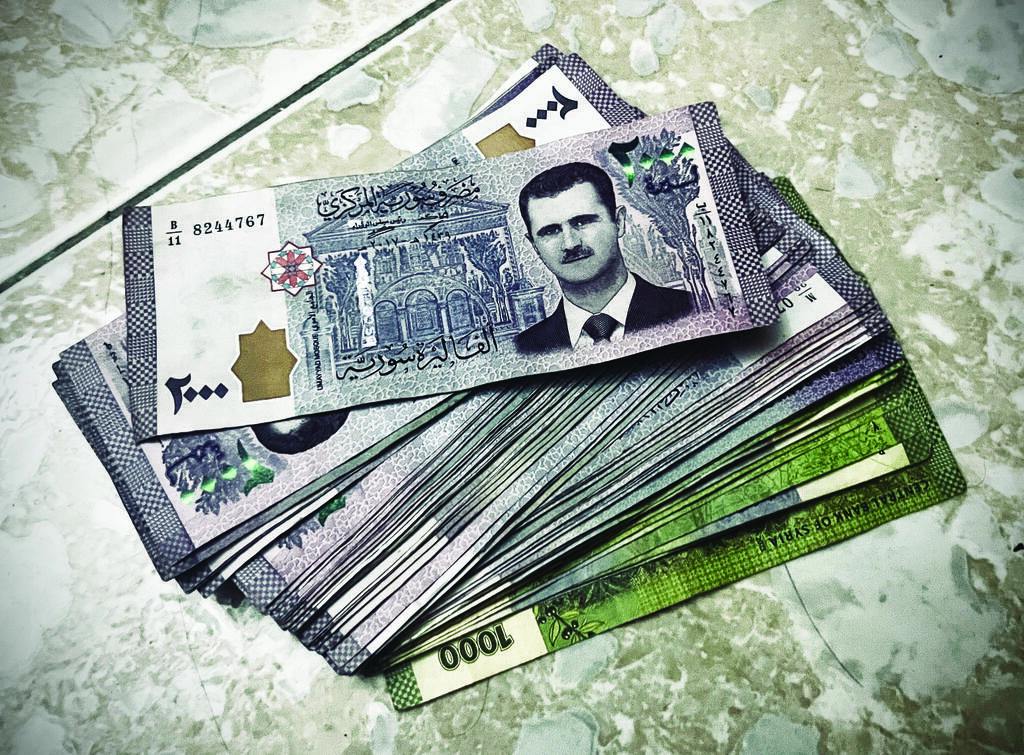
Syrian pound banknotes bearing the portrait of President Bashar Assad are displayed in Damascus. A year after Assad’s disappearance, the currency has plunged in value as the capital struggles with soaring prices and widespread poverty
(Photo: Francesca Borri)
"It is much better, obviously. But living as if nothing happened, alongside those who jailed, tortured, and killed you, is not easy," says Jamal Mosa, 56, who has always criticized Assad and roots for Ahmad al-Sharaa, the new president who has moved from al-Qaeda to suit and tie.
But now, he is as mixed up as the owner of the Al-Nawfara. He has a car repair shop. And when he ended up in prison, one of his customers was among his tormenters. “Instinctively, you want justice. Not revenge, but at least a bit of justice. A bit more severity toward the loyalists of Assad who are still here, including the businessmen, who often profited from the war, and whose assets were rarely confiscated. Then, rationally, that’s how it goes: peace requires compromise. Especially in a country like Syria. Where everyone has a gun. In 1945, Italy did not execute all those connected to Mussolini. But, then again, it is not easy.
“Above all, it is bitter to realize that in spite of all, Ahmad al-Sharaa is in power only because, suddenly, the world decided that Assad was no longer the right president for Syria. Not for the Syrians: for Syria. For the role of Syria in the post-Gaza Middle East. And tomorrow, the world might decide that Ahmad al-Sharaa is no longer the right one. In this regard, everything is as it was before: we are nothing,” says the tire specialist. “And that's why everything is in rubble? Over 600,000 dead, 14 million refugees, and what have we achieved? Assad has been defeated, yes. But have we really won? Does Syria really belong to the Syrians now?"
The problem, however, is not al-Sharaa himself. He appears to have won over even the staunchest skeptics. A provisional constitution was adopted on March 13, and on October 5, a new parliament was elected, albeit indirectly and with significant limitations.
"There is no reconstruction plan. Al-Sharaa has asked for investments, not aid, and rightly so; we are not beggars. But the private sector does the private sector, and Syria, like Gaza, like Ukraine, will be a magnet for speculators."
A trial is also underway over last spring’s massacre of Alawites, an attempted uprising by Assad loyalists crushed in street-to-street raids that left 1,426 dead. The proceedings began on November 18, and al-Sharaa had promised that the law would apply equally to everyone, and of the 14 defendants, half are members of the government’s security forces. He spoke at the United Nations and later became the first Syrian president to visit the White House, where he met President Donald Trump, who lifted many of the sanctions on Syria.
The moves earned him not just trust, but the investment he has made a top priority. About 90% of Syrians are below the poverty line. “But will the reconstruction really benefit everyone? Or will we get billions of dollars that will go to waste or be stolen? And will we only be delivery men and carpenters?” says Hadi Seif, 28, a clerk in his uncle's tailor shop.
After the fall of Assad, he returned from abroad, like 780,000 other Syrians, almost 10% of all refugees, but like many others, he returned only to see which way the wind was blowing. And for now, he is preparing to leave again, waiting for things to improve. “There is no reconstruction plan. Al-Sharaa has asked for investments, not aid, and rightly so; we are not beggars. But the private sector does the private sector, and Syria, like Gaza, like Ukraine, will be a magnet for speculators. Among the first projects, one is the Latakia marina. A yacht dock.”
Also in the pipeline is a $2.8 billion deal with Italian firm Ubako-I to build 60 residential towers with a total of 20,000 apartments in downtown Damascus. Founded in 2022, the company has a single employee and, according to its website, specializes in elevators.
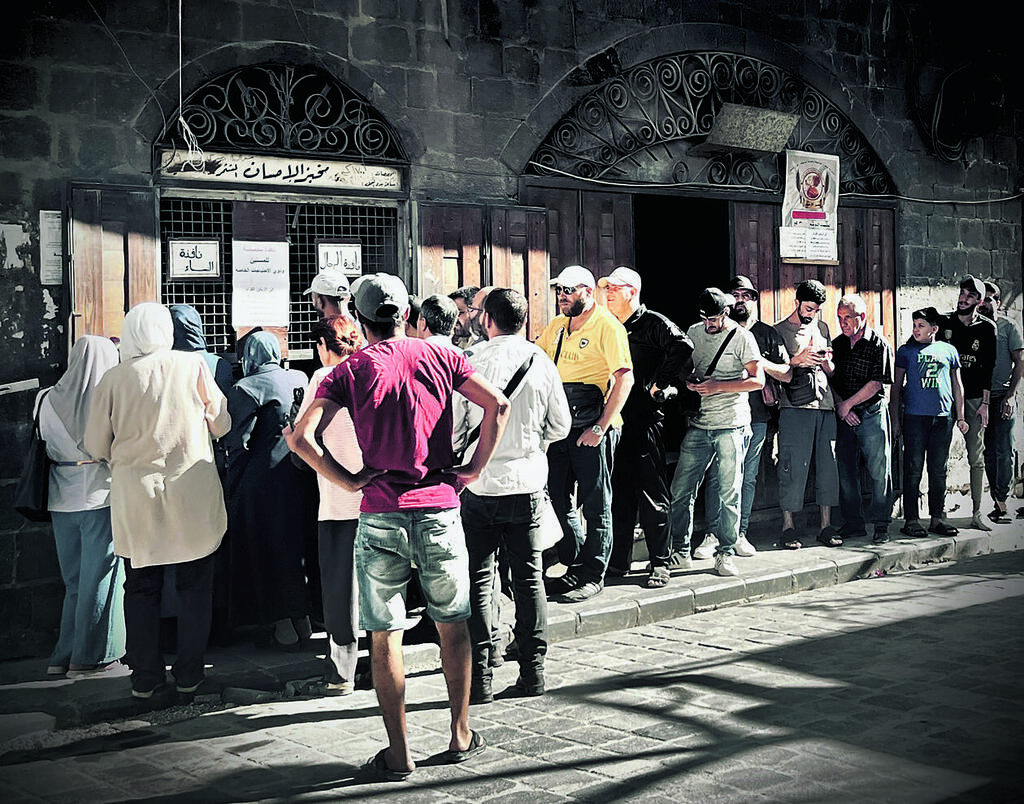
People wait in line outside a government-subsidized bakery in Damascus. Long queues for basic goods remain common as Syria’s economic crisis deepens
(Photo: Francesca Borri)
They all live in Dweila, the neighborhood near the Old City that may best reflect today's Damascus. It is here, in these three- and four-story buildings, that Syrians from across the country resettle in search of opportunity. They are Sunni, Alawite, Christian, Druze and secular, and listening to them, you cannot tell who is who. Next to a man selling whiskey stands a pastry chef in a hijab; he serves the coffee, she brings the cookies.
While the Damascus built in the Assad years is largely defined by four-lane roads, underpasses and overpasses, a city where you can walk and walk without encountering anyone, a city where you stay, not live, Dweila is the opposite. Here, you get around by bicycle and you immediately feel at home. There isn’t a stationer who won’t treat you to a pen, nor a greengrocer who won’t treat you to an apple.
“Syria is always analyzed in sectarian terms. But in the end, this here is the book that explains everything,” a local bookseller says, pointing to Marx. “The true front is between the haves and the have-nots.”
In Dweila, everyone is poor, and everyone is exhausted by war. They are not afraid of one another; the only people they fear are the jihadists — the foreign fighters who do not want to, and often cannot, return to their home countries. “Those are unmistakable,” says Khaldoun al-Batal, 38, one of the country's most popular bloggers.
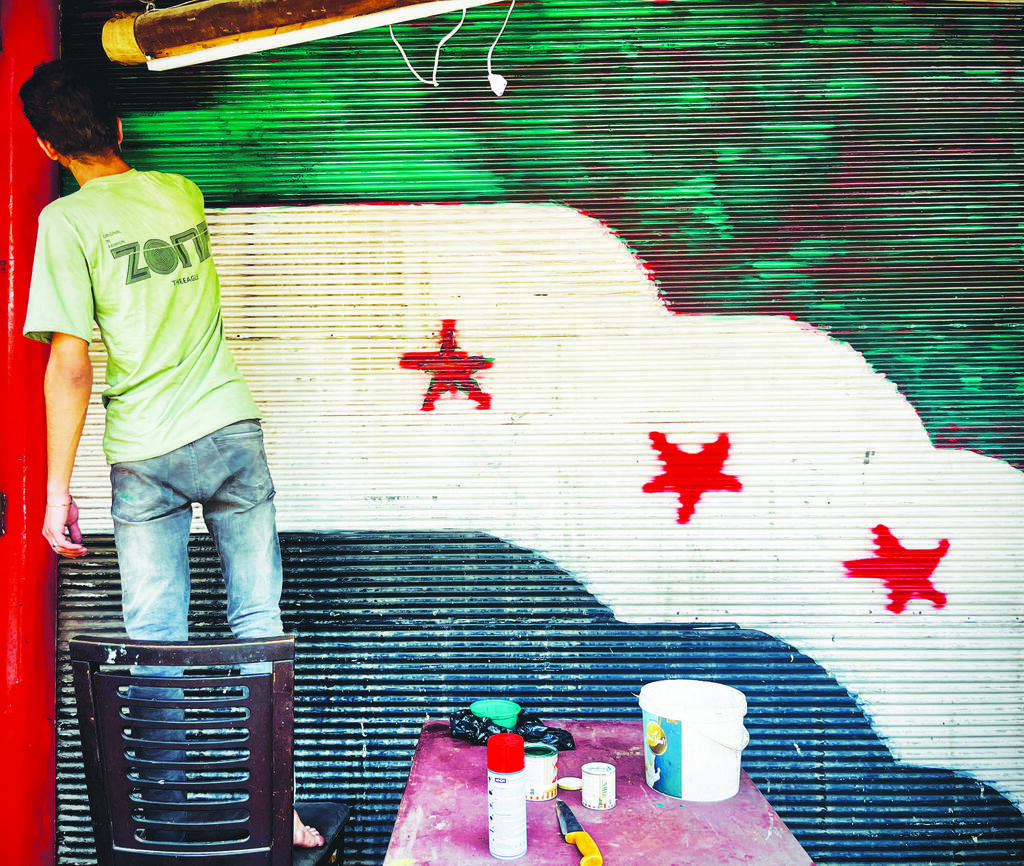
A man paints the Syrian opposition flag on a shopfront shutter in Damascus. Despite the government’s hold on the capital, signs of dissent still surface as residents adjust to political uncertainty after Bashar Assad’s departure
(Photo: Francesca Borri)
They are in Idlib and Raqqa, and they come to Damascus on weekends, each with a couple of wives in tow. All in niqab. All in black. And Syrians all step aside. “They are not only foreigners, actually. The militias outside government control are many and everywhere," he says.
"Ahmad al-Sharaa is trying to co-opt them, enlisting their commanders in the security forces, and in the meantime, he is working around the clock on the economy to give a choice to the many who fight just to get a salary, but the showdown is unavoidable. Because either you create the Syria the Syrians want—modern, open, plural—or you create the Syria of the jihadists. No one is under any illusions. This is not peace yet: it is just a truce.”
He is filming the Mar Elias Church, which ISIS destroyed last June. The group still has an estimated 5,000 men in Syria.
Christians, who once accounted for roughly 10% of Syrians and may now be closer to 2%, are somewhat of a special case. They are largely concentrated in Bab Touma, a quarter of the Old City that resembles Rome with its cobblestones, squares, fountains, lined with churches, each serving its own community of faithful — Greek Orthodox, Assyrian, Catholic and Melkite. And they want to leave.
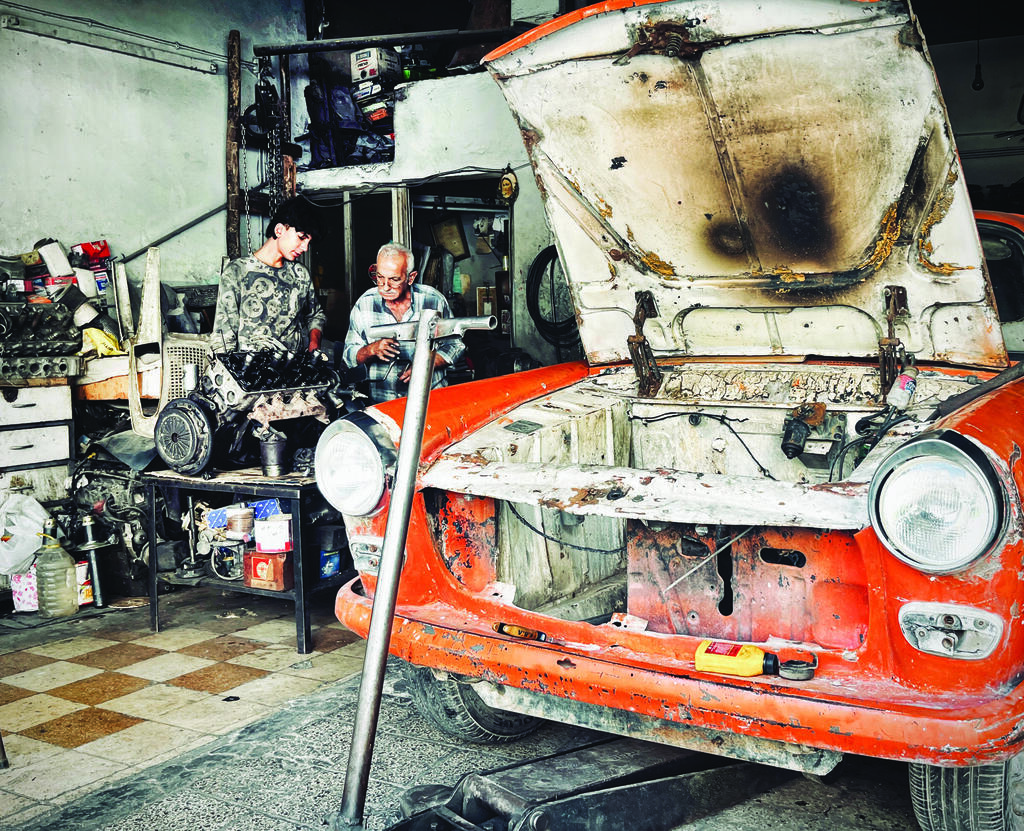
A mechanic and his assistant work on an engine in a small garage in Damascus. Many residents say rebuilding their lives has proved harder than surviving the war itself
(Photo: Francesca Borri)
After the attack on Alawites in March and another on the Druze in July — when the army intervened in a clash between Druze and Bedouin, further inflaming the situation — many Christians are convinced they will be next. “Under Assad, if you minded your own business, you wouldn't have any problem, whereas now, the danger is not what you do, it is who you are,” a bishop says, echoing what everyone else is saying.
And yet the reality is more complex. Each incident may look like sectarian revenge, but further scrutiny almost always reveals more than a single cause, and the sectarian element is often the least relevant, serving mainly as a pretext.
People here are not only Druze, Alawite or Kurdish. They carry several identities, many overlapping ties and, above all, many scars. After 14 years of war, they want one thing: for the fighting not to start again. So much so that they are not even responding to Netanyahu.
Since Israel established a de facto buffer zone along the border, extending beyond the Golan Heights, IDF incursions have become a daily occurrence. Among many Syrians, this sparks anger. Why ignite new tensions in a country already full of flashpoints — a country on edge, on its last legs, still searching for the missing in mass graves?
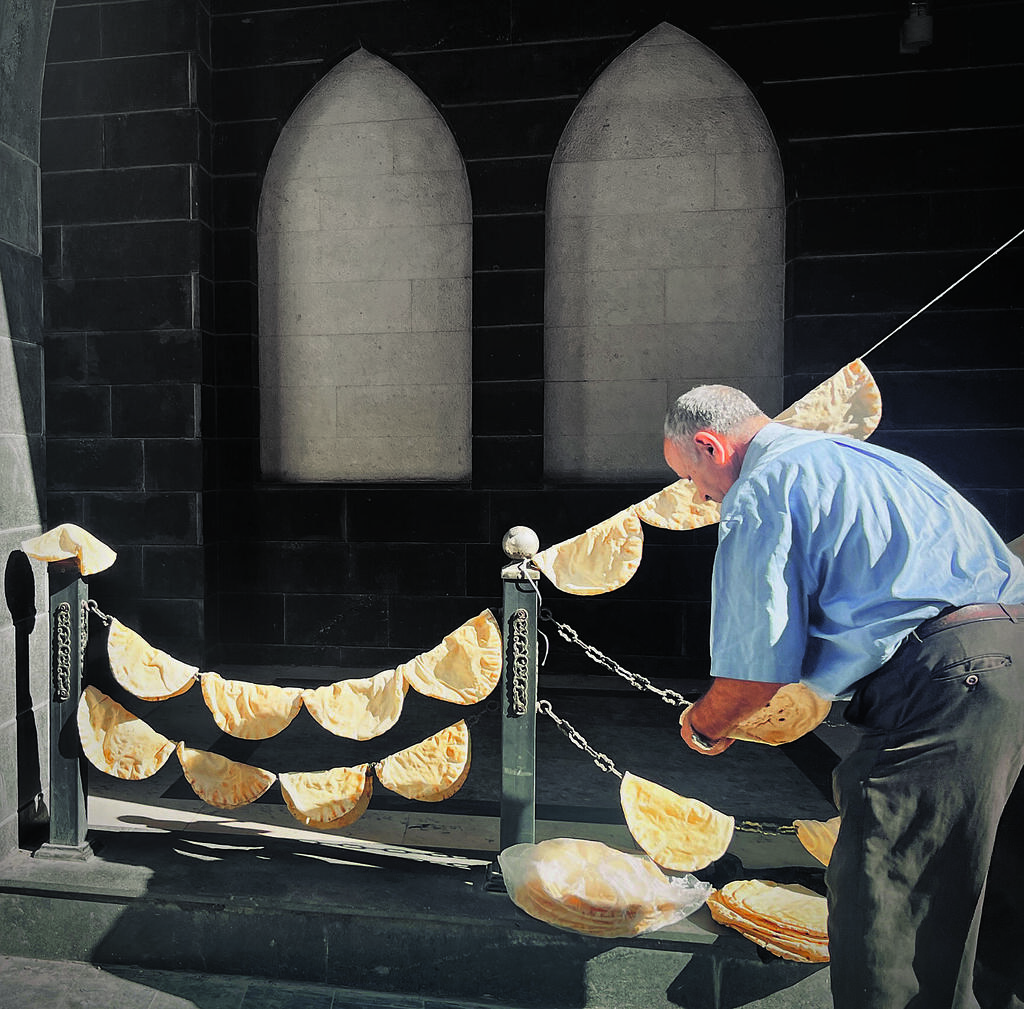
A man hangs flatbread to dry in Damascus. With food costs soaring and electricity scarce, residents rely on improvised methods to preserve staples
(Photo: Francesca Borri)
Yet they are keeping a cool head. They do not believe Israel is trying to destabilize Syria, which now serves as a barrier to Iran. Rather, they think Prime Minister Netanyahu is applying pressure to negotiate a demilitarized border.
And even in Syria’s weakened state, the south remains volatile: between the Golan Heights and the Druze communities backed by Israel lies Daraa — home to the Southern Front, a key pillar of the anti-Assad coalition.
“Netanyahu won’t have our reaction because that’s exactly what he aims for. And here, we are all experts in tactics,” says Khaldoun al-Mallah, 42, who was the only surgeon in the Yarmouk district of Damascus during the 2015 siege by ISIS fighters. “I have been through more war than all his generals, and war solves nothing. Trust me.”
He limps, chain-smokes and drinks. He lost everything in the war. In recent years, he has lived in Idlib, the last stronghold of the opposition, and of jihadists — a situation that was complicated enough. But somehow, being in Damascus is making it even more complicated. “There’s never been a war here. Down there, you crossed the street, and all was normal. Here we died, there they danced,” he says. “And now I am the one who needs a psychologist?
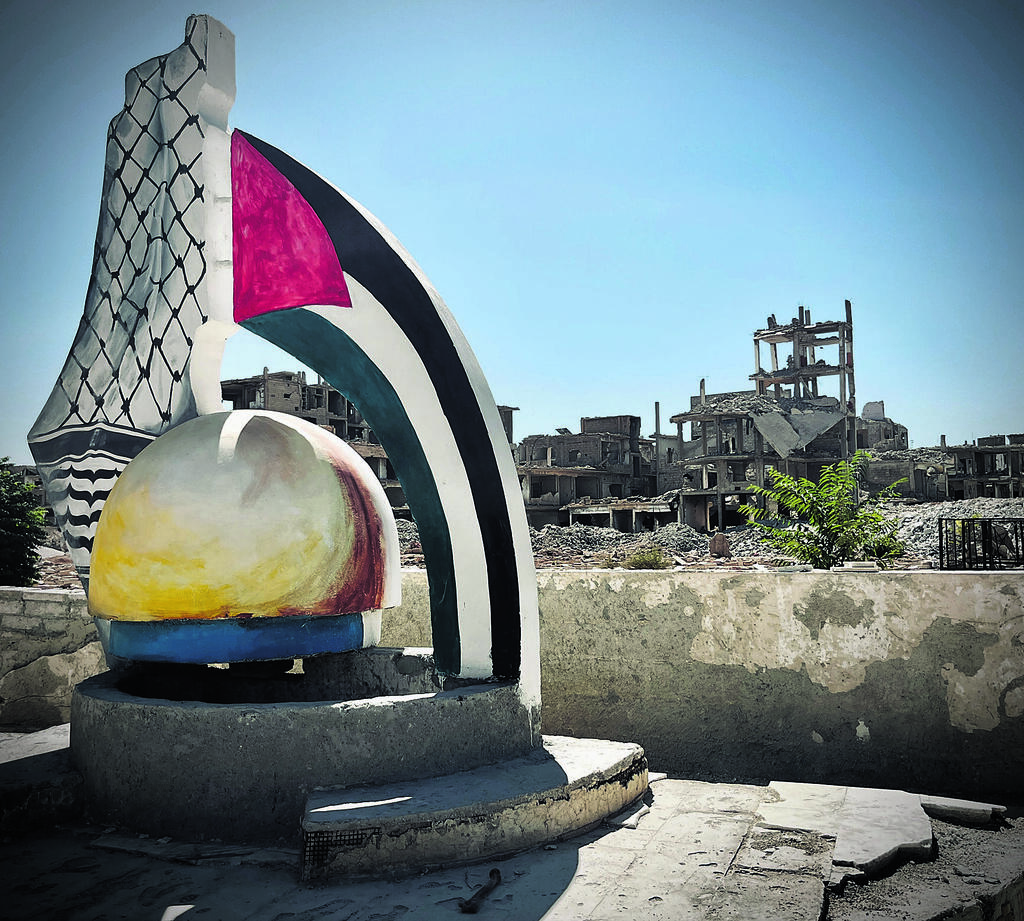
A monument in the Yarmouk district of Damascus stands in front of destroyed buildings. Once home to Syria’s largest Palestinian community, the area remains largely in ruins after years of fighting
(Photo: Francesca Borri)
“I know this is how history goes. There is a vanguard that fights for everyone and that pays for everyone. But I truly gave everything for freedom, everything. I will never get my life back, I will never even get myself back, and many now don't seem to know what to do with it. And is this the Syria we died for? All of us? Even those of us still alive?"
It is striking. Damascus feels like a city under anesthesia, a dull city. Since December 8, no one here has been to Aleppo, Homs or Daraa. Not because it is still dangerous, but because this is the imprint Assad has left on the capital. Everyone plays their part and that’s it. Eyes down. Conversations are brief, often empty. Opinions are never expressed — not out of fear, but out of disuse. You simply toe the line. Physically, the city is intact. But in truth, Damascus is the most ruined of all.
If there is a single symbol of the Assad years, it is the Four Seasons — Damascus’s only skyscraper. All white stone, square, minimal, impeccably polished. It stands as an island. Literally. Beside it runs one of the city’s typical four-lane roads, a maze of asphalt and flyovers above a stagnant river choked with algae, rats and garbage. Around it stretches nothing but poverty.
Behind the hotel, Syrians without access to water use the lawn irrigation system to wash clothes and shower. It is both an island and a bunker. It is so heavily fortified that it is not immediately clear how to get in. The entrance resembles a bank vault: a long concrete tunnel designed to absorb a blast should someone try to blow themselves up.
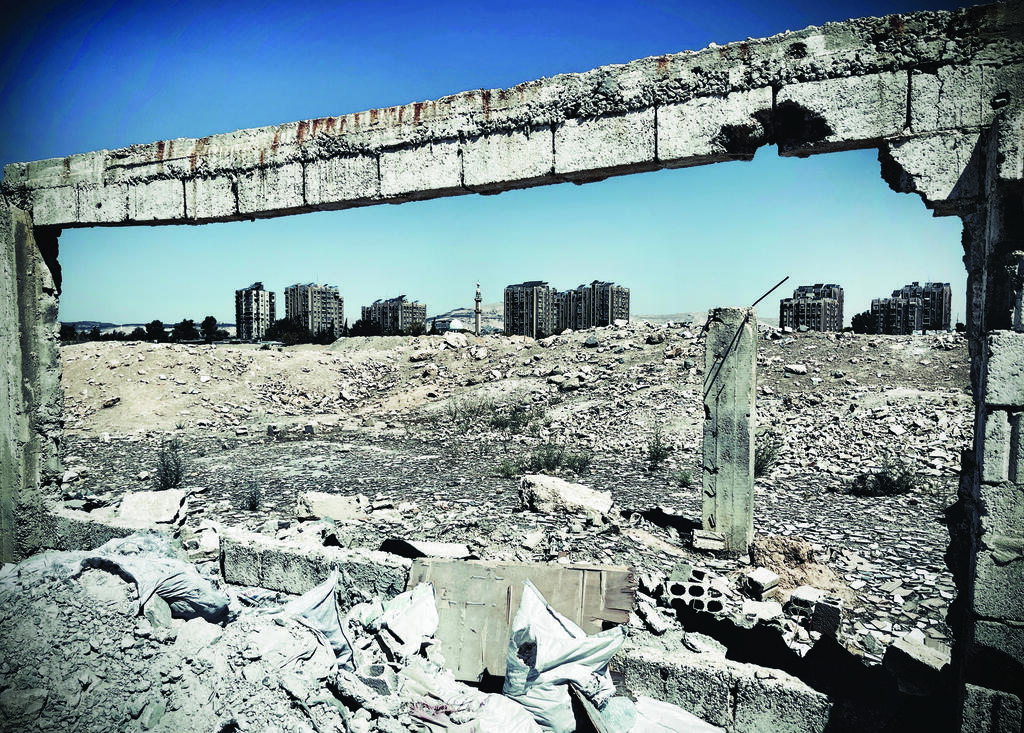
War-damaged buildings and rubble are seen on the outskirts of Damascus. Much of the capital remains physically intact, but surrounding districts still bear deep scars from more than a decade of conflict
(Photo: Francesca Borri)
Inside, it is not merely five-star. It is unapologetically luxurious. During the war, the UN based its operations here, spending more than $10 million a year — even as it later cut food rations for displaced Syrians because funds had run out. The UN is still here, its fleet of armored jeeps parked outside, all bearing its logo or that of an NGO. Taking photos is forbidden. At the reception, you are tersely told: “It's all OK. We are fully booked.” You are told: “It's always been OK”. It is like the Titanic, only it never sank; all the others did.
"I don’t know what future holds. But in the end, the model, if not Kabul, will be Dubai," says François Achkar, 41, the manager of Zawal, one of the last art galleries of the Old City.
It stands across from the Hassan Palace, now in ruins like many of Damascus’s once-famous houses. Often, no one nearby can even point you to where they are.
“But because this is the Middle East today, the dream is the Gulf," he says. "With its quick and boundless wealth. And these metropolises of Four Seasons hotels and eight-lane roads, without bookstores, without theaters, without cinemas, without squares: without citizens. Only consumers. Only SUVs and malls. The only ones who come here are diplomats and journalists. Which means art is over. Because without Syrians, these works are just souvenirs.”
After a war like this, he says, there is no aftermath and no real rebuilding. It isn’t only about bricks. “There is another Syria. And that's it. Another city that coincidentally is called Damascus like the Damascus that was before it.”
First published: 20:08, 12.05.25