

In collaboration with Cut Inside
AI Mode has officially rolled out and everyone is feeling it. Across industries, we're seeing sudden shifts in organic traffic, visibility and user behavior. In this piece, we aim to bring clarity to what we know so far, unpack the mechanics behind the change, and offer Cut Inside’s perspective on where the value is moving and how brands should respond.
The end of the beginning
For over two decades, the core transaction of the web was remarkably stable: a user poses a question to Google, and Google returns a list of blue links. The idea that this was changing isn't new, but the recent hype train is justified. The full-scale rollout of Google's AI Overviews represents a true inflection point—a fundamental restructuring of the internet's front page.
The rollout of AI Overviews and AI Mode in Google search has led many site owners to notice a distinct, and increasingly familiar, pattern in their Search Console graphs: a widening gap between impressions and clicks. This jagged, open "mouth" shape has quickly become a visual shorthand for the shift we're all feeling.
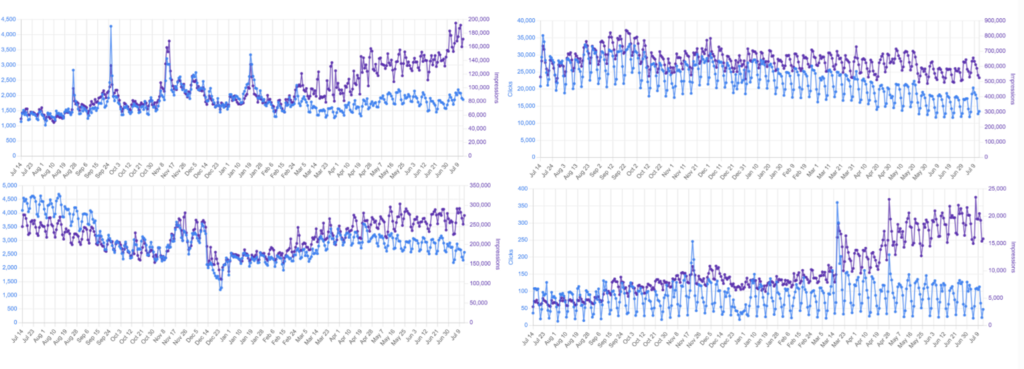
The shift is from a retrieval engine to a synthesis engine. The immediate impact is stark: according to a July 2025 Similarweb report, the share of "zero-click" searches has surged from 56% to 69% in the year since AI Overviews were widely deployed. This isn't just a statistical change; it's a physical one. The average AI Overview pushes the first organic result down by 980 pixels—often below the fold entirely. The impact on the most valuable organic position is severe, with some studies showing that the CTR for position one can drop by as much as 50% when an AIO is present.
This is a significant disruption. However, viewing this solely through the lens of traffic loss is a strategic error. It mistakes a change in the mechanism of search for a change in the demand of users. People still need products, services and solutions. The AI-powered SERP is not destroying demand; it is rerouting and refining it. The critical question is not "How do we get our traffic back?" but "Where is the value now accumulating?"
This is a moment of asymmetric opportunity. While the value of generic, top-of-funnel information is being commoditized by AI, the value of specific, high-intent and brand-driven interactions is increasing. The businesses that understand this distinction will not just survive; they will thrive.
The great informational squeeze
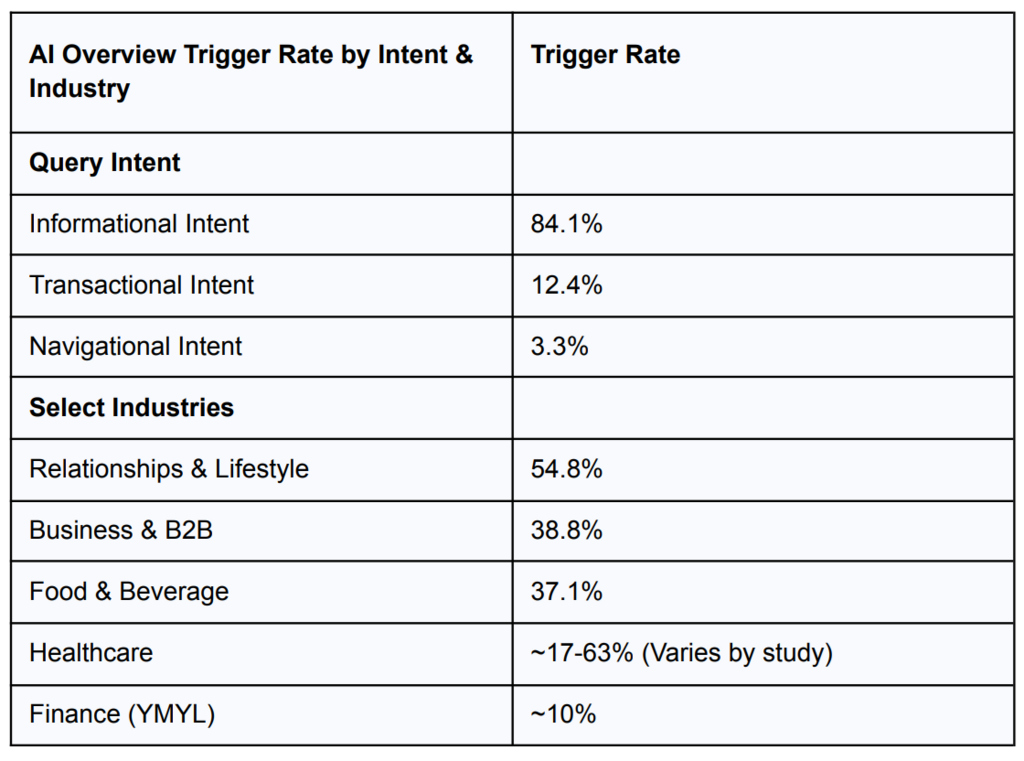
The data is unequivocal: Google's AI Overviews are disproportionately affecting informational queries. Research from seoClarity shows that 84% of queries that trigger an AI summary are informational. If your SEO strategy was heavily weighted towards "what is" and "how to" content, you are feeling the squeeze. This is by design. Google is using its Gemini models to provide direct answers, effectively absorbing the top of the funnel for a vast number of user journeys.
Sources: seoClarity, SE Ranking, MADX Digital
This squeeze has nuanced manifestations. In local search, for instance, the divide is stark: high-intent navigational queries ('plumber near me') still trigger the traditional Local Pack 93% of the time. But informational queries ('how much do plumbers charge?') are dominated by AI Overviews over 92% of the time. The battleground is clearly defined around information, not direct action.
However, we must be honest about the business impact of this specific traffic. For many, the value of ranking for a query like "what is content marketing?" was always questionable. It generated traffic, yes, but it was low-intent traffic that was difficult to convert. The AI Overview is now absorbing this traffic, and while the volume drop is real, the corresponding drop in revenue may be far less significant.
The data suggests a crucial insight: there may be fewer organic clicks, but not necessarily less organic revenue. The AI is surfacing information and possibilities, not purchasing products. It cannot be your shampoo, your dress or your flight to London. The demand for goods and services has not changed, but the discovery process has.
However, the exception is when your product is information: comparison tools, aggregator platforms, online courses and other knowledge-based offerings are more vulnerable. If the AI can summarize or replicate your value proposition, you risk being disintermediated. In these cases, the strategy must shift from supplying generic information to delivering differentiated experience, authority or tooling the AI cannot easily replace.
Traffic quality over quantity: The new funnel
The new search landscape creates a more "mature" user at the point of click-through. By handling the initial research on the SERP, AI Overviews pre-qualify your traffic. And users are adapting: a surprising 60% of consumers already trust AI-powered search results. This means the users who do click through are not just evaluating your page; they are arriving with a baseline of trust established by the AI summary. This is backed by analysis from seoClarity, which found that when a brand is cited in an AI Overview, there is a 30% higher likelihood that users will also click on that brand's traditional organic link below. The AIO acts as a powerful endorsement, turning a simple answer into a brand-building amplifier.
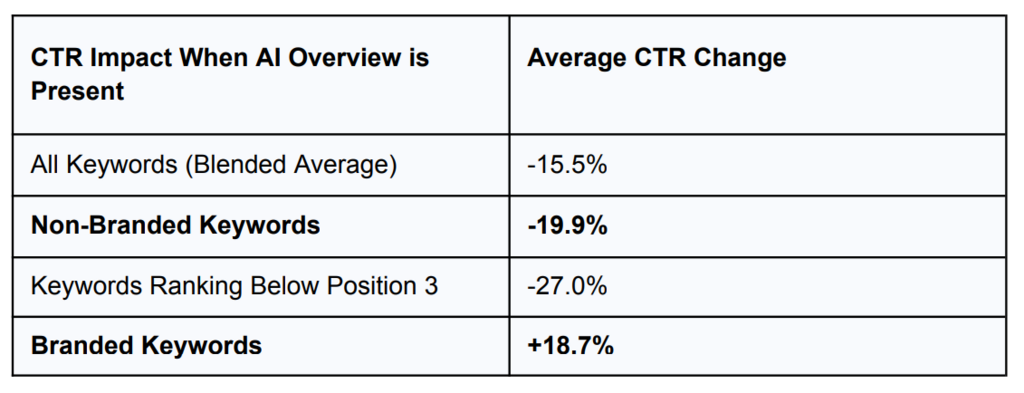
This leads to a counterintuitive but powerful outcome: your overall traffic may be lower, but your average traffic value will be higher. This isn't just a theory; it's a position backed by data and confirmed by Google's Head of Search, Elizabeth Reid, who stated that clicks from AIOs are of "higher quality" because users are pre-qualified by the summary. This is validated by case studies, such as one from Conductor, which found that while their site's traffic dropped significantly after the AIO rollout, their "conversions... have only fallen slightly," implying the lost traffic was low-value. This trend is most evident in the dramatic split between branded and non-branded queries. An Amsive study of 700,000 keywords reveals a powerful inversion: while non-branded queries suffer significant CTR loss, branded queries that trigger an AIO actually see a CTR increase.
Source: Amsive, 2025 CTR study
This dynamic is so powerful that Google is demonstrably willing to demote its own AI. In about 12.4% of cases, the AI Overview actually ranks below the first organic result. This happens most often on transactional queries where Google's systems recognize that users are bypassing the summary to click on a trusted e-commerce link. Quality and user intent can, and do, win.
The conversational web and the niche opportunity
Google's vision extends to a fully conversational "AI Mode," signaling a long-term trajectory toward an agentic search partner. This is where the game truly changes. Long-tail keywords (4+ words) are 4.6 times more likely to trigger an AI Overview, a clear signal that Google is optimizing for natural language and complex questions.
The "query fan-out" mechanism that powers AI Mode deconstructs questions into sub-queries and selects sources based on “passage ranking.” But the key to getting cited lies in a concept we can call "Informational Gain." While Google's AI can source foundational knowledge from top authoritative sites, its goal is to create the best possible answer, which means it actively seeks out passages that add unique value-information that cannot be gained elsewhere.
This is where the opportunity lies. The goal is not to be the single, comprehensive source, but to provide a crucial piece of the puzzle that no one else has. The data supports this: the average AI Overview cites 6.8 different sources (source), proving it's synthesizing, not just summarizing. It actively sources from forums like Reddit to inject 'first-hand experience' and is 50% more likely to cite a niche local blog over a national publication for local queries. In both cases, it's seeking unique expertise-high informational gain.
This focus on informational gain disrupts the old rules of domain authority. While for most general queries, over 90% of AIO sources are pulled from pages already ranking in the top 10, this is not a universal law. A landmark analysis of e-commerce queries provides a stunning exception: 80% of sources cited in product-related AIOs came from outside the top 10. This is informational gain in action. A specific product page with unique, structured data (pricing, user reviews, specs) offers more value for that query than a generic article on a high-authority domain. Your size is no longer your primary advantage; your ability to provide unique, proprietary data and deep expertise.
What to do now: The generative engine optimization playbook
Adapting requires a strategic evolution from traditional SEO to New Age SEO. The goal is no longer just to rank, but to be cited by providing unique value.
1. Mine your internal expertise for 'informational gain'
The most defensible content you have is the knowledge that exists only within your organization. Instead of creating broad, top-of-funnel content that AI can easily summarize, focus on your proprietary data and unique experiences to provide "informational gain"—value the AI cannot get elsewhere. To do this, look into your:
- Support center goldmine: Your support logs and internal playbooks are filled with answers to real, nuanced customer problems.
- Proprietary data: Leverage data from your product usage or audience behavior to create unique insights and statistics.
- Existing knowledge base: Your inventory of white papers, user guides and manuals contains a lifetime of accumulated expertise.
Once you've identified this unique knowledge, make it machine-readable with Structured Data (Schema.org). This is non-negotiable, as it explicitly defines the context of your content for AI. Furthermore, increase your statistical chances of being surfaced by turning this unique knowledge into multimodal content. With modern tools, it has never been easier to transform a deep article into a video, podcast or infographic, creating more assets that can be cited across different formats.
2. Build a brand that bypasses and influences AI
Vaguely "building a brand" is not an actionable strategy. In the AI era, brand becomes a two-pronged technical advantage:
- Create a "destination experience": The first goal is to make your website an experience that users prefer over an AI summary. Even if an AI can plan a trip to Japan, users may still flock to a dedicated site that makes the process more enjoyable and interactive. The objective is to create a desire not just for the information, but for the experience of consuming it on your platform.
- Establish brand-as-authority: The second goal is to make your brand synonymous with a specific need, audience or use case. This has a dual benefit. First, it drives high-value, branded search queries for your products and services. Second, it signals to the AI models that your brand is a highly relevant and authoritative source for a given topic, increasing the likelihood you'll be cited in a non-branded AI Overview. Track brand search volume and impressions as a core KPI for this effort.
Want to see how ChatGPT and Gemini see your brand vs your competitors?
Try out our tool for free
3. Map and master every commercial intent
As users grow accustomed to using AI for product research, a new imperative arises: the amount of information available about your products will determine how often, and in what contexts, AI surfaces them. It is your company's responsibility to provide this information and control the framing of your products. Don't let the AI rely solely on what others know about you—own the conversation, because nobody will do it for you.
With AI handling broad discovery, the users who reach your site have already moved past "what is" and are now asking "which one for me?" Your goal is to proactively answer every possible nuanced question they might have about your offerings. This requires a systematic effort to research and create dedicated content for all the specific user intents and needs surrounding your products and services. Go beyond a simple feature list and build out product pages, collection pages, service pages or content clusters that address:
- Specific use cases: Who is this for? (e.g., "for small businesses," "for enterprise teams," ”for gamers,” ”for side sleepers,” ”a red night dress with side slit”).
- Feature deep dives: How does a specific feature solve a specific problem?
- Common problems and solutions: Address the pain points your service directly solves.
- Comparisons and alternatives: Honestly compare your solution to others, or different tiers of your own service.
By creating the definitive answers for these nuanced, high-intent queries, you not only increase your conversion rate by serving users better, but you also create a library of highly specific, authoritative content that is more likely to be cited by AI for valuable long-tail commercial searches. The ultimate goal is to dominate the conversation as much as possible.
The generative shift is here. It is changing the flow of information and value on the web. But it is not an extinction-level event for businesses with real value to offer. It is a clarifying moment - a culling of low-value content and a focusing of user intent. AI is doing what search engines always promised to do: bring people closer to the answers they actually want. But now, it’s skipping the fluff. If your brand exists to rank - not to resonate - you will feel the squeeze. If your content exists to check SEO boxes rather than solve real problems, AI will gladly do it faster, cheaper and better. But for the rest? For the brands who’ve invested in clarity, trust, relevance and depth - this is your leverage point.
Because in this new landscape:
- Specificity beats scale.
- Trust beats tricks.
- And substance beats surface.
The AI layer between your audience and your site is not a barrier. It’s a filter - one that rewards originality, brand equity and true expertise.
This is the shift, and it’s not a glitch or a trend. It’s a reordering of how value flows through the web. AI isn’t destroying demand; it’s reshaping discovery. And the brands that win will be those who don’t just show up, but show up with clarity, credibility and context AI can’t replicate.
At Cut Inside, we’re working hands-on with clients navigating this new reality, rethinking their content structures, identifying informational advantage and making sure their brand stands out where it matters most: in the conversations AI is already having. If you want to understand how AI sees your brand and how to position yourself in this new landscape, we’d love to talk.
In collaboration with Cut Inside