

Born out of wedlock in a small town near Barranquilla, Colombia, raised in Europe, converted to Judaism and later living in Tel Aviv, she went on to become the chief money launderer for a sprawling Colombia-linked cocaine organization that moved huge quantities of drugs into the United States and washed millions of dollars through secret financial channels.
The story of Michal Kourani — also known as Marlene Navarro and Nora Estrella Ramirez — reads like an international crime thriller, blending immense wealth, criminal brutality, glamorous high society, multiple identities, a sentence that was effectively life behind bars and a twist ending few would have predicted.
She was born in 1943 to unmarried parents who struggled to raise her and was sent to live with her grandparents, who baptized her as Marlene Navarro and placed her in Catholic schools. Around age 10, she was adopted by relatives serving as Venezuelan diplomats in Paris. There she received an elite education, stood out as an exceptional student and went on to earn degrees in art and economics at the Sorbonne.
Her life took an unexpected turn after she met her first husband, an Israeli, and moved to Israel with him. From the beginning, Kourani felt a powerful connection to Israel and Judaism. She converted, changed her name to Michal, studied Hebrew in an ulpan and quickly integrated into Israeli society. She lived in Tel Aviv for five years before the marriage collapsed and ended in divorce.
Soon afterward she met the man who would become her second husband and moved with him to Miami. Although she resumed using her original name in the United States, she remained proud of her Jewish and Israeli identity, stayed active in the local Jewish community and continued her studies, specializing in international economics and business administration at the University of Miami.
In late-1970s Miami, a city awash in drug trafficking and black money, she met Carlos Alvarez-Moreno, also known as Jose Jader Alvarez-Moreno, the Colombian boss of a major cocaine trafficking operation moving drugs and cash through the southeastern United States. Federal court records later described the case as a massive drug importation, drug distribution and money laundering enterprise. His network stretched from Colombia to Miami, California and Denver and handled cocaine shipments and financial transactions on a staggering scale.
Alvarez-Moreno was impressed by the small, elegant woman and began giving her minor assignments to test her abilities. She carried out every task with ease. As time passed, he brought her closer to him and the inner leadership of the organization.
At the end of 1980, Alvarez-Moreno suffered a major blow. U.S. Customs agents seized more than $1.6 million in cash from a private aircraft linked to him at Opa-locka Airport in Florida, along with additional money found with the pilot. He was declared a fugitive and effectively blocked from returning to the United States. Forced to run the organization from Colombia, he needed someone he could trust to oversee the financial side of the operation inside the U.S. Kourani, with her academic background in economics and business, was the natural choice. She threw herself into the work and quickly proved to her boss that he had chosen well.
Because of her beauty and tiny frame, she was nicknamed “the Butterfly.” Alvarez-Moreno himself called her “Hummingbird,” a reference to how small and quick she was.
Her daily work involved collecting millions of dollars in cash from cocaine sales, from Miami to California. According to later federal court findings, she told an undercover operative that she handled about $80 million a year for her boss. The money came from what she described as “powder people,” associates tied to the cocaine trade. Cash was delivered to her in locked suitcases and shopping bags in public parking lots, lawyers’ offices and quiet meetings around Miami.
Her central task was to turn small bills into large bills and launder the proceeds through covert financial routes, especially wire transfers to numbered accounts in Panama. Court records show the organization used a front company set up by the U.S. Drug Enforcement Administration, Dean International Investments, which secretly offered laundering services such as currency exchange, bank transfers and cashier’s checks to people trying to avoid normal financial channels.
Kourani did not know that Dean Investments was part of “Operation Swordfish,” a DEA undercover probe launched in 1981 to identify and arrest people laundering narcotics proceeds. Through referrals in Miami, she was brought into contact with Roberto Darias, a confidential informant working with the operation. He became one of the most important people in her life and, ultimately, the man who helped bring her down.
One of the early transactions set the pattern. She delivered $500,000 in cash to be wired to Panama and agreed to pay a commission. Days later she handed over a locked suitcase in a parking lot. It contained $484,700, which was transferred to a numbered Panamanian bank account according to her instructions. Later, at her lawyer’s office, a receipt for the wire transfer was delivered and her attorney allegedly said the money came from “chemical plants” in Colombia and that its owner handled between $400 million and $500 million a year.
From then on, the relationship between Kourani and Darias deepened. They spoke almost daily. She described her customers as “powder people,” explained that some of the money came from California and some from Miami and gradually introduced Darias to other members of the network. Federal evidence later showed there were 20 or 21 major transactions involving large sums of money, along with negotiations over cocaine shipments.
In one episode, Kourani said her boss in Bogota was using a pilot in Tampa to fly cash to Colombia and argued that it would be safer to use Dean Investments to send money to Panama. In another, after Alvarez-Moreno’s children were kidnapped in Colombia, she urgently sought to exchange hundreds of thousands of dollars in small bills into larger denominations to pay ransom. She later claimed much of the cash she handled was tied to those ransom efforts, though prosecutors said the broader evidence overwhelmingly showed it came from cocaine sales.
Court records identified other alleged members of the organization she brought into the orbit of the undercover operation, including Luis Rodriguez, Carlos Alvarado, Oscar Garcia and Said and Ricardo Jatter. According to the evidence, she said Rodriguez handled proceeds from cocaine sold in California, Garcia supervised distribution into the United States and the Jatters were involved in major distribution activity in Colorado and California.
The picture that emerged was not of a freelance money mover but of a disciplined, far-reaching criminal organization with Alvarez-Moreno at the top and Kourani as one of its key financial operatives. The Eleventh Circuit later upheld Alvarez-Moreno’s conviction in the case, describing voluminous evidence of a widespread drug enterprise and noting that investigators had recorded about 300 phone conversations among Kourani, Alvarez-Moreno and other associates.
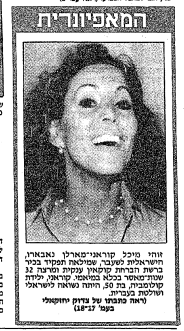
Michal Kourani
Despite her importance to the organization, it turned on her with shocking cruelty. During one trip to Colombia to meet Alvarez-Moreno, she was kidnapped by a guerrilla group. The kidnappers demanded millions in ransom, but the cartel refused to pay the full amount. She was eventually released for a much smaller sum, but only after brutal abuse. She was raped, mistreated and forced to endure humiliations that seemed almost beyond belief. Yet the trauma did not break her loyalty. She returned to work for the cartel.
Her downfall began with what she believed was an ingenious new way to launder the cartel’s money. Dean Investments presented itself as a Miami company that could buy securities in cash and quietly move money. In fact, it was a DEA front, and Darias was secretly recording everything.
As their relationship grew closer, Kourani began to confide in him more and more. She later said Darias reminded her of her grandfather, the first man in her life who had truly cared for her. She discussed nearly every issue with him, opened up about the mechanics of the cartel’s operations and gave investigators, through hours of taped conversations, a detailed map of the organization’s finances.
By late 1982, the case against the organization had become enormous. Federal prosecutors eventually charged Alvarez-Moreno and others in a broad narcotics case. The appellate ruling years later would uphold convictions for conspiracy to import cocaine, conspiracy to possess cocaine with intent to distribute and, for Alvarez-Moreno, engaging in a continuing criminal enterprise.
As the evidence mounted, investigators prepared to make arrests. But Kourani, already known among law enforcement as the “Cocaine Queen,” had other plans. Someone tipped off one of her associates, and two days before the arrests, she disappeared.
At the end of 1984, just before a federal indictment against her was to be finalized, she resurfaced in Caracas, Venezuela, taking advantage of the fact that the country had no extradition treaty with the United States. She arrived not as a frightened fugitive but in style, carrying a forged Venezuelan passport in the name of Nora Estrella Ramirez. In Caracas society, however, many knew her by her Hebrew name, Michal Kourani.
She refused to live underground. She rented an apartment in the upscale Altamira neighborhood, only a few streets from the U.S. Embassy that was searching for her. She opened a successful foreign currency brokerage, worked directly with major banks and said she was planning eventually to move to Sao Paulo. She became a familiar sight in the city, driving a pink Fiat from place to place.
Her social life was equally conspicuous. She mixed with senior officials and business figures, became a regular guest at diplomatic cocktail parties and dined in some of the city’s most exclusive restaurants.
In 1985, at a human rights conference in Caracas, she met Rene de Sola, a respected jurist, diplomat, former minister and a man of standing who would later become president of Venezuela’s Supreme Court. He was married, a father and a grandfather, but the connection between the judge and the fugitive money launderer was immediate.
They spoke by phone several times a week, always in French, and shared a love of art, food and Paris, where both had once lived. Their intellectual connection soon turned into a passionate affair. He spent Wednesday afternoons at her apartment. She proudly displayed his photograph and diplomatic business card on her bedside table. They dined together in hidden romantic restaurants across the city, and he sent her flowers from Europe.
The Venezuelan chapter ended when an anonymous source leaked her whereabouts to the Americans. Legally, there was no easy way to deport or extradite her. But Venezuelan authorities, grasping the political danger posed by exposure of the romance involving the country’s top judge, chose to cooperate with the DEA. They made her forged passport disappear. Without proof of Venezuelan citizenship, it became far easier to detain her and quietly hand her over to four federal agents who had arrived in the country.
(Photo: shutterstock)
Days later, a special DEA plane landed in Caracas. The four agents boarded accompanied by a large dog cage. After takeoff, once the plane crossed the coastline and was over international waters, the agents opened the cage, took Kourani out and formally arrested her.
Her trial in Miami shattered records and became the longest federal trial in the history of the Southern District of Florida. She hired the best lawyers she could find, rejected plea deals and continued spinning what prosecutors said was a web of lies from the witness stand. She insisted the millions of dollars in cash were really intended to pay ransom for her boss’s kidnapped children.
The most dramatic moment came when Robert Darias, the confidant who had become the government’s central witness, took the stand. Kourani completely lost control. In front of the packed courtroom, she jumped to her feet and screamed at him: “Dirty son of a bitch! You’re a rat, that’s what you are!”
The jury was not persuaded by her version of events. She was convicted and sentenced to 32 years in prison.
Then came the astonishing twist. After she had spent nearly eight years behind bars, a federal judge ordered a new trial because of sloppy work and administrative errors by a court stenographer. The transcript had been so badly compromised that it prevented a proper appeal.
Darias, the undercover operative who had risked his life and the safety of his family, felt betrayed after the DEA failed to honor financial promises made to him. He refused to return to the witness stand. Prosecutors were forced to swallow the bitter pill and agree to a far more lenient plea deal with the woman once called the “Cocaine Queen.”
That deal cleared her path out of prison in 1994.
Her story remains one of the strangest intersections of Israeli life, Latin American cartel violence, high-society scandal and American law enforcement: a woman who lived in Tel Aviv, embraced Judaism and then vanished into the machinery of an international cocaine empire before reappearing in one of the most extraordinary criminal cases of its era.