

In the small house in Nir Oz, Ariel Bibas was supposed to wake up on August 5 to his mother, Shiri's, kisses. Father Yarden would have decorated the living room with colorful balloons, a plate loaded with sweets would have been placed on the table, and birthday songs would have played in the background. Little Kfir surely would have clapped his hands in excitement. He was supposed to be 2 and a half years old, a sweet redheaded toddler, whose steps were still accompanied by childish caution and whose words came out with the growing clarity of a child learning about the world.
Tonto, the family's beloved dog, would also have been part of the celebration, and with pure canine joy would have licked the face of the sweet birthday boy whom it was impossible not to love. At school, they would have celebrated Ariel with a huge chocolate cake and a sugar sheet featuring a drawing of Batman, his favorite superhero. He would have sat on a decorated chair, a colorful flower crown on his head, while his classmates blessed him with children's wishes: "May you receive many gifts," "May you have many friends," "May you never be sad."

In another reality — a normal reality — a few hours later, on the green grass in front of the family home, right under the same tree where the world first saw the image that became a symbol of the pure evil that struck the nation on that cursed Saturday — a terrified mother covered with a blanket, hiding two small redheaded heads pressed to her body, surrounded by dozens of armed Gazans — perhaps a family birthday party would have been held.
Yossi and Margalit Silberman, Shiri's parents, who lived not far from them in Nir Oz and were murdered by the terrorists, would certainly have come to celebrate with their beloved grandson, who loved butterflies and dreamed of being Batman and rescuing people from pits.
But Ariel didn’t celebrate his sixth birthday this year. For two years now, Ariel hasn’t celebrated birthdays. Neither have Shiri and Kfir.
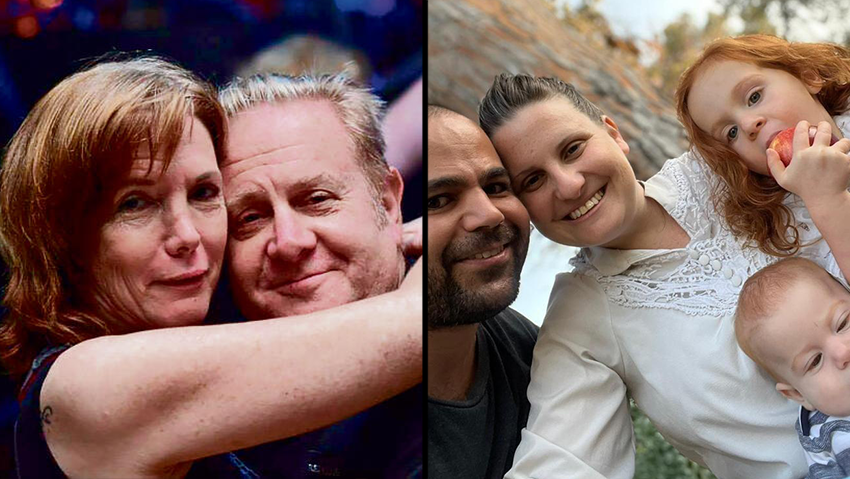
The parents of Shiri, Yossi and Margalit Silberman
(צילום: באדיבות המשפחה)
The story of the Bibas family became one of the most painful symbols of the Oct. 7, 2023, massacre. Yarden, who went out to fight the terrorists who invaded their home and tried to defend his family, was kidnapped, wounded, and bleeding in the Gaza Strip. A few hours later, Gaza civilians kidnapped Shiri, Ariel (then 4), and Kfir (only 9 months old). Tonto, the faithful dog, was murdered on the spot.
Yarden was released from captivity after more than a year. The bodies of Shiri and the children were returned for burial in February 2025, a few weeks after his release. They were the last children to remain in captivity, the only ones not released in the hostage deal, along with the other mothers and children.
And on Aug. 6, the day after the uncelebrated birthday — instead of balloons and a flower crown, instead of cake and birthday songs — dozens of people gathered in a hall at Schneider Children's Medical Center. The Bibas family, American donors, hospital management, representatives of the “Toys for Hospitalized Children” association, and other guests came to inaugurate the “Playroom in Memory of Shiri, Arie, and Kfir Bibas,” the first of four therapeutic playrooms to be established in the hospital, thanks to the association's initiative.

Itai Reginiano and Yossi Shnaider, Shiri, Kfir and Ariel Bibas
On the wall was a sign covered with white cloth. Yossi Shnaider, Shiri's cousin on her mother's side, stood and looked. He knew that the moment the cloth was removed, the second the names were revealed, reality would hit him again like a punch to the gut. Next to him, leaning on crutches, stood Itai Reginiano — an officer in Givati reconnaissance who searched for Shiri and her children in the Strip and was seriously wounded two months later. Both looked at the covered sign and knew that the moment it was revealed, the pain would flood back again.
“All this activity, all these things's's amazing, it warms the heart, it's beautiful,” Yossi would say later, trying to find words for the feelings flooding him. “These beautiful Jews, American Jews — they represent beautiful Israel. The values I grew up on, that I was told about as a child — this is exactly what I see here. People who love us with real love, love without conditions — and unfortunately, they are across the sea.”
Then his voice trembled. “I had a nice event. Maybe not fun, but nice — until they revealed the sign. Because suddenly you understand again that you are mourning. That it’s a sign, just a sign. Instead of the children being here and celebrating Ariel’s birthday, it’s another sign. Your family has become a sign. It’s suddenly seeing again this terrible reality before your eyes, and that’s quite a slap in the face.”

Itai and Yossi
When the cloth was removed and the names — Shiri, Ariel, and Kfir Bibas — were revealed, Yossi looked at his family and felt something inside him tear again. “I see the face of Dana, Shiri’s sister, and the look of Yarden — and I understand what’s going through their heads. I understand the difficulty. It wasn’t supposed to end like this. Shiri and the children weren’t supposed to be a sign.”
Yarden’s eyes — fixed on the sign bearing the names of those who were his whole world and were taken from him in one horrific moment — told a whole story: the enormous pain, the longing for the small and beloved family he built with Shiri, his high school sweetheart. Maybe, if eyes could speak, they would also tell of the unbearable moments he endured in captivity. But eyes don’t speak, and one can only guess what goes through the heart of a man who lost his beloved, his small children, his father and mother-in-law, his dog, many of his friends, and his home, and survived months of captivity in hellish conditions.
"Sorry I couldn't bring them home"
The connection between Yossi and Itai began in the rehabilitation ward at a central Israeli hospital on Dec. 22, 2024. “I came to the hospital to visit wounded soldiers and Nova survivors,” Yossi recalls. “I saw Itai sitting in a wheelchair. I was wearing the ‘Bibas’ shirt. I asked him if I could hug him.”
“No, I want to stand and hug you,” Itai answered, surprising everyone around. This was only the second or third time he had stood since the injury. “He stood up, approached me, and we hugged,” Yossi says emotionally. Then Itai whispered something that made the moment sacred. He told him how, together with his battalion friends, he had searched for Shiri and the children in Jabaliya two months before the incident in which he was wounded. “We had a mission,” he said in a broken voice. Then, almost in a whisper: “Sorry, I couldn’t bring them back.”
How did you respond? I ask Yossi. He looks at Itai, smiles, and replies: “I looked him in the eyes and told him: ‘You are my brother. We are family from now on and for life.’”
Only later, as their trust built brick by brick, did Yossi learn about Itai’s injury. In one of the house clearings in the Strip, an explosive device detonated, causing the building to collapse. Five soldiers were killed, 11were wounded. Itai was the most seriously injured. He remembers nothing of the incident — a complete blackout.
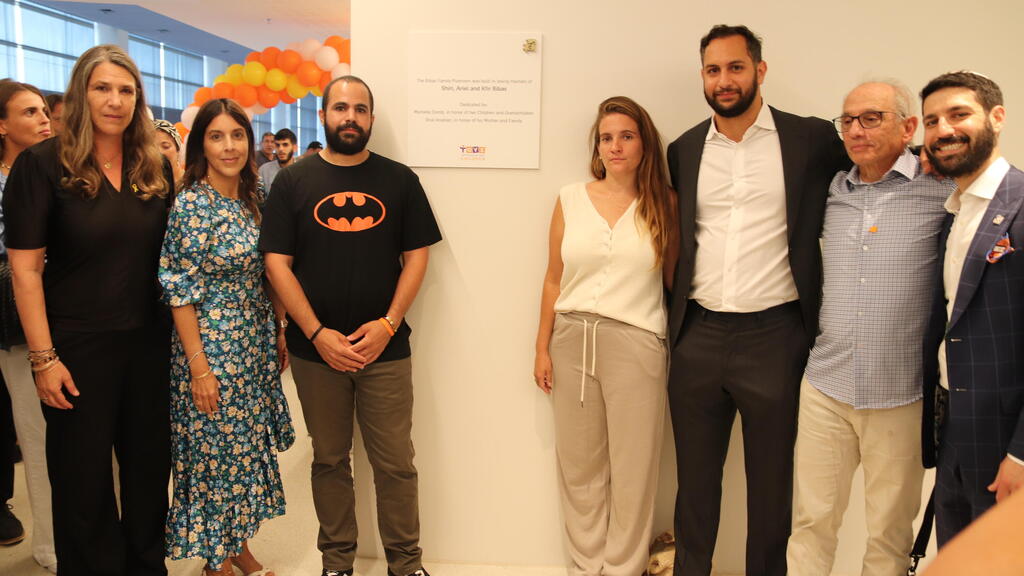
The integration ceremony
(Photo: schneider Children's hospital)
For five months, he was bedridden, 100% dependent on care. He couldn’t move or speak. His mind was clear, but his body didn’t function. “He dreamed of rescuing hostages and instead became a hostage in his own body,” his mother later said.
Then, last Sukkot, a miracle happened — Itai woke up and, slowly, began signaling for a board and marker to communicate. Later, he started talking, then standing, and finally walking. On his wrist, Itai wears a bracelet engraved: “Take my broken wings and learn to fly.” “Everything is in the head,” he says, tapping his temple. “This is dedicated to my team. They took me when I was half broken and lifted me again.”
Despite the serious injury, he says that if he could, he would go into Gaza again to help rescue hostages. “I’m happy I at least managed to help a little in the war, until I was wounded.”
Yossi: “What do you mean by a little? You did a lot. You sacrificed your life.”
Since meeting in December, the two haven’t parted. Yossi invites Itai and his parents to every memorial event for Shiri and the children, and they always come. Once, at a Tel Aviv memorial ceremony, Itai asked to speak in their memory — and insisted on climbing the stage alone.
“She told me: ‘I don’t need help, I can do everything alone. I’m strong,” Yossi recalls. “He has mischievous, playful eyes,” he adds, smiling suddenly. “Then I noticed someone in the audience, a gorgeous flower girl, and I saw them winking at each other. I couldn’t restrain myself — I went up to her and asked who she was.”
And what did she say?
“That she’s his girlfriend. You have no idea how excited I was at that moment.”
Itai and Roni — the “flower girl” who sat in the audience at the Sarona ceremony, moved by her hero boyfriend who refuses to give up on himself — had met only two weeks before he was wounded. Just four dates. When his serious condition became clear, his mother, Lilach, tried to “release” Roni: “You’re a young woman, you don’t have to put yourself into this tough story.”
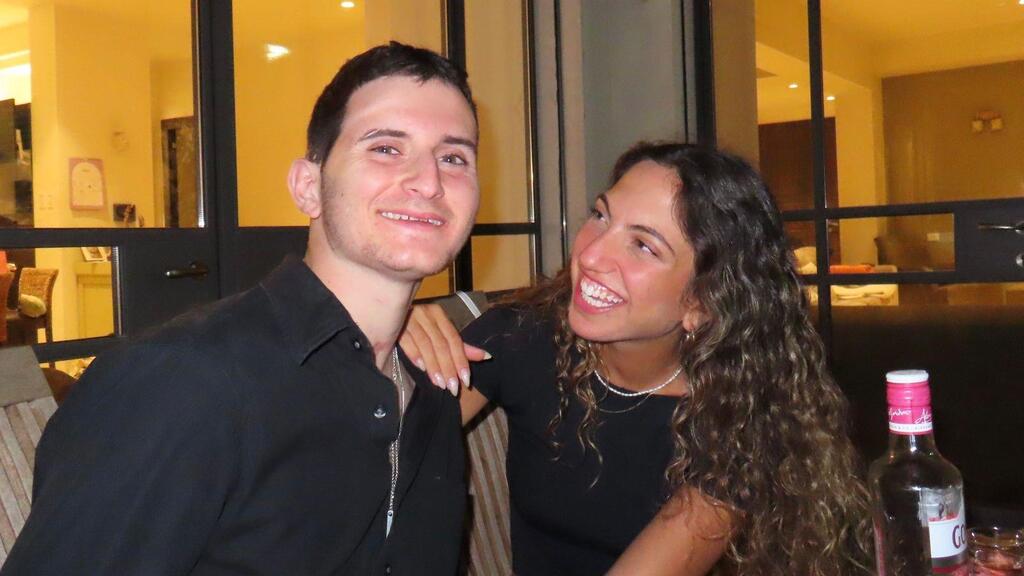
Itai and Roni
But Roni didn’t give up. She came day after day to the hospital, sat by his bed, talked to him even when he didn’t open his eyes, and didn’t despair when all he could manage were hand signals. When his condition worsened after a critical surgery, she reassured his mother: “He’s a fighter. He’ll win.” She became the family’s lifeline of hope.
Today, exactly a year after Itai managed to write to Roni — for the first time since they met — the sentence “I love you” on his small board, letter by painstaking letter, they are celebrating a full year together. That moment, when the wounded fighter expressed his love to the woman who refused to abandon him even when it seemed all hope was gone, became their official anniversary.
“I spoke with him a week and a half ago,” Yossi says, “and she had just gotten into the car. I heard her say to him, ‘Itai, how beautiful you are today!’ in such a tone full of love. After all the horror we went through, hearing such a moment of pure good — it’s like seeing there’s still light in the world. I told him: ‘You’re only missing wings. You’re a pair of angels.’”

Roni and Itai
Schindler’s list of our time
Since Oct. 7, Yossi’s life has been turned upside down. “Someone sent my phone number to a WhatsApp group of journalists. From that moment, I’ve been handling 20 to 30 calls a day. Morning in Israel, night abroad. Trips, amshassadors, diplomacy — it’s been insane.”
Meanwhile, his real estate business collapsed. “It’s not a store you can just close and reopen. We’re talking about long processes. Only now, after almost two years, am I starting to try to rebuild.”
Jimmy Miller, another cousin of Shiri’s, joined Yossi’s efforts two and a half months after the abduction. Both are self-employed, and both paid a heavy price — economic, familial, psychological, and physical. “And the state doesn’t recognize us. At the hostages’ headquarters, they told us: ‘You’re edge cases.’ We’re second-degree relatives. Dana couldn’t fight at the time — on that Saturday, she also lost her parents. What she went through… I wouldn’t wish it on anyone.”
During the first hostage deal in November 2023, the family endured a hell of waiting. “I called it ‘Schindler’s List of our time,’” Yossi says painfully. “Every day we waited for a list that would decide if our family would live or die.
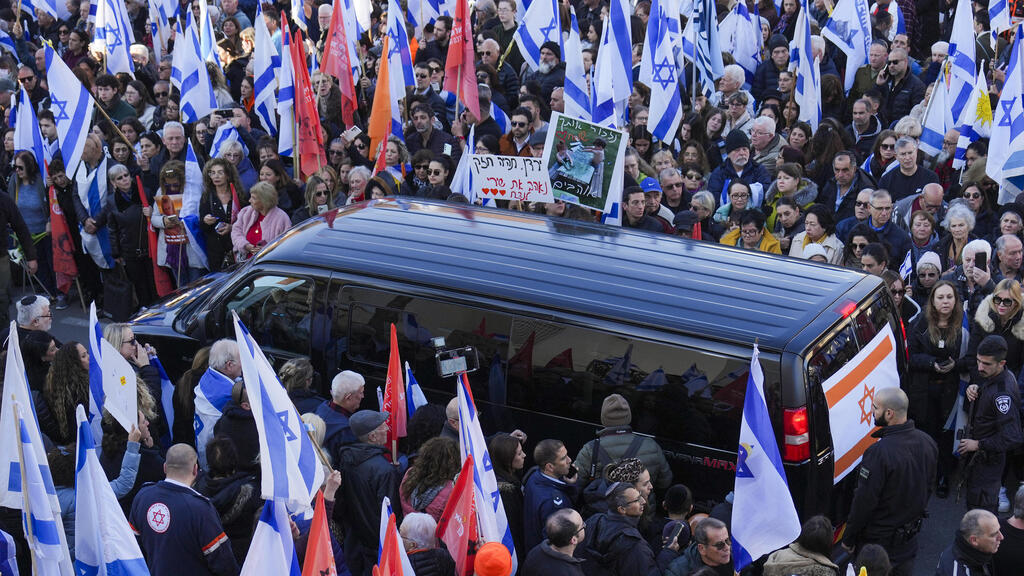
The funeral of the Bibas family
(Photo: AP/Ariel Schalit)
“The first day, Shiri and the children weren’t on it. We said, ‘Kfir is a baby, surely they’ll return him first.’ Then day two, three, four… Every day you wake up with hope and fall asleep in disappointment. I can’t describe what it’s like to wait for that list every day.”
In real time, he opposed partial deals. “I knew that between deals, months — if not years — would pass.”
From the start, rumors spread about Shiri and the children’s condition. Did he believe they were alive? “Until the last moment, I believed they were alive,” his voice breaks. “I told the family — I feel Shiri, I feel her. And when the terrible news came… I called everyone to apologize. I said, ‘I failed.’ Especially to Dana. I told her: ‘Sorry, I thought I could bring them back to you.’ She was angry with me and told me never to dare blame myself again.”
Among the soldiers who fought in the Strip, Shiri and the children were considered the “holy grail.” “You don’t understand how many phone calls I got from soldiers,” he says. “Everyone who entered Gaza sent messages — ‘We’re looking for them,’ ‘We’ll bring them back.’ Returning the hostages was the most important mission, and still is.”

The gravestone of the Bibas family
(Photo: Meir Even Haim)
The joint funeral for Shiri and the children became a moment of national mourning. Thousands came to accompany the procession from Rishon Lezion to the Tzuhar cemetery in the Eshkol Regional Council. “It took five hours to get there. Thousands stood along the roads with Israeli and orange flags. Soldiers and police saluted. It was overwhelming.”
Itai, despite his condition, also came with his parents, who haven’t left his side since the injury. “Like a ninja, he arrived,” Yossi says with a sad smile. “I don’t know how he managed, with the pain and difficulty walking — but he was there.”
Itai: “What did you think, that I wouldn’t come? Of course, I came. It was important to pay them final respects.”
It wasn’t easy. The trip was long, the experience deeply painful. Itai: “It was sad, but there was no chance I wouldn’t be there.”
Yossi: “The part that broke me was realizing they were burying all three together, in one grave. I didn’t even know that was possible. It destroyed me.”
A room of light in the darkness
In the playroom dedicated to their memory, every detail tells Ariel and Kfir’s story. Landscapes of Nir Oz are painted on the walls — the small houses with red roofs, the green fields. Colorful butterflies that Ariel loved so much. Orange flowers — the color tied forever to the redheaded brothers. Even the pink elephant doll that Kfir hugged at night is painted on the wall.
The Schneider Center staff, together with the “Toys for Hospitalized Children” association, made sure the room would be filled with natural light and hope — just like Ariel and Kfir brought into the lives of everyone who knew them.
“The playroom in memory of Shiri, Ariel, and Kfir is much more than a play space — it’s a symbol of memory and pain but also of hope,” said Schneider Center director Dr. Efrat Baron-Harlev at the ceremony.
“Our rehabilitation department received most of the children who were released from captivity in Gaza, and it remains empty, waiting for more to return. For weeks, we hoped and prayed to receive Kfir and Ariel for treatment — the last two children left behind, together with their mother, er Shiri. When the news of their murder arrived, we felt deep pain that we couldn’t help or comfort them.
“Their commemoration here, in the heart of the hospital, is our mission. If we couldn’t treat them in life, we can at least bear their memory and turn it into a source of light and healing for other children. Recovery isn’t just about treating disease — it’s about restoring healthy life through art, musicplay ay and more. This room expresses that belief in full force. We thank ‘Toys for Hospitalized Children’ and everyone who took part in this moving project.”
In the hall, among dozens of people who came to pay respects, Itai stands on crutches, his parents beside him. “This is the hardest war I’ve known,” he says, “and that’s after I fought in Gaza.”
He’s still not completely independent, but insists on doing what he can himself. Crowded places are hard — the head injury makes all the noise confusing. “It’s also physically hard to stand for long,” he says almost apologetically. “But it’s important for me to come, to honor and be part of the family.”
“In a recent TV interview,” Yossi says, “I said we need to remember what unites us and forget a little about what divides us. I don’t know if Itai is right-wing or left-wing — it doesn’t matter. The soldiers gave their body and soul for the hostages, these people, for the state. For all of us.”
“People go through things,” Yossi reflects. “We complain about work, about family, about money — but since O,ct. 7 Everything seems so small and unimportant. Itai’s father told me, ‘My leg hurts and I want to complain, but how can I? Look at what my son is going through.’ It puts everything into perspective.”
Itai: “I don’t agree. Everyone is allowed to complain. You don’t need to compare troubles.”
When Yossi and I call him a hero, he cuts us off. “Don’t call me a hero, because I’m not one. We had a mission and we carried it out. Nothing more.”
“After everything we’ve been through,” Yossi says, “to meet people like Itai and see this beautiful room — maybe it will be good here after all.”
Outside, the August sun is setting. In Nir Oz, the houses are still charred. In Hamas captivity, 50 hostages are still held — living and dead.
Ariel Bibas didn’t celebrate his sixth birthday. Nor his fifth. But his memory, and that of his mother Shiri and little brother Kfir, will live on in the laughter of sick children playing in the new playroom — children who, for a moment, will feel the world can also be a good place.
The project to establish the playrooms at Schneider Medical Center was made possible thanks to the “Toys for Hospitalized Children” association under the management of Rabbi JJ and the generosity of donors Michelle Domb and Sruli Anatian, with the support of Morris Schneider — Shiri Bibas’ uncle and the family’s representative to the association in the United States.