

At midday on Saturday, Feb. 28, 2026, Lt. Col. R. and his wife were supposed to host another couple. At 8 a.m., they took their toddler daughter to R.’s parents, who live nearby, then returned home to prepare for their guests.
“Just as I put a cake in the oven, we received an advance alert that a campaign against Iran was about to begin,” R. says, describing the opening shot of Operation Roaring Lion. As commander of the INS Dolphin submarine, he knew exactly what he had to do.
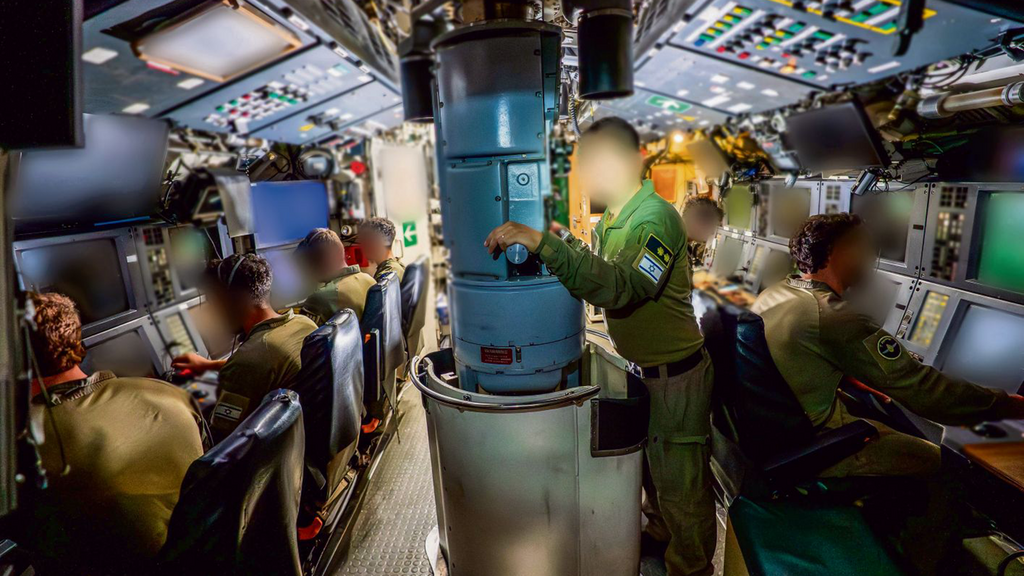
“I dropped my wife off at my parents’ house, went back home, put on my uniform, grabbed a bag and drove to the base.”
A few hours later, he was already at sea. The Israeli Navy’s five submarines, including his, emerged from their concrete-covered pens at the Haifa naval base and began making their way toward the combat zones.
“He still managed to call before he entered the submarine, but it wasn’t a long conversation,” says his wife, S. “I told him, ‘Take care of yourselves,’ and that was it. I had no idea when he would be back. The next time I heard from him was a few weeks later, when they returned to shore for a 24-hour break. Then they went back to sea for another few weeks.”
Throughout that time, R. and the dozens of sailors aboard his submarine were cut off from the outside world.
“When we’re underwater — and during Roaring Lion we were underwater most of the time — we have no contact with headquarters, and no one but us knows the submarine’s exact location,” he explains. “In the Navy command bunker, they know the general area where I am based on the mission I was assigned, but they can’t track my activity.
“If we need to send a report and it isn’t truly urgent, we move away from the enemy coast and from other vessels and do it as quickly as possible. From time to time, we make contact to say everything is all right, but we do so sparingly.”
S., 33, an economist at Teva Pharmaceutical Industries, admits the isolation is extremely difficult.
“He writes to me, ‘I’m turning off my phone,’ and I know the next time I speak to him could be weeks later,” she says. “I don’t think there is any other job in the military like this. You can’t send a message, you can’t call, there’s no FaceTime, no telling your daughter good night. It’s a total disconnect. That is the hardest part of the job.”
Were there moments during the war when you thought, “I have to speak to him or write to him right now”?
“One evening, an Iranian missile landed not far from our community. It was a boom unlike anything I had ever heard, and the next day was very difficult for me. For our daughter too. And there was no one to talk to.
“I could have asked the submarine flotilla’s operations officer to update R. the next time he contacted headquarters, but you know he’s out at sea, you have no idea where he is or what he is doing, and you don’t want to tell him you’re struggling. You want him to focus on his mission.”
R., when did you learn that the missile had landed?
“Only after we returned to base.”
× × ×
He took command of the INS Dolphin about a month before Operation Roaring Lion. The ceremony at which he was promoted to lieutenant colonel was held at the Clandestine Immigration and Naval Museum in Haifa, beneath the bridge of the INS Dakar submarine.
That was no coincidence. It was a personal request by R., the grandson of one of the 69 crew members who died in the disaster.
On Jan. 25, 1968, while sailing from England to Haifa ahead of its entry into Israeli Navy service, the Dakar vanished beneath the waves. For 31 years, no one knew what had happened to it. On May 28, 1999, after years of searches in the eastern Mediterranean, its wreckage was discovered about 485 kilometers, or 301 miles, off Israel’s coast.
Lt. Col. R. was 7 years old at the time. He grew up with the story of the lost submarine and of the grandfather he never knew. His grandfather’s name cannot be published for information-security reasons because it could expose the identity of his grandson, who holds one of the most highly classified positions in the Israel Defense Forces.
“The story of the Dakar was always present in our home, especially after the submarine was found,” he says. “There are two events I remember from the time I was very young.
“One is the state memorial ceremony held every year at the military cemetery on Mount Herzl. The Dakar crew members are officially classified as fallen soldiers whose burial place is unknown. There is a beautiful and chilling memorial there, and when you enter it, it really feels like a submarine.
“The second is the memorial flotilla for the Dakar, held in Haifa Bay every year on the first Friday after the date the submarine was found, meaning in late May or early June.”
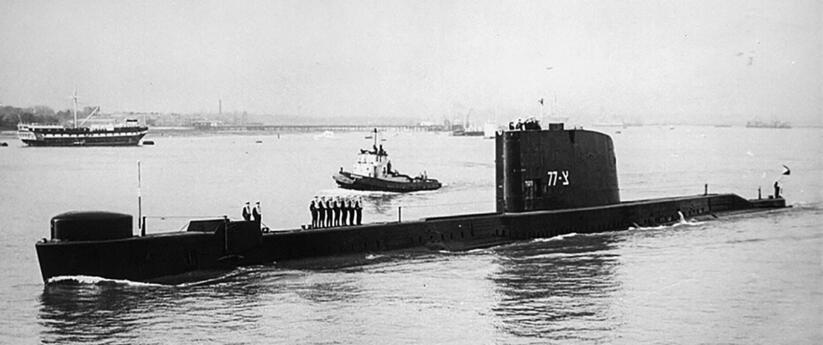
The INS Dakar submarine; 'The story of the Dakar was always present in our home, especially after the submarine was found'
About three years ago, photographer Gadi Kabalo and this reporter joined the INS Rahav submarine as it took part in the flotilla. During the ceremony, 69 wreaths were cast into the sea.
“At the most recent ceremony, when I was already commander of the INS Dolphin, I insisted that our submarine do it,” R. says.
What were you told about your grandfather?
“My father was a young child when the disaster happened, and my grandmother died when I was 11, so I didn’t really get to know him through their stories. It was actually my maternal grandmother who told me a great deal about him.
“There are also five men who served with him on the Dakar but were taken off the submarine before it left Portsmouth or along the way, in Gibraltar, which saved their lives. They also told me about my grandfather — what kind of person, fighter and friend he was.”
A photograph of his grandfather in an Israeli Navy uniform hangs on the wall of Lt. Col. R.’s office in the submarine flotilla’s new building. On a bookshelf are several books about the Dakar and a wooden plaque bearing a model of the submarine and a piece of metal inscribed with the words, “A bridge in their memory.”
“That is a piece of the Dakar,” he explains. “When they raised the submarine’s bridge from the water — it is now in the museum — they cut 69 pieces from it, one for each family.”
As fate would have it, his daughter was born on the anniversary of the Dakar’s discovery.
“She was born at 11:30 p.m.,” S. says. “Only afterward did I learn that it was the date the submarine had been found. Had I known, maybe I would have held out for another half-hour.”
Ahead of his taking command in February, the Israeli Navy’s Facebook page published a post announcing that the grandson of one of the Dakar victims was about to be appointed commander of a submarine.
The interview with him was scheduled for March 1. The day before, Operation Roaring Lion began.
“When I went to sea on Saturday morning, I turned off my phone and left it at the base,” R. says. “When I returned a few weeks later for a break and opened WhatsApp, there were hundreds of messages. One of the first was from the Navy spokesperson: ‘For the avoidance of doubt, the interview with Yedioth Ahronoth has been postponed.’”
Like most Israelis, he was surprised when he heard the alert on Feb. 28. His wife was not.
“A year earlier, I had already said that the moment he took command of a submarine, a war with Iran would break out within a month or two,” S. says. “I had a feeling. He took command on Feb. 1, and exactly one month later, the operation began.
“During the first siren, before he left the house, he said, ‘I can’t believe it. This is exactly what you said.’ I was mentally prepared because I knew it would come. Even so, it was very, very hard to sleep alone with a 2-year-old in the safe room while missiles were falling, with no one to talk to, while his phone was off and he was at sea.”
In the interview, which ultimately took place about two weeks ago, R. revealed a glimpse of what his submarine and the submarine flotilla as a whole did during Operation Roaring Lion. What he did not disclose can only be imagined.
“It was a very intense period,” he says. “There was a great deal of uncertainty and missions changed at sea based on ongoing situation assessments.
“We have seven operational theaters, and in every theater that includes a maritime arena, submarines can operate — whether on attack missions, defensive missions or intelligence-gathering missions. That applies to nearby theaters and distant ones, at every range you can imagine, from the most tactical activities, such as visually observing what is happening on an enemy shore, all the way to strategic deterrence.
“It is a large platform that can be anywhere, and the enemy never knows where it is. Suppose, hypothetically, that we want to sit off a target on the coast and gather intelligence to enable some kind of covert operation.
“You can send an unmanned aerial vehicle over the target once every few hours, but that is not good enough and it could be detected. A submarine can operate covertly and remain opposite the coast for 24 hours or more.
“That way, you can see when their guard changes, what observation posts they have, whether they are lit, what equipment they are operating and where they are operating it. You can identify a vehicle arriving at a house, a motorcycle, even a single person.
“Now, what is unique about a submarine? Suppose a covert operation is being planned on a certain beach, and suddenly, at the moment of truth, it turns out there are people sitting around a campfire cooking food in a pot. That can derail the operation. You now have to cancel or postpone it.
“When you’re in a submarine, everything is fine. We’re there, we’re not in a hurry to go anywhere and no one can see us. That is an extraordinary advantage a submarine has that no other platform does.”
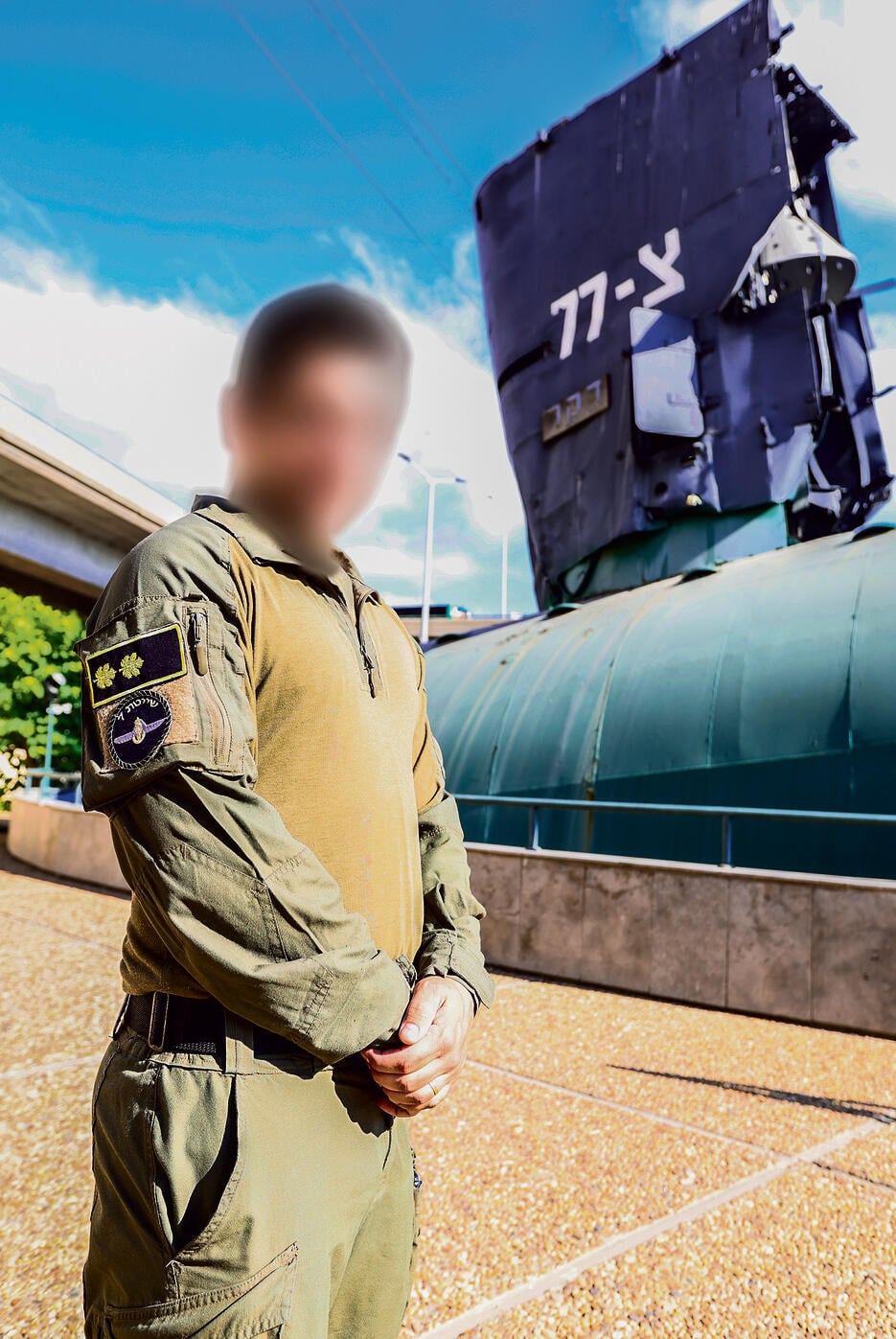
Lt. Col. R. beside the Dakar’s bridge
Do you have intelligence personnel aboard the submarine?
“When necessary, personnel from Israeli Navy intelligence join us. They are not part of the submarine’s permanent crew but are specialists attached for a specific mission.”
There has been a great deal of talk about the Strait of Hormuz. Have you passed through it in the submarine?
“As I said, wherever there is a sea, a submarine can operate.”
You mentioned that the submarine has offensive capabilities. What weapons are involved?
“I have a torpedo system.”
What about other systems that foreign reports say are aboard the submarine?
“As I said, I have torpedoes.”
Have you fired a torpedo at an enemy vessel during the war?
“I can’t discuss that.”
“Have you encountered Iranian submarines?” Kabalo, the photographer, asks. “Do they even have submarines?”
“They have relatively outdated submarines,” R. says. “In general, I can’t refer to a specific navy we encountered. I can only say that we have encountered submarines in every theater where we operated, and we usually break contact.
“The most important thing is to prevent a collision because both submarines are extremely quiet. It is like driving through a completely dark parking lot and suddenly discovering another car traveling without headlights 2 meters away from you.”
Have there been cases in which another vessel detected you?
“When I am at depth, no one can detect me.”
How deep can you go?
“I can’t give a specific depth.”
Hundreds of meters?
“Yes.”
The Israeli Air Force operates in Iran and other theaters in coordination with the U.S. Air Force. Is the same true for submarines?
“Neither we nor they are eager to share information about our submarines’ activities.”
Today, we are hearing many threats from Turkey, and we know it has advanced submarines. Is that something that concerns you?
“That is not something I can discuss. I can say the following: The Mediterranean Sea, Red Sea and Arabian Sea have all become focal points of geopolitical interest in recent years, which is why everyone wants to send their submarines there.”
Do you also find yourself serving as a “taxi driver” for commando units such as Shayetet 13, the Israeli Navy’s elite commando force?
R. appears offended. “I wouldn’t call it being a taxi driver. We work with many units and organizations across the military and the broader defense establishment, both within the Navy and outside it. That includes transporting forces to a target.
“Where secrecy is a factor and you do not want anyone to know you are operating there, that is where our relative advantage lies. This is not a division maneuvering in Lebanon or Gaza. It is a surgical operation involving three people who go in, do something for an hour and get out.”
Does that capability, transporting special forces, also exist in the so-called third circle, meaning more distant countries such as Iran and Yemen?
“It exists in every theater.”
× × ×
As commander, he keeps three fundamental principles in mind: the safety of the submarine, secrecy and completion of the mission.
“You could sum it up in one sentence: ‘Mission first, safety always,’” he says. “That is why commanding a submarine is one of the greatest positions of trust in the military. They take a kid, in quotation marks — compared with other navies around the world, I am very young for a commander, only 34, and my sailors are also very young compared with their counterparts — and give you the most expensive platform we have.” A submarine of this kind is estimated to cost about half a billion euros.
“You go to sea with a particular operational order and a set of guiding principles. If you reach the area and see that the situation or intelligence picture has changed, you have to make decisions independently.”
For example?
“During the war, I found myself in many situations in which I had to make decisions, particularly along the spectrum of secrecy. We have a very broad framework for how to operate the submarine — how much noise you can emit, what communications you use and when you raise a mast or periscope.
“Suppose we are on a coastal intelligence-gathering mission intended to build an intelligence picture for another IDF force. You arrive with a certain secrecy policy and are told: Report once during the night on what you have seen.
“Then, during the operation, you realize you have seen something unusual. You tell yourself: If I wait until night and do not report what I saw in real time, or do not send headquarters the image I took through the periscope, it may no longer be relevant and I will have failed the mission.
“On the other hand, I have to preserve secrecy because when I raise a mast to report, I expose myself. That is where I, as commander, have to make a decision, and it requires a great deal of creativity. There is one area in which there are no compromises or dilemmas, and that is the safety of the submarine and its crew.”
Even if that means not completing the mission?
“The situation would have to be extremely severe for that to happen. I’ll explain why: Every system on the submarine is duplicated or even triplicated. Each one has a backup in case of a malfunction.
“There are two battery rooms, so if one fails, the other can supply electricity. Every valve has an alternative valve and so on. It begins with the safety systems and continues with the others: two periscopes, two rudders, two cameras and so forth.
“There is nothing singular on the submarine — except the commander. We have a system that acts like an escape mechanism, bringing the submarine to the surface in an emergency, and it is not dependent on electricity. It operates in the simplest possible way.
“But for you to reach the point at which you use it, something extremely serious has to happen. It is one of the most difficult decisions a submarine commander can make. The submarine’s operating procedures allow us considerable freedom in completing the mission, while also doing a great deal to protect our safety.”
That does little to reassure his wife, S.
“There is a great deal of anxiety,” she says. “He may not be entering Lebanon or Gaza, but I don’t know where he is and I can’t call and ask, ‘Where are you now?’ Even when he comes back, he can’t tell me where they were.”
You can only imagine.
“I can only imagine, and that frightens me even more. I like to imagine that he is in the Sea of Galilee.”
Because of the submarine’s unique nature, every deployment requires the approval of either the Navy commander or the head of naval operations, an officer with the rank of brigadier general.
“Of course, the commander of the 7th Flotilla, the submarine flotilla, who is himself a former submarine commander, is involved in every decision and is also the highest-ranking professional authority in the field,” R. stresses.
Contact with submarines at sea is managed by the submarine control center in the Navy’s underground command center at military headquarters in Tel Aviv. Because, as noted, there is no contact with a submarine most of the time, ordering it to change missions presents a challenge of its own. But during the war, it happens frequently.
“First, I have a bank of missions,” R. explains. “They tell me, ‘Go to Mission A,’ and I know where it is and what the objective is. If they want to give me an immediate change of mission, they have a way to transmit a communication that I can only receive.
“This tension between completing the mission and preserving the submarine’s secrecy is also reflected in command and control. Today, from the command center in Tel Aviv, you can see what the pilot sees, what the UAV sees and even what the tank commander or infantry soldier sees. Everything is connected to headquarters.
“With a submarine, it is different. I can transmit to headquarters what I see through the periscope, but again, to do that I have to expose myself.”
Is it only a periscope, or can you launch a drone or something similar from the submarine?
“There is a wide range of detection systems, some of them inside the submarine and some that also go outside,” R. says, noticing the alert expression on the information-security officer sitting with us during the interview. “I didn’t say which systems, I didn’t say what their range is and I didn’t say how we communicate with them.”
× × ×
He enlisted in the IDF in 2010 and, despite his family legacy, never dreamed of serving aboard submarines.
“They sent me for Air Force pilot-course screening, but I wasn’t accepted. Their loss,” he says. “I took part in the selection process for Shayetet 13, completed it but didn’t pass. Then I was accepted into the naval officers course.
“At that point, it was already clear to me that I wanted to serve on submarines, but not because of my grandfather. It was for professional and operational reasons. Ultimately, it is the most classified and operational activity, at the greatest distances, with the highest-quality personnel and the most significant command complexity.”
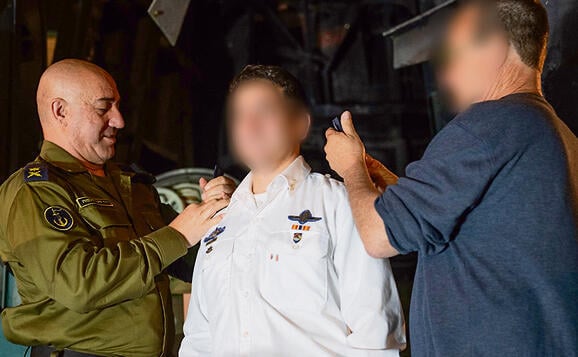
At his promotion ceremony
At what stage of the course are you assigned to submarines?
“Today it happens relatively early. Six months after beginning the naval officers course, you already know whether you will serve on submarines, corvettes — the large Sa’ar 6 ships — or a smaller missile boat or Dvora patrol vessel. In my time, it happened close to the final stage of the course.”
Alongside the division by type of vessel, the course is divided into three tracks: navigation, engineering and electronics.
R. completed the course, which at the time lasted two years and four months, in the navigation track. His first posting was as a deputy department commander aboard the INS Dolphin, the submarine he now commands.
“In fact, I held all my sea postings on the same submarine: deputy commander of the detection, navigation and communications department, deputy weapons department commander, weapons officer, deputy commander of the INS Dolphin and now submarine commander.”
In between, he also held two staff positions ashore: operations officer of the submarine flotilla and another position in the Navy’s operations division dealing with what he calls “third-circle theaters,” meaning more distant countries such as Iran and Yemen.
Despite his experience, he was required to undergo a full year of specialized training before taking command of the submarine, in addition to completing the IDF’s interservice command and staff course.
“There are things aboard a submarine that only the commander does, and there is considerable latitude for decision-making under conditions of uncertainty,” he explains. “You have to understand what the commanding level needs from you and how to translate that into actions at sea when you cannot ask or consult with them in real time.
“That is why such deep and lengthy training is required before you receive command of a submarine.”
Describe the challenges you face as a submarine commander.
“The first challenge is operational. Sending a submarine to sea is easy, in quotation marks. The challenge is identifying the changes that have taken place in the theater. You arrive in an area where you have operated many times and need to understand what is different and how it affects your mission.
“The second challenge is weaponry and technology. We are constantly receiving new systems — both systems that fire and systems that gather intelligence — and we need to know how to employ them in the best, most effective and most covert way.
“The third challenge, though not the third in importance, is command. Casting off and going to sea in a war like this, while missiles are falling near your home, is very complicated for someone with a family.
“It requires a great deal of honesty with the sailors. It is all right to tell them, ‘I don’t know what is happening ashore, but from the mission we received, I understand one, two and three.’ Both they and I live with uncertainty. It is an inseparable part of submarine service.”
Even to the point that a missile could hit a sailor’s home and he would not know?
“On another submarine, there was a sailor whose brother was killed in combat. Headquarters found a way to notify the submarine commander, and he was the one who broke the news to the sailor.
“They then launched a very complicated operation to extract him in time for his brother’s funeral and bring in a replacement. It was Friday evening, and the submarine was very far from Israel’s shores. A missile boat was sent out to sea with a helicopter aboard, and that was how the exchange was carried out.
“I had a case involving a sailor whose relative died unexpectedly. It happened during a training voyage when we were relatively close to port, so getting him off the submarine was comparatively simple. Even so, it is a difficult situation — how to break the news to that sailor.”
Have you also had evacuation operations involving medical emergencies?
“It depends on the theater you are in, your distance from shore and your ability to surface. There is a doctor aboard the submarine who can stabilize a patient for hours with oxygen and relatively advanced medical equipment, and can even perform emergency surgery.”
Including an operating room?
“Calling it an operating room would be an insult to operating rooms.”
The extreme isolation also gives rise to amusing situations that are part of submarine culture.
“A sailor can decide to start some rumor, and no one can disprove it because there is no internet or ChatGPT,” R. jokes. “It can circulate for two or three weeks until we return to shore.
“Take the radio operator, for example. He is the only sailor aboard the submarine who receives communications before they reach me. That requires a very significant relationship of trust.
“He may receive messages that are extremely sensitive from an operational standpoint, but sometimes he takes advantage of that position to joke with the others. For example, he might announce that England beat Argentina in the World Cup semifinal — and only when they return to shore do they discover that Argentina won.”
× × ×
The submarine dock at the Haifa naval base, known as “Polynum” and named after submarine flotilla founder Yosef Dror, is one of the most sensitive and highly classified sites in the IDF.
Phones, cameras and even car keys with remote-control fobs are prohibited aboard the submarine. The photographs for this article were taken by Kabalo with a camera brought by a Navy spokesperson’s representative. The images were given to him only after a thorough review by information-security personnel, who blurred every sensitive detail.
When we descended into the INS Dolphin, it was being prepared for a four-day training voyage. But even a short training deployment can turn in an instant into a two- or three-week operational mission. That is part of the uncertainty in which the crew constantly lives.
The sailors, dressed in tactical uniforms, loaded crates of vegetables, fruit and frozen meat onto the submarine ahead of its departure.
Much has already been written about the cramped conditions and sense of confinement aboard a submarine. Even the commander’s cabin, which also serves as his office, is a cubbyhole that cannot hold more than two people standing.
On the wall is a safe containing highly classified operational orders, alongside photographs of R.’s wife and daughter.
S. visited the submarine once, and that was enough for her.
“He tried to show off for me after we had been dating for six months,” she recalls. “I told him, ‘This isn’t for me. I’m claustrophobic.’”
His long periods at sea come at a cost to him as a father.
“I have missed important moments in my daughter’s development,” he says. “For example, when she started crawling. Sometimes you come home and don’t know whether she will run to you happily or be angry with you. When I’m home, I try to make the best possible use of the time, both with my wife and my daughter.”
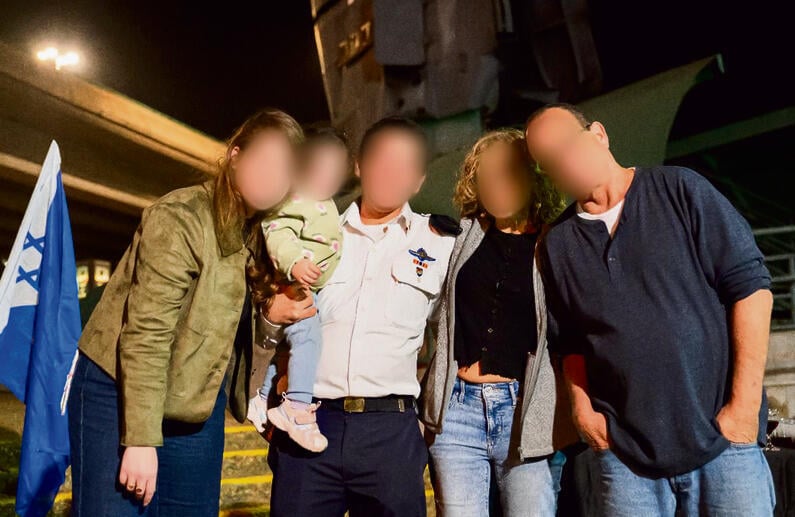
R. with members of his family
“He is the best father in the world and tries to make up for every moment he isn’t with her,” S. says. “He was just at sea for a week and barely slept. When he came home, I told him, ‘Go rest, take a nap.’ But he wasn’t willing to miss a moment with her.
“They play, roughhouse, cook together and act silly. She is completely a daddy’s girl.”
“Every day that she allows me to do what I do is something I never take for granted,” R. says.
Israel’s sixth submarine, the INS Drakon, is expected to arrive soon from Germany. In several years, the Navy will begin receiving the next generation of Dakar-class submarines, named after the lost submarine.
The first of them will replace Lt. Col. R.’s submarine, which entered service in March 1999 — two months before the Dakar was found.
The INS Dolphin will then be retired, but the legacy left by R.’s grandfather and his fellow crew members will continue to accompany the submarine flotilla. The wound left by one of the worst disasters in IDF history will never fully heal.