

Under the entry “Comparisons between Israel and Nazi Germany,” I read in the English edition of Wikipedia that these are comparisons that “occur frequently” and “have been made by academics, politicians and public figures, both Jewish and not, since before the establishment of Israel." How is that possible, I wonder. Israel, incidentally, is the only country to receive such a comparison.
Under the entry “Zionism,” I read that it is an “ethno-cultural nationalist movement that emerged to establish and support a Jewish homeland through colonization in the region of Palestine,” and that antisemitism is used as an “Israeli weapon” against criticism.
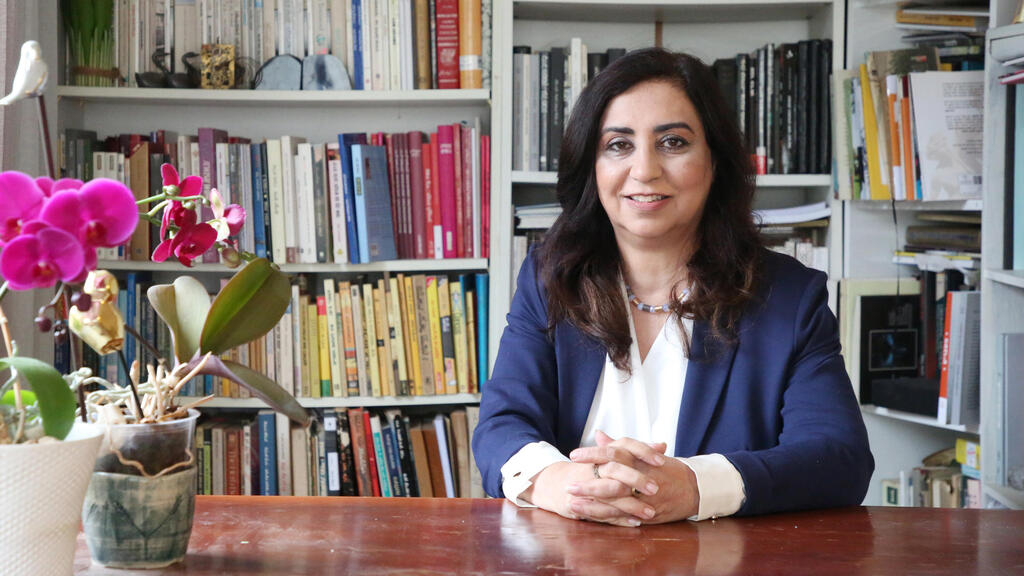
While Zionism is colonialism, Hamas is merely a “political organization with a military wing” that carried out several “attacks” on October 7. Every mention of a massacre was changed. The entry “Destruction of Israel in Iranian policy” was deleted, as was the entry “Nazism in Palestinian society,” which was removed from English Wikipedia on Oct. 24, 2023.
By contrast, it is not hard to find extensive and detailed entries for “Jewish terrorism,” “Israeli terrorism,” “apartheid,” “settler terrorism” and the like. I searched for Palestinian terrorism, and the closest I found was “Palestinian political violence,” centered mainly on “insurgency.” From there, the rabbit hole only grew deeper, while familiar reality became increasingly blurred, to the point that when searching for “Palestinian people in the period before the British Mandate,” one can find, among others, Jesus and Mary, and even Rabbi Yohanan, one of the greatest amoraim (Jewish scholars in the Land of Israel and Babylonia who interpreted the Mishnah) — which is somewhat amusing, because the famously handsome Rabbi Yohanan was known for the great importance he attributed to the commandments connected to living in the Land of Israel. Apart from that, nothing here is funny.
English Wikipedia is the largest and most-read encyclopedia in the world, and in history. With more than 7 million entries and about 7 billion visitors each month — out of roughly 67 million entries in 361 languages and about 15 billion visitors overall — it is consistently among the top 10 websites on the internet.
Whoever wants to sabotage human knowledge will sabotage Wikipedia
Wikipedia, founded 25 years ago, is one of the greatest collaborative human enterprises in history. A shared, almost romantic effort by millions of people who have contributed, and continue to contribute, their time and wisdom to spreading knowledge for the common good, turning Wikipedia — whether we like it or not — into the global source of knowledge, the well from which most human knowledge is drawn and shaped today, including, of course, attitudes toward Israel. It is also a source for the future: It is one of the main databases on which artificial intelligence engines are built and trained. Whoever wants to sabotage human knowledge will sabotage Wikipedia.
So this is the well — and the well is poisoned. Unlike fake news, whose influence is felt but limited to one cup of poison at a time and can be refuted relatively easily, Wikipedia’s lies, distortions and biases are far more dangerous and harmful because they arrive in the guise of authority and objectivity, presented as neutral encyclopedic knowledge free of interest or ideological affiliation.
And if it looks like an encyclopedia and quacks like an encyclopedia, people think, then it is probably an encyclopedia. One does not even have to work particularly hard: In a world where a person spends on average no more than 25 seconds reading a Wikipedia entry — a terrible statistic in itself — changing the first paragraph of an entry is enough to control the narrative of knowledge.
Suspicions of foreign funding
“It’s called knowledge poisoning,” says Dr. Shlomit Aharoni Lir, a research fellow and lecturer in the interdisciplinary master’s program in culture and film at the University of Haifa and a researcher in the “Consciousness and Foreign Influence” project at the Institute for National Security Studies, who has delved deep into the depths of anti-Israel bias on Wikipedia and returned with fairly chilling reports that demonstrate the depth of the bias and the scale of its influence.
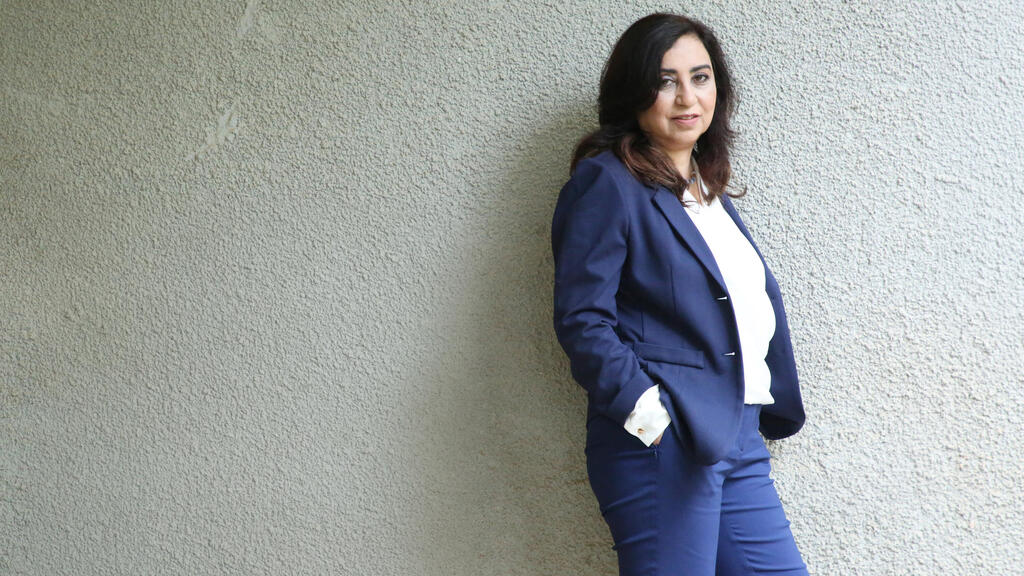
Wikipedia is a Trojan horse, says Dr. Shlomit Aharoni Lir
(Photo: Ryan Preuss)
“This is a Trojan horse that injects poison under the guise of neutral knowledge,” Aharoni Lir emphasizes. “We live in a period in which, alongside the physical war, an information war is also being waged in various arenas, and basic assumptions have been inserted into our consciousness that steer conclusions in a certain direction.
“Knowledge poisoning is the ability to influence how we perceive and understand reality, and our ability to think freely. It influences not only what we think, but how we think. And when search engines and language models rely on Wikipedia, its influence extends far beyond the site itself. This is not only a localized distortion, but contamination of the entire global knowledge base.”
The strange thing about the whole story is how easy it was to take over this enormous repository of knowledge and skew it. All that was needed to distort and contaminate Wikipedia — a project that, at its core, relies on the good and fair side of human beings — was a small, determined, coordinated and extremely industrious group of several dozen editors hostile to Israel. “Veteran and educated users, some with degrees from prestigious universities,” Aharoni Lir says.
For years, they sat eight to 10 hours a day — apparently for pay, she says cautiously, noting that “the suspicion is growing that this is not spontaneous activity but involvement by external actors” — and carried out about 1 million edits in some 10,000 entries, tilting them in favor of the Palestinians, Iran, Hamas and Hezbollah, and against Israel and the historical connection between the Jewish people and the land, reshaping for the worse the way Israel is presented on the platform.
In her research, Aharoni Lir explains that, thanks to a very good understanding of Wikipedia’s internal mechanism, with its many rules and regulations, the group Tech for Palestine took over the processes for voting on and approving entries, and did almost as it pleased with them, including passing a rule within Wikipedia that gave it a monopoly over editing sensitive entries. Thus, for example, it is impossible to change the sentence stating that Zionism is colonialism. The group, Aharoni Lir says, “is also connected to changing the list of sources that may be relied upon on Wikipedia: disqualifying information sources such as the Anti-Defamation League, the New York Post and Fox News, and preferring Al Jazeera as a source.”
Wikipedia’s lies, distortions and biases are far more dangerous and harmful because they arrive in the guise of authority and objectivity, presented as neutral encyclopedic knowledge free of interest or ideological affiliation
According to her, the group operates on several levels: “Undermining the connection of the Jewish people to Israel - They create an alternative history by using and distorting the term Palestine, from the name of a place into a term of identity. In addition, they literally invent a ‘Palestinian-Hellenistic’ history that never existed, going through entries in which, for example, ancient coins appear, and changing them from Hebrew to Canaanite, and more. Through this, they achieve an undermining of Israel’s right to exist.
“We can laugh about the matter of ‘Jesus as a Palestinian,’ but what is happening here is an undermining of the perception of history and reality. And once history is disrupted, it also disrupts the present and harms the future. The third dimension in which the group operates is the ‘cleansing’ of terrorist organizations. Thus, in the entry on the Al-Mujahideen Brigades, it is claimed that members of the Bibas family were killed by IDF bombings. The truth, of course, is that the family members were brutally murdered by the terrorists.”
What do we know about this group?
“We do not know who they really are, which is very problematic. This is a platform that encourages and enables anonymous activity, and most Wikipedia editors do not use their real names, so there is no way to know the true identity of those involved. Even the IP addresses of all Wikipedia editors remain confidential and are fiercely protected by the global Wikimedia Foundation.
“One can only see what is written on their talk pages and learn from them what they believe, how much they work and how they edit. Based on the characterization of the activists in the group, the nature of the editing and conduct and the information on user pages, it can be assumed that these are educated people with advanced degrees and broad interdisciplinary knowledge, while at the same time they are radical and dangerous people, on some of whose talk pages one can find texts hinting at support for violent action to destroy Israel.”
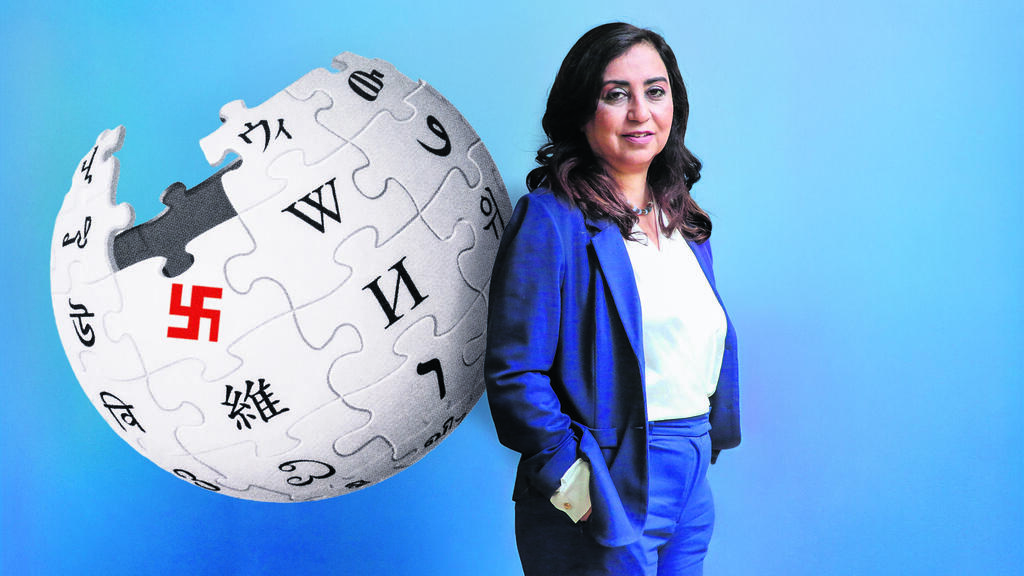
'An undermining of the perception of history and reality'
(Photo: Ryan Preuss)
Although Wikipedia rules prohibit editors from coordinating edits with one another, Lir and other researchers found that the group Tech for Palestine coordinates its actions through the Discord app, which enables communication while preserving anonymity. They uncovered hundreds of exchanges regarding thousands of entries related to Israel, in which strategy was planned, tasks were divided among members of the group and more.
Isn’t it strange that so few people are enough to skew such a huge and impressive enterprise as Wikipedia?
“No. Once a hardworking group with seniority is formed — some of them have been active for more than a decade — one that backs its members, knows the rules, has accumulated status and has become a hegemonic group that clearly appears to act in coordination, even 40 people can be enough. One of the prominent activists in the group, known as Iskandar, is personally responsible for 50,000 edits, including of the entry ‘Zionism.’”
The unbearable ease with which one can whitewash a terrorist organization or diminish the connection between the Jewish people and Israel teaches another dubious lesson about the liberal nature. “Wikipedia’s basic assumption,” says Aharoni Lir, who herself edited Wikipedia for many years, “is that editors act in good faith. These are wonderful ideas from the 1960s. Wikipedia’s vision is one of the most beautiful there is, but in practice, forces took it over that exploited that innocence and turned it into a source of propaganda.”
The dream of an encyclopedia open to all, based on collaboration and goodwill, contained within it the seeds of its own destruction. A sad lesson.
The Protocols of the Elders of Zion
The battle for consciousness was being waged on Wikipedia long before Oct. 7, 2023. Wikipedia has always been an arena of clashes between narratives, national and otherwise, and a good place from which to launch influence operations of various kinds and poison the well of knowledge. Over the years, quite a few affairs have been exposed involving companies such as Sony and Microsoft, and even the Church of Scientology and the CIA, as well as states including Russia and Qatar, and members of the U.S. Congress who paid to alter entries about them.
The Israeli-Palestinian conflict has also been burning on Wikipedia since the beginning. Israeli and Palestinian groups alike have trained editors with the aim of strengthening their national narrative, but one must sadly admit that the other side has been far more successful. This conflict even has an extensive and detailed entry, “English Wikipedia and the Israeli-Palestinian conflict,” which details decades of keyboard warfare over consciousness.
Then came October 7, and it changed everything — including Wikipedia. “Shortly after October 7,” Aharoni Lir says, “I noticed the difficulty of uploading entries to English Wikipedia on the subject, and a recurring pattern of tendentious changes in wording and framing of events, such as entries in which the definition was changed from ‘massacre’ to ‘attack.’ I also noticed extensive activity in all entries related to Israel and the strengthening trend of presenting Israel in a negative light.
“At first, I thought it was random, part of the general anti-Israel atmosphere. But when I began to investigate the issue in depth, follow the talk pages and examine who the editors involved were, the same names came up again and again — until it became clear that this was a group acting in coordination. This sharpened my understanding that this was a deep pattern of the politicization of knowledge," she explains.
Israeli and Palestinian groups alike have trained editors with the aim of strengthening their national narrative, but one must sadly admit that the other side has been far more successful
Aharoni Lir compiled her findings into a report prepared for the World Jewish Congress, published in April 2024 and presented at the United Nations. Her report presented a range of entries that had been rewritten or deleted and proved what she calls “a dramatic acceleration of anti-Israel bias trends on English Wikipedia that existed before as well, but on a more moderate scale. Central entries about Israel, Zionism and the war in Gaza underwent linguistic and narrative reframing, selective use of sources and systematic omissions of terrorism, antisemitism and historical context.
“Zionism has not changed in recent decades, but its entry underwent thousands of edits that fundamentally changed it and placed Israel in an unequivocal position as a colonial aggressor, while intensifying narratives of demonization and delegitimization, alongside the disappearance of terms such as ‘terrorism’ and ‘antisemitism.’”
Aharoni Lir says that, at first, the response to the report from the Wikimedia Foundation, which operates Wikipedia, was “dismissive and contemptuous, but later the atmosphere changed. The penny dropped. They understood there is bias against Israel, and that it is a problem. The report stirred public opinion and accelerated other actors’ engagement with the issue.”
Pressure on Wikimedia grew: From late 2024 to early 2025, English Wikipedia’s Arbitration Committee, considered the site’s “Supreme Court,” suspended nine pro-Palestinian editors, as well as two pro-Israel editors. In March 2025, Aharoni Lir launched an exhibition called “Manipulated History,” in which she presented additional screenshots of entries that had undergone changes and manipulations during the Swords of Iron War.
At that stage, the pressure began to work. On April 24, 2025, the U.S. attorney general sent a letter to the Wikimedia Foundation, claiming that Wikipedia “allows foreign actors to manipulate information and spread propaganda to the American public by ‘rewriting key historical events.’” The foundation was forced to establish a research group to examine the matter.
Four months later, in August, a letter was sent from James Comer and Nancy Mace — chair of the House Oversight and Government Reform Committee and chair of the Subcommittee on Cybersecurity, Information Technology and Government Innovation — to the Wikimedia Foundation, in which the two announced that Congress was investigating Wikimedia because of “multiple studies and reports highlighting efforts to manipulate information on Wikipedia for propaganda.” The letter also raised questions about the involvement of hostile states in inserting anti-Western messages into Wikipedia.
“That is the good news,” Aharoni Lir says. “The less good news is that Wikipedia’s deep structure has not changed: The same relatively small group still holds great power, anonymity still exists, and those who try to fix things from within often run into a fortified wall.”
Nine editors, as noted, were removed from Wikipedia, but there are thousands more like them still active. Most of the entries also remain unchanged. Try fixing a million edits now. Some crack will always remain, and through it hatred can peek out.
“And so,” Aharoni Lir says, “the bias continues and spreads. In that sense, Wikipedia is like the Protocols of the Elders of Zion. Tendentious editing and one-sided framing have become the normal way. The result is a mad deception of consciousness that is taking place according to all the rules and protocols.”
Aharoni Lir gathered the many biases, manipulations, distortions and lies into a website called WikiBiases, which systematically exposes how bias is created on Wikipedia on issues related to Israel, Jews and the conflict. “The project creates a broad evidentiary infrastructure: comparisons between previous and current versions, screenshots of edits, documentation of talk-page discussions and recurring patterns of conduct by editors, and exposes the internal dynamics of the system: how terms undergo semantic change, which sources are defined as ‘reliable’ and how seemingly tiny formulations manage to shift the center of gravity of an entire entry. The result is that the reader is exposed to a one-sided narrative, often without being aware of it.”
‘Soft terrorism’
Knowledge poisoning is not a new idea. Thirty-five years ago, in 1991, the FBI discovered a Muslim Brotherhood explanatory memorandum that laid out the idea of “soft jihad,” or “soft terrorism” — a subtle but effective mechanism for shaping consciousness, one that does not use force but slowly builds a reality in which certain narratives gain the status of self-evident truth, while others are pushed to the margins, lose legitimacy and sometimes are erased entirely.
“Soft terrorism,” Aharoni Lir says, “is not a one-time action but an accumulated, almost imperceptible process that works to instill basic assumptions through repetition and the shaping of public thought, to the point of harming a person’s ability to think independently, exercise critical judgment and extract meaning from the overload of information surrounding them.”
What can be done to avoid losing this war entirely? In her research, Aharoni Lir compares Wikipedia with two relatively new competitors, Elon Musk’s Grokipedia and Justapedia — two online encyclopedias that are also not free of problems and biases, but at least on the Israeli-Palestinian issue they do not take a clear side. True, these are still marginal options, but “with new players Wikipedia’s exclusivity can be undermined. That is important, because our ability to think requires reliance on different sources.”
Above all, Aharoni Lir says, “It is important not to believe, to ask questions, to challenge, to examine additional sources. It is our duty to protect ourselves. The most precious thing in the world is knowledge, which enables our freedom and our thought. Knowledge must be protected in an era of post-truth, in which many things are happening that could harm the ability to think independently.
“Precisely at a time like this, it is important to increase creation and writing, to strengthen Israeli, Hebrew or Jewish identity and to feed the world with knowledge, perceptions, articles and creative thought. This too is a strategy for preserving and protecting ourselves in a world that is trying to undermine our right to exist. We can no longer afford to be naive, but must look at reality as it is: The campaign began long ago, and we are in the midst of a disruption and flattening of knowledge.”
Do you see a future in which we can trust Wikipedia again, or should we accept that the world’s encyclopedia has become a battlefield for consciousness, and that there is no one to believe?
“I do not predict the future. In the present, Wikipedia plays a substantial role in the dumbing down of the masses, in which entire publics take part in a struggle based on shallow perceptions and a lack of understanding of reality. Wikipedia used to be the thing itself, but now it is a symbol of a dystopian reality, of a beautiful vision of democratizing knowledge that has become a source of exclusion, bias and deception.”