

In the early morning hours this past May, Lt. S., 24, commander of a Technology and Maintenance platoon in the Givati Reconnaissance Unit, crossed the Lebanese border. The mission was to repair a disabled Namer armored personnel carrier deep inside the field together with her noncommissioned officer.
“They needed it urgently in order to launch an attack,” she recalls. “On the way, we linked up with one of the fighters who escorted us to the disabled vehicle.”
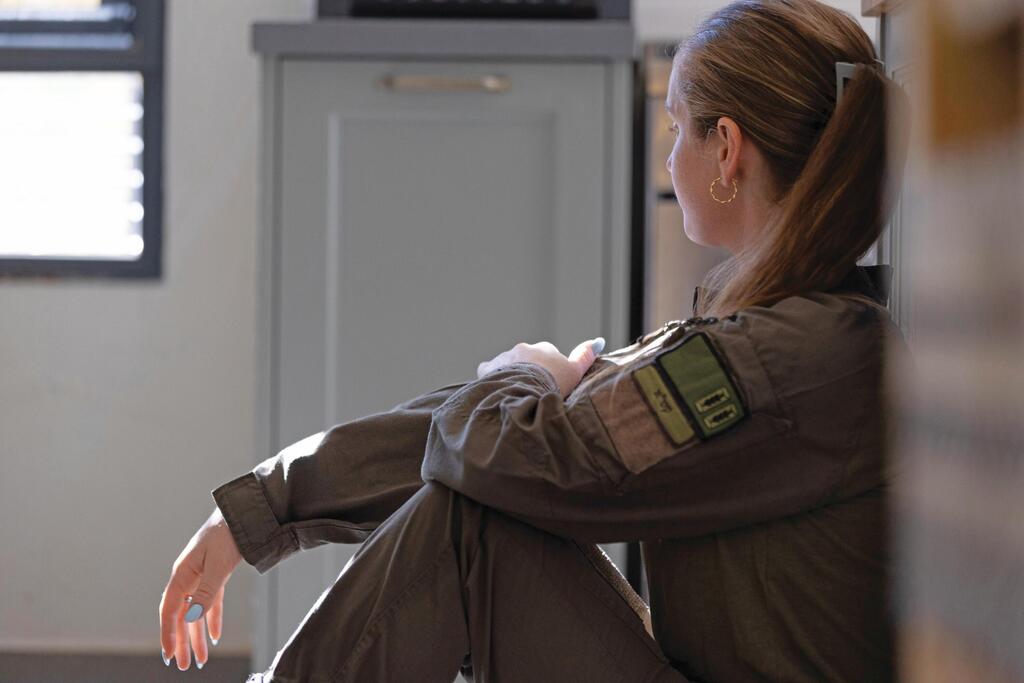
Suddenly, the NCO spotted an explosive drone that had locked onto them and was approaching quickly. “When he was already standing on the Namer’s ramp, he suddenly said to me: ‘That drone is not ours.’ In a second, he came to his senses, pushed me inside the Namer and jumped in after me at the last moment. We had not yet managed to close the ramp from the inside when the drone penetrated the Namer and exploded right next to us. A lot of shrapnel flew at us. I was hit mainly in the face and head, and he was hit mainly in the legs. We shouted to each other to see that we were alive, and then he dragged me out and we ran toward one of the combat companies. They had already heard the explosion and linked up with us. The paramedic gave us initial treatment while my whole face was covered in blood.”
S. was evacuated by helicopter to Ichilov Hospital with blast injuries, damage to her eardrum and many pieces of shrapnel in her face, two of them very close to both her eyes. She was taken immediately into surgery and later underwent another operation, but doctors were unable to remove all the shrapnel. She will have to live with some of it for the rest of her life without knowing what the consequences may be. A plastic surgeon also took part in the operation to prevent facial scarring as much as possible.
“The way I looked was frightening, but in the end I am glad I took the shrapnel where I did and not in more strategic places, because I could have lost one eye, maybe both,” she says. “There was a lot of luck in this injury. If the NCO had not noticed the drone coming, we would have been in a completely different situation.”
A day before she was wounded, her parents had flown to Cyprus for a vacation and received the news there. “The doctor asked me whom to call, and I would not let her call my grandparents or my sister. I was afraid they would panic,” she says. “I told her to notify only my parents, even though they were abroad. She called my mother and there was no answer, so she said I should call myself so she could hear my voice. I called and she did not answer me either, but after a few minutes she called me back on FaceTime. She wanted me to see the sea and said, ‘Turn on the camera,’ but I did not want her to see me like that. I told her I had been wounded and looked a little scary, but I was all right. She got frightened and insisted that I turn on the video, so I asked the doctor to clean my face as much as possible. Even though I still looked frightening, it calmed them down.”
S. was hospitalized for a month at Ichilov and was later released home. The scars are barely visible, but she has ringing in her ears and hearing loss, and she cannot open her mouth fully because of a piece of shrapnel lodged in the muscle responsible for opening the jaw.
“Let’s say I still cannot eat a hamburger, which I love very much, but I am doing physical therapy and hope it improves,” she says.
Childhood: Pointe shoes, competitions and prizes
S. was born in a moshav in the Hefer Valley, the eldest of three daughters. Her mother manages an association for senior citizens under the Lev Hasharon Regional Council, and her father works in high-tech and is a director at Mobileye. Her 23-year-old sister served as a sniper instructor and is now traveling the world, and her 19-year-old sister is doing a year of national service before enlisting.
She was actually supposed to be discharged from the IDF as an outstanding classical ballet dancer. In high school, she studied in the dance track, completing 10 units and graduating with honors. At 18, she was set to move to Barcelona after signing a contract with a leading dance company in Spain. But then she decided to give up the tights in favor of coveralls and grease.
“I started dancing at age 3,” she says. “I took part in competitions abroad, in New York and Paris. I worked with leading choreographers and with the most successful companies in Israel. I won competitions. It was my dream. My path was aimed there from a very young age, and I sacrificed a great deal for it.”
What did you have to sacrifice?
“I did not meet friends whenever I wanted. I did not go to bat mitzvahs. I had a special diet. The hardest thing was giving up the youth movement because I live in a moshav where everyone goes to the movement. I was in the movement until fourth grade, and then my ballet teacher decided to put me on pointe before everyone else, and I had to come on Tuesdays too, which was the day of the youth movement. At 11, when I traveled to New York for two weeks during summer vacation with my teacher for open classes, I did not even see the Statue of Liberty.”

'Dance was my dream, and I sacrificed a great deal for it'
(Photo: Private album)
So what happened that made you decide to give up dance in favor of enlisting in the army?
“Toward the end of high school, I heard the friends around me starting to go through screenings and I felt I could not give up enlistment. It did not seem logical to me that I would be a citizen of the State of Israel and not serve in the army. In my home, the army was a supreme value. I grew up on my grandfather’s army stories. He was a fighter in a mortar unit in Givati’s 51st Battalion. My father was also a combat soldier and my mother was an education NCO in Nahal. I already had one foot in Barcelona, a moment before buying plane tickets. On the company’s Facebook page, they published a post with my photo and wrote, ‘A dancer from Israel is joining the company.’ In one moment, I changed my mind and went to a pre-military academy.”
Military track: From Egoz to Nahal, then Givati
After the academy, S. enlisted in the IDF as an ammunition inspector in the Technology and Maintenance Corps, formerly known as the Ordnance Corps. She then remained at the IDF training campus as a commander in courses. After a year and two months, she went to officers’ course and was assigned as a battalion Technology and Maintenance officer in the Egoz Unit, part of the Commando Brigade. A Technology and Maintenance platoon is responsible for the operational readiness of a battalion’s weapons systems, from tanks to light arms.
After six months, she moved to the same position in the Nahal Brigade’s 931st Battalion, and a year and a half ago she became a Technology and Maintenance platoon commander in the Givati Reconnaissance Unit.
When you were assigned to the corps, did you ask what you had to do with maintenance?
“At first, when I got the assignment, I thought it was a mistake, a system malfunction. I admit I asked to see a placement officer at the induction center, and he actually agreed to switch me and gave me a job that was even less interesting. In the end, I went with what they had given me in the beginning, and looking back after four years and nine months, I know it was the best decision I made in my life.”
From ballet to maintenance. That is a sharp transition.
“I took a lot from ballet into my military role: self-discipline, striving for excellence, perfectionism, sacrifice and dedication to the mission. I came prepared for the army because of ballet, because ballet taught me not to give myself any breaks and always to strive for more.”
What did you know about the Technology and Maintenance Corps beforehand?
“I knew all the stereotypes, but the moment I enlisted, I understood how much that did not reflect reality. Since they rebranded the corps as Technology and Maintenance and adapted the name to the work, because today we deal with new technologies that did not exist in the past, there are not really so many stereotypes about the corps anymore.”
Where were you on October 7?
“I was a battalion Technology and Maintenance officer in the Egoz Unit and was staying on base for Shabbat at the Tapuah outpost in Samaria. The night before, we were still sitting and laughing. One of the officers brought a guitar and we sang until 1 a.m. I set an alarm for 6:40. I was supposed to take part in a sector situation assessment and planned to go back to sleep afterward, and then I got a call from a friend who asked whether I had spoken to my parents because there had been a siren in the moshav. I did not understand what she was talking about because in the area where I live there are almost no sirens. I went down to the situation assessment, and the deputy battalion commander reported that something was happening near Gaza and that everyone in his sector should start preparing to pack up quickly. Very quickly, we went south and began preparing supplies for the fighters, and then the unit went up to hold the line in the north. When the battalion returned to Gaza, I finished the position and moved to do the same job in Nahal.”
Was there a difference?
“Of course. In Egoz, they would not let me get close to the front. We prepared the vehicles, 20 hours of nonstop work, and in the end they went in and I was full of frustration that I could not go in with them. When I moved to Nahal, the role changed 180 degrees. After two days of overlap, I was already going into Gaza. At midnight, just before I went to sleep, the weapons inspector asked if I had been in Gaza. I told him, ‘No,’ so he said, ‘At 7:30 in the morning, put on a vest, helmet and weapon. You are going in with me.’”
How did they receive you there?
“I admit that at first they laughed at me. People did not know how to process me. I look small and fragile, long nails with polish. In short, I look completely unsuited to the role, so people are surprised. The truth is, I enjoy that the most. I like that I am unexpected. When people see me, they think I probably sit in front of a computer and make presentations and spreadsheets, but in practice I know how to replace an engine or an air conditioner in a Namer.”
Is that part of your job?
“Basically, I am not a certified professional and I am not supposed to do those things. That is what I have NCOs for, mechanics, electricians and whatever else is needed. But they taught me the work and I work with them. I am a support force in every sense, whether dismantling engines or installing parts. My job is to make sure my vehicles are operational.”
What did they say at home when they heard you were going into Gaza?
“My parents were very afraid, of course, but I had an agreement with them that I would send a message when I went in and another message when I came out. That way, I reduced their moments of anxiety to fixed times. It did not work that well because we mostly went in at night. I would wake them up and then they could not fall asleep again because of the anxiety.”
How did you feel the first time?
“Butterflies from excitement and a lot of concerns. I wanted to be significant and give the maximum. Finally, I was leaving the operations room and doing something connected to my role and relevant to the war. This is what they taught me. This is what I was trained for.”
Were you not afraid?
“Ultimately, I was in a threatening place, so it was definitely frightening, but in the end I got used to that too. When I arrived at the Givati Reconnaissance Unit, it was no longer a question. They immediately made it clear to me that a Technology and Maintenance officer was needed inside at any given time, so I did week-on, week-off with my deputy, and that is how for months and months I was week-on, week-off in Gaza and later in Lebanon.”
What is scarier, Gaza or Lebanon?
“In my opinion, Lebanon, because of the drones. It is a very unpredictable threat that can reach you without warning, at any given time, from anywhere. Well, they surprised me too.”
Women’s service: ‘It is a very frustrating discourse’
In the past, it was difficult to find many women in the Ordnance Corps, but the situation has changed. “As the army opened up to integrating women in meaningful roles, the other positions also opened up to us. Today there are many female Technology and Maintenance officers in the field, including beyond the borders. In Gaza there were many women, some of whom were there for long periods of a year or more.”
We thought October 7 had put an end to the debate over drafting women for combat roles, and now the issue is coming up again in the context of the exemption from military service bill, as an argument against drafting Haredim.
“As a woman doing meaningful service, this discourse, which comes up again and again, is very frustrating. Today, in my unit, there is a female majority in the command of the administrative support company. I do not see integrating women into the IDF as being against anyone, and I am not talking about an agenda, feminism or politics, but purely about the IDF. The IDF needs female combat soldiers. They make up 20% of the fighting force in all the corps, including those crossing borders in the Gaza Strip and Lebanon. There are female fighters in Yahalom, one of the most highly regarded units in the IDF. There is a female operations officer in Haruv, female fighters in Oketz, Caracal, armored units and combat-support troops without whom it is impossible. Women can do whatever they set as their goal, and the army has excellent solutions for the Haredi population. So there is no need to ride on women again as an excuse to dodge service.”
Did you encounter physical difficulties compared with men in the same role?
“Lifting heavy things is harder for me as a woman, but people know to come and help me where I need it. Why should I lift something alone if I can get help from someone for whom it is easier?”
As a woman, did you feel you received different treatment than a male officer?
“Of course. In Egoz, they did not let me enter Gaza because I am a woman. In my assessment, if there had been a man in my role, he would have gone in with them.”
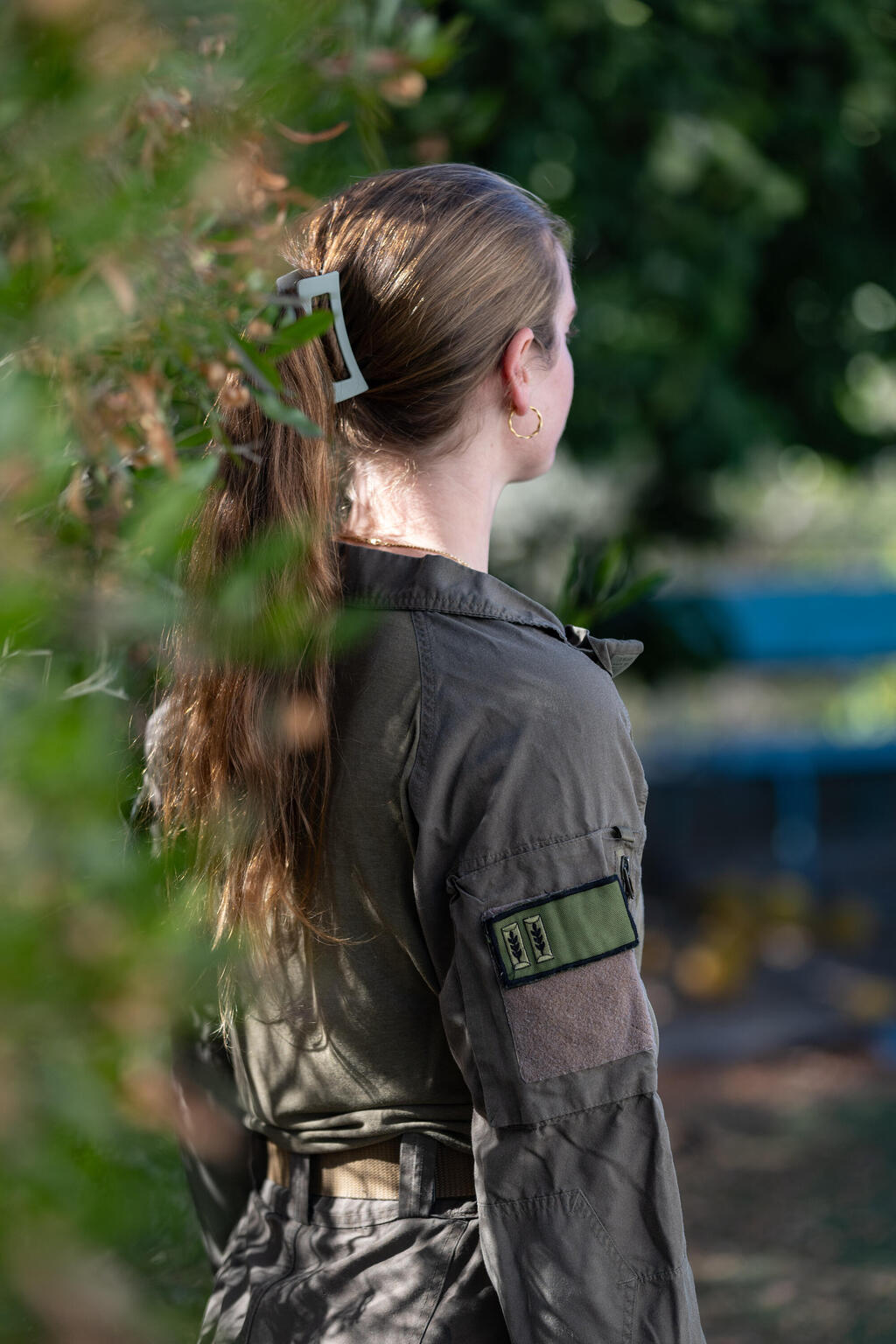
'Women can do whatever they set as their goal'
(Photo: Nimrod Glickman)
And maybe they did not let you because you are not actually a combat soldier, but defined as combat support and not trained to fight in case of an encounter?
“True, but that is a problematic definition. If I crossed the border, and I spent a lot of time in Gaza and now also operated inside combat areas in Lebanon, then I am a combat soldier. I went in to repair malfunctions and trusted the fighters to protect me and give me the opportunity to provide them with the response they needed.”
How did they receive you in the Givati Reconnaissance Unit?
“In general, they received me really well. They had already seen women in this role. But once, one of the commanders said to me in an officers’ meeting, ‘Shut your mouth.’ He silenced me in front of all the officers. I was very angry, even offended. I did not go near him for five days, and he understood that he had done something wrong. He asked, ‘Is it because of what I said?’ So I told him I felt my word was not accepted because I am a woman. He apologized and said he trusted me 100%. He said he had been angry that day and it happened to come out on me, and that my being a woman by chance had nothing to do with the incident in any way.”
How did you manage with bathrooms and showers in a place where there were only men?
“Improvisation. You have to know how to be creative. There are women who did not shower for a week, but in my case the role requires it. You do physical work, sweat a lot, soot, oil, grease up to the elbows. There is no way not to shower. So there are two options: a bucket and wipes, or water bottles. With one hand you hold the bottle over your head and with the other you shampoo. Bathrooms were a little more complicated because we cannot stand and urinate. You have to take a garbage bag, do what you need to do and throw it in the trash. The most complicated part was the period. If you do not know the exact date and do not prepare accordingly, then good luck, as they say.”
Did it happen to you?
“Absolutely. Tel Sultan, 4 a.m., all my equipment was up on the Namer, there was no chance of unloading, and I had a feeling it was happening. I had nothing, but I found a package of wipes, so I used them. I felt like a baby with a diaper. After a few hours, we met the battalion communications officer and I told her, ‘Please tell me you have a way to help me.’ Luckily, she saved my evening. My NCOs already knew how to handle it. They always guarded the door for me when I needed the bathroom or a shower, and made me feel comfortable with the fact that I was the only woman around.”
When will you return to service?
“I am supposed to be discharged soon, after nearly five years in the army. I love the military system, but it is not the future I want for myself.”
So what are your plans?
“I enrolled in a law and government track for a bachelor’s and master’s degree at Reichman University. It is a field that has always interested me, maybe in the direction of diplomacy or the Foreign Ministry. It will take years, so I am not thinking that far ahead.”