


This August, Yovel Lewkowski will mark 10 years since the night her life nearly ended.
She was 18, visiting London with her grandfather shortly before beginning her military service, when they were caught in a stabbing attack on their way back to their hotel. An American tourist standing nearby was killed, while Lewkowski was wounded in the hand after instinctively raising it to defend herself.
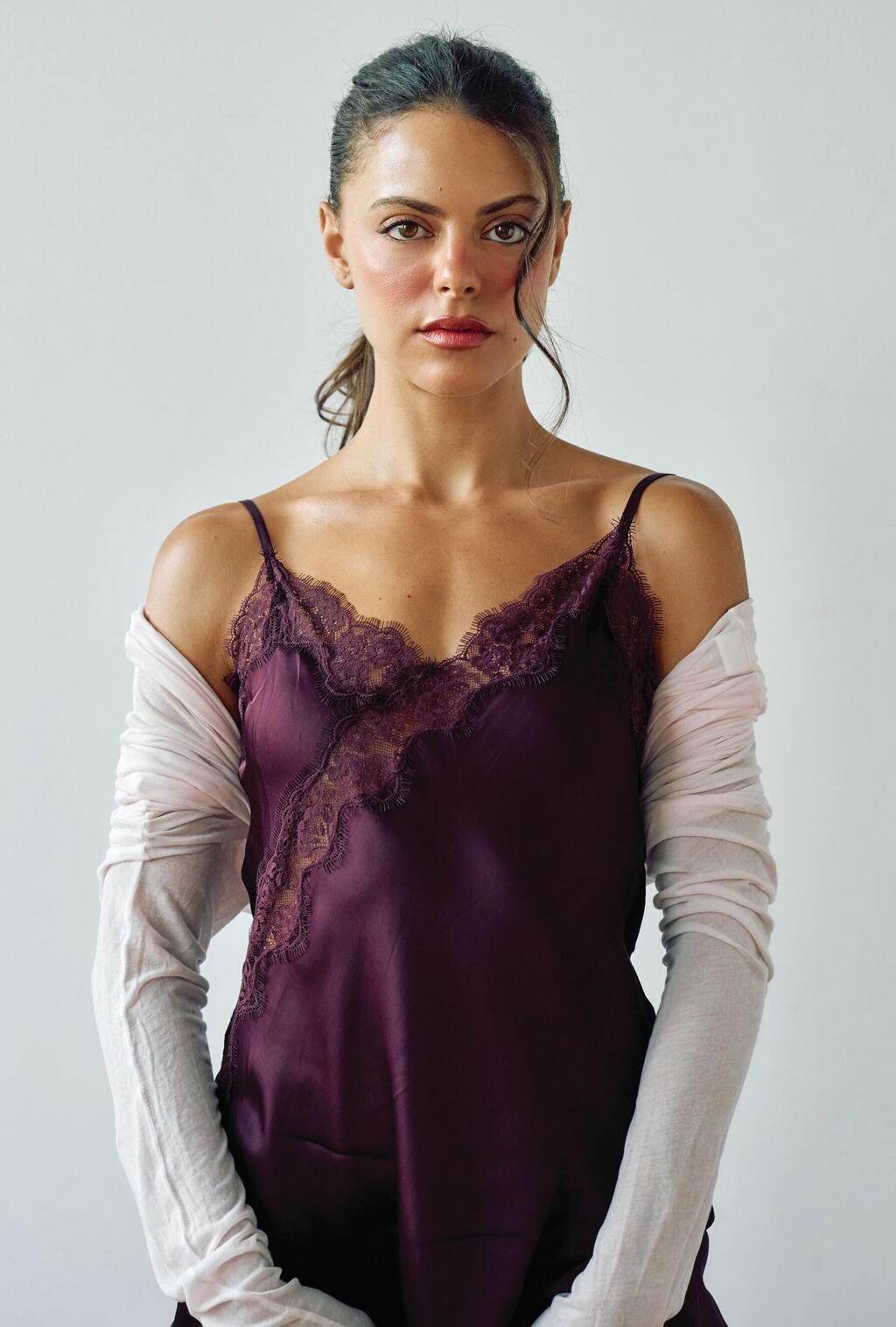
The attacker, a Muslim man of Somali origin, was subdued and arrested. A court later ruled that he had acted during a psychotic episode. It was a terrifying experience, but Lewkowski, now 28, chooses to focus on what it gave her.
“I understood that life is short and unpredictable, and that everything can end at any moment,” she says. “I decided to do everything I could to make my days here on Earth fulfilling and happy, and to try to achieve everything I want and love.”
That determination led her to move to France after completing her military service as a shooting instructor in the Armored Corps. She followed a relationship there despite barely speaking French and decided that it was precisely in that unfamiliar country that she would pursue her childhood dream of becoming an actress.

(Photo: Bat Shachar Nisan)
Six years later, with her career gaining momentum, she once again abandoned the safer path. She returned to Israel and began trying to establish herself in the local entertainment industry.
Lewkowski’s parents named her Yovel because she was born in the year Israel celebrated its jubilee. She spent most of her childhood in Tel Aviv. “My hobby was watching movies, writing down the scenes and then performing them in front of the mirror,” she recalls.
At 12, she joined the Israeli youth performance troupe The Neighbors of Chich, though her parents hoped acting would remain only a hobby. “My father called it ‘the bug in my head,’” she says.
At 18, Lewkowski met Anthony, a French Jewish lawyer 13 years her senior who was visiting relatives in Israel. “We managed to maintain a long-distance relationship throughout my military service, and the plan was for me to join him after I was discharged,” she says.
“When I told him I wanted to study acting, he said, ‘I don’t know how you’ll become an actress in France when you don’t even speak the language. I don’t want to make you choose between your dream and me.’ I thought, I’m not giving him up, and I’m not giving up on my dream. I’ll study French day and night.”

The October 7 massacre forced Lewkowski to rethink her future
(Photo: Bat Shachar Nisan)
After her discharge, she moved in with Anthony, enrolled in French classes and, a year later, was accepted to the Cours Florent drama school in Paris. “I worked so hard on the auditions because I was terrified I wouldn’t get in,” she says. “Then they told me they were moving me straight into the second year.”
She went on to appear in several French productions, including the successful Netflix film “Young Millionaires,” in which she played a leading role. “People started recognizing me and stopping me in the street,” she says. “A lot of young people, and also many Jews who were excited to see an Israeli actress in a French film.”
The October 7 massacre forced Lewkowski to rethink her future. “The massacre happened shortly after Anthony and I broke up,” she says. “Experiencing October 7 abroad felt like the end of the world had arrived.
“Within three weeks, I was already in Israel, and I stayed for a month. I had to be close to my family and friends. It reconnected me with my identity and my roots, and then I realized I also wanted to act in Israel.”
Initially, she planned to continue living in France while flying to Israel for acting projects. Eventually, she decided she preferred the opposite arrangement. “There were all kinds of unpleasant experiences in France,” she says. “I had many friends there who supported and encouraged me, but there were also people who called that terrible massacre ‘the liberation.’
“When you hear something like that from someone you consider close to you, it shakes you very, very deeply.”
Did you feel that you were also being offered fewer roles?
“Antisemitism in Europe has clearly escalated, but I don’t want to believe that every role I don’t get is connected to that. I still continue to act in France.”

(Photo: Bat Shachar Nisan)
In early 2025, Lewkowski filmed a French-Swiss series titled “The Deal,” in which she played a Mossad agent. She said she received hostile treatment from one of the lead actresses. “She really attacked me,” Lewkowski said in an interview with Mako. “I was so shocked that I couldn’t respond. I just started crying and walked away. Later, I saw that her Instagram was full of pro-Palestinian posts.”
Still, Lewkowski stresses that the actress did not represent the entire production. “Everyone except her was amazing and embracing,” she says.
Despite continuing to work in France, Lewkowski admits that acting in Israeli productions feels different. “Everyone wants to be recognized at home,” she says. “There are many projects I did in France that I have no way of even showing my family. Suddenly, we could sit together and watch me. It was incredible to see how excited and happy they were.”
The first Israeli series she filmed was “Missing,” which premiered on yes last summer. She played a young woman investigating the mysterious death of her best friend, portrayed by Israeli pop star Noa Kirel. She has since appeared in two films made for the ultra-Orthodox film industry. “It is an insane industry,” she says.
But the project that made her widely recognizable in Israel was the successful web series “It’s Not Over,” created by Ray Solash. Each episode runs for about two and a half minutes and realistically portrays the emotional fallout of a chance encounter between two former partners. “It’s funny,” Lewkowski says. “Usually, I work on a character for a long time and analyze every detail. Here, I received a scene, learned it and we simply did it for the art and the fun.
“I never imagined it would take such a meaningful place in viewers’ lives. Today, people stop me in the street and tell me how deeply the series affected them, how much they identified with it and how it helped them through breakups and difficult periods.”

(Photo: Bat Shachar Nisan)
Lewkowski, who separated from her French partner three years ago, says the character she plays in “It’s Not Over” reminds her of herself. “He wanted a family, and for me it was too early,” she says of the breakup. Asked about her current romantic life, she requests that the answer be written in English: “It’s complicated.”
What remains of Paris in your wardrobe?
“When I arrived in France, my suitcase was full of tank tops and flip-flops,” she says. “Then I discovered brands, button-down shirts under sweaters and, above all, that shoes could be something other than sneakers. I developed a very European style.”
And today?
“That’s the thing. I don’t really have anything to do with those clothes in Israel. Most of the sweaters are stuck in the closet, and the tank tops and flip-flops have completely returned.”