


Haifa has its wild boars, the Tel Aviv area has its growing jackal population and the Negev has its ibexes.
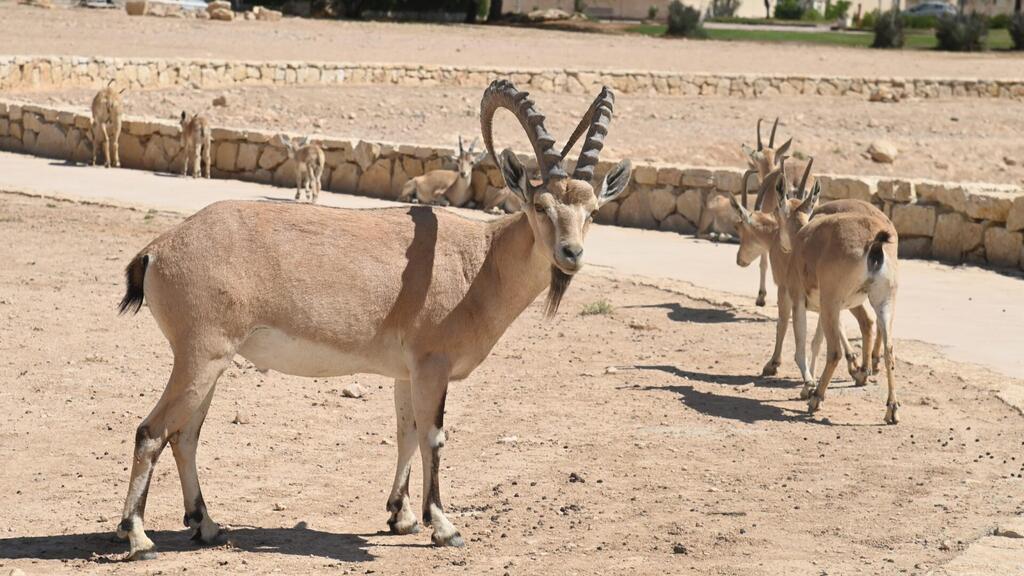
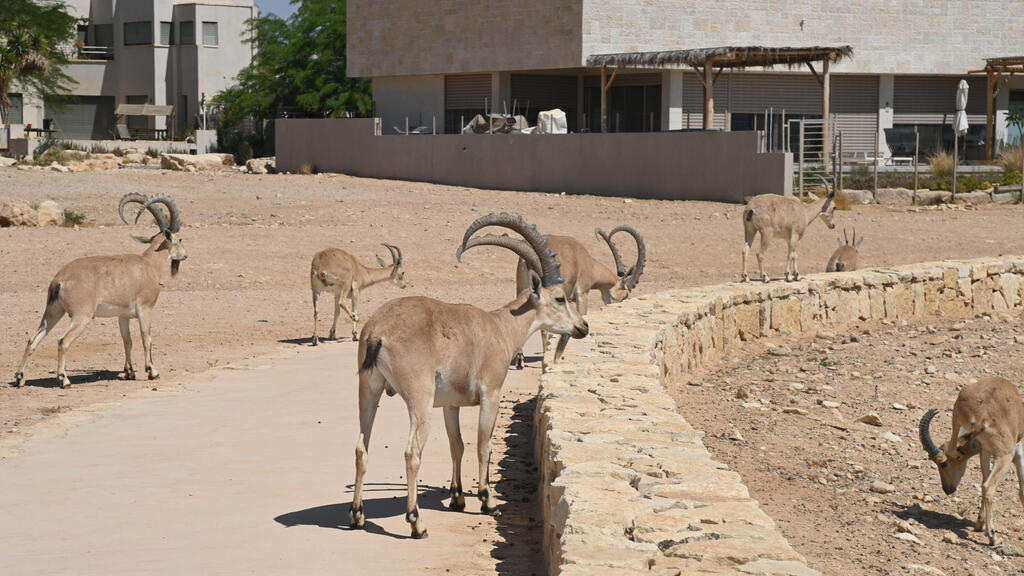
They are beautiful, a natural part of the desert landscape and one of the most recognizable symbols of Israel’s south. But for residents of Negev communities, especially Midreshet Ben-Gurion and Mitzpe Ramon, the Nubian ibex has also become a real nuisance: leaping onto cars, chewing through gardens and, when startled into a sudden stampede, turning into a potential danger to human life.
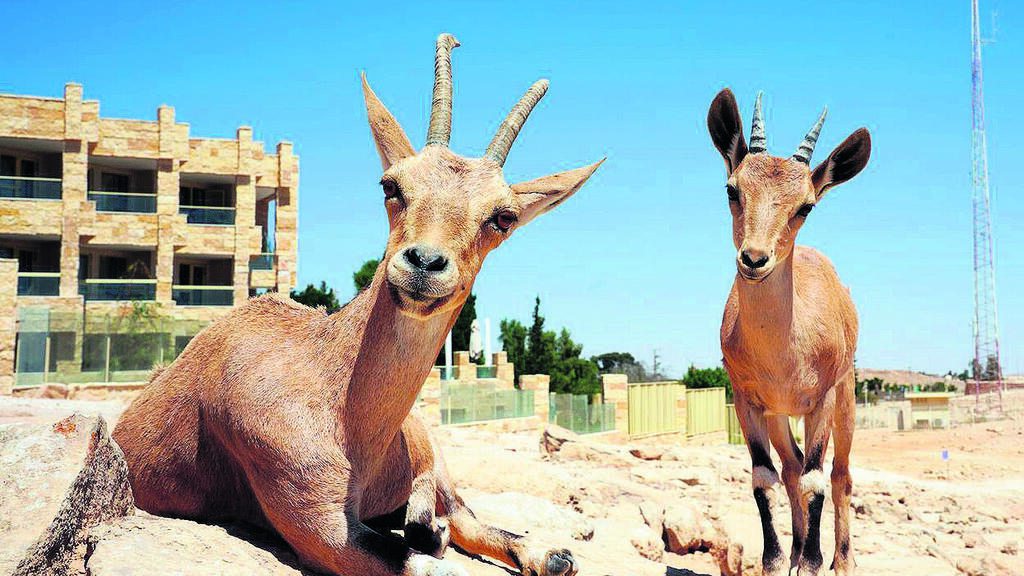
Some residents are calling for humane action to keep the animals away. Others warn that the ibex, an endangered species that was here long before the humans, must be protected. In between are towns trying to decide how to live with wild animals that have learned to live among people.
“It all began when I was hit by seven large males,” said Raz Arbel, a tourism professional and resident of Midreshet Ben-Gurion. “The car crumpled when they got on it. They simply passed through the car while I was driving, jumped on the roof, on the hood. One ibex hit the front door and bent the metal. Another slipped on the hood and shattered the windshield. I got out of there by the skin of my teeth. I shook the glass off myself and realized: something has to be done.”
That encounter turned Arbel into one of the leading voices in the fight to keep ibexes out of the community. He later helped establish the committee for removing ibexes from Midreshet Ben-Gurion.
“Since then, we have been at war,” he said. “Animals should live in nature, and people should live inside a community.”
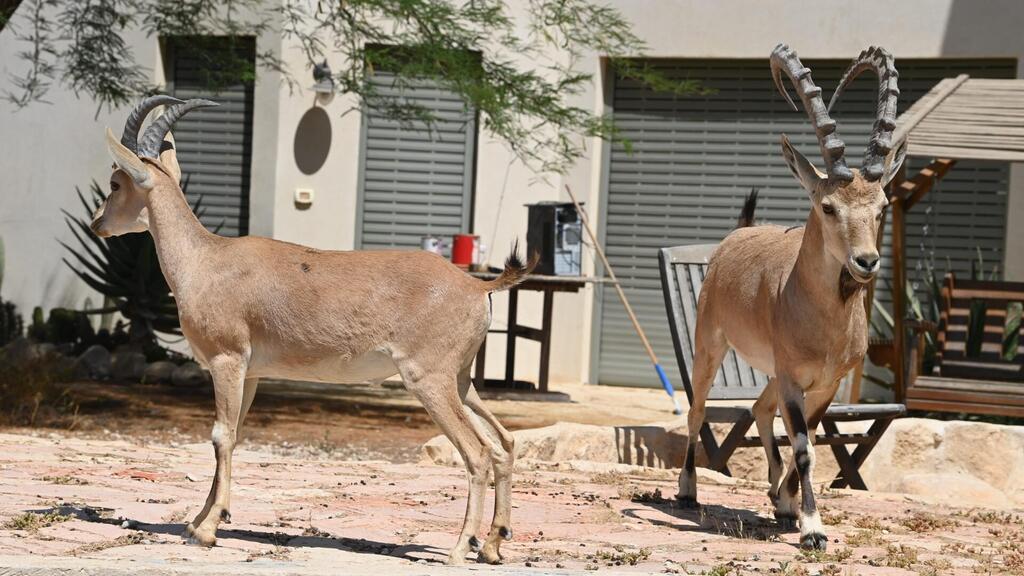
In spring, when Nubian ibex females are at the height of calving season, kids can be seen beside their mothers at Ben-Gurion’s burial estate. The pepper trees surrounding the graves of David and Paula Ben-Gurion are fenced off to protect them from ibexes, which scrape the bark with their horns.
(Photo: Herzl Yosef)
The animals roam freely through Ein Avdat National Park and across the Midrasha. To outsiders, the herds look as if they were taken from a folk tale. The ibexes leap across lawns and between homes, hide among mesquite trees and sun themselves along the cliff overlooking Nahal Zin. In summer, they move freely almost everywhere, crossing roads and grazing on the lawn near the small commercial center, almost indifferent to human presence. In fact, they are also there in autumn. They are there all the time, but especially in summer, when they are desperate for water and food.
Residents of the Midrasha have already given up on planting flowers. What is the point, they say, if the ibexes will devour everything anyway?
“In July and August it becomes insane,” Arbel said.
There are only about 4,500 Nubian ibexes in the world, and even that is considered a generous estimate. The Nubian ibex is endangered, and a few hundred live in Negev communities, some of them in Midreshet Ben-Gurion and others in Mitzpe Ramon. In Ein Gedi, where there is a flourishing ibex population, the kibbutz was fenced off. In the Midrasha, such an idea is seen almost as sacrilege. Fencing the desert is out of the question, even if that means the ibexes climb their way into town.
It was not always this way. Over the years, the ibex presence began to weigh more heavily on residents.
“This year we feel the growth of the ibex herd and its movement deeper into the community’s neighborhoods,” the local secretariat wrote several years ago, in a notice that marked the beginning of what many residents see as the ibex takeover.
“Let’s just not become Mitzpe Ramon,” said Gilad Broders, owner of the Canaanite restaurant in the commercial center. “Otherwise, it will be a complete mess. Mitzpe is a tourist town. Here, that is not the situation. In general, the ibex is a strange animal.”
One employee at the restaurant said an ibex once got caught on the fence near her home.
“It happens to the best of them,” Broders said.
A luxury hotel, car damage and ‘uninvited guests’
The fear of becoming Mitzpe Ramon 2.0 is not without basis. Nearly a decade ago, damage caused by ibexes led to a lawsuit against the luxury Beresheet Hotel and the Isrotel chain, over claims that ibexes had damaged guests’ cars in the parking lot.
“Delightful wild animals,” the lawsuit called them, while alleging that the hotel knew very well that ibexes tended to climb on cars parked beneath mesquite trees but hid that information from guests.
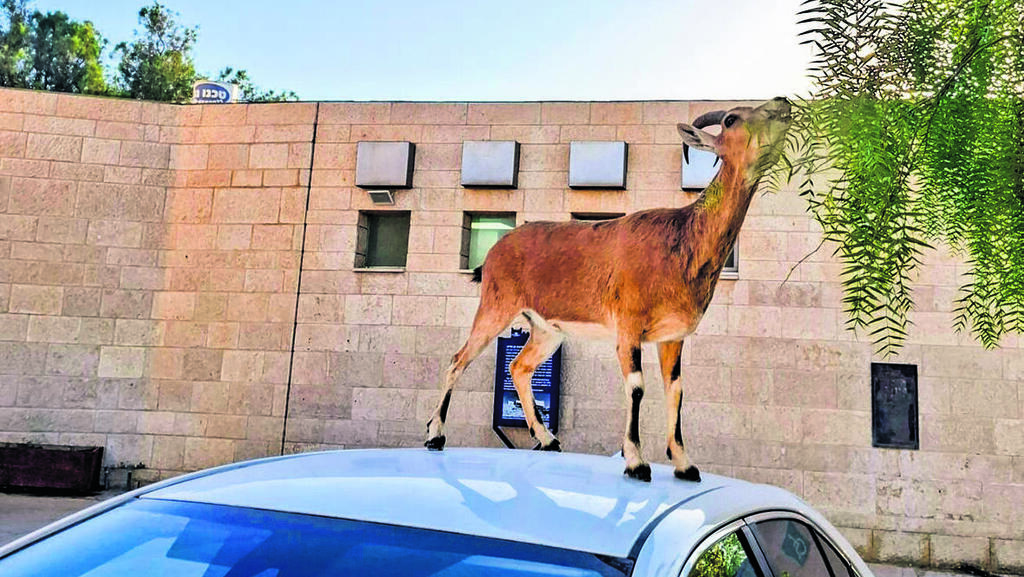
Nubian ibex on a car in the Negev
(Photo: Ben-Gurion Heritage Institute)
“Although the sight of ibexes climbing on cars in the hotel parking lot is charming and heartwarming, the innocent animals jumping on guests’ vehicles weigh dozens of kilograms,” the lawsuit said.
The case was closed two years later in a settlement, under which the chain agreed to fence the stone wall around the parking lot and move the mesquite trees in order to keep away the “uninvited guests.”
But the ibexes, it turns out, were determined. They were later documented entering guest rooms at the hotel. In one case, a male climbed onto a bed; in another, a female broke her leg in a failed attempt to enter the hotel through a fence.
“The mixing of humans and wild animals will always be bad for both the wildlife and the humans,” Arbel said. By now, he knows the ibexes’ schedule, when they roam below the cliff and when they are likely to take a tour through the community.
“There is mutual harm here, and meanwhile the ibexes are beating us,” he said. “Have you ever seen a panic stampede? It happens from time to time, mainly because of visitors’ dogs. The local dogs have already gotten used to them, but visitors’ dogs chase the ibexes, and then they burst into a run toward the cliff and pass through everything in their path, whether it is a child on a bicycle or a mother with a stroller and a baby. Or my car, which was totaled.”
Arbel concluded that something had to be done, including forming the ibex removal committee. The committee led a survey that reached one simple conclusion: the ibexes eat almost everything.
A survey conducted last year found that garden owners suffer especially, and that young ibexes sometimes get stuck in nursery areas.
“According to the survey, the ibexes eat everything,” the summary said. “Several families noted that they do not eat succulents. By contrast, other families noted that they ate and trampled succulents. The administrative staff at the Zin elementary school noted that the ibexes manage to enter the school mainly in the afternoon and on weekends, causing serious damage to gardens. Kindergartens have complained about young ibexes entering the nursery area and sometimes getting stuck there. In conclusion, the ibexes are present in all neighborhoods of the Midrasha. There is extensive destruction of public and private landscaping.”
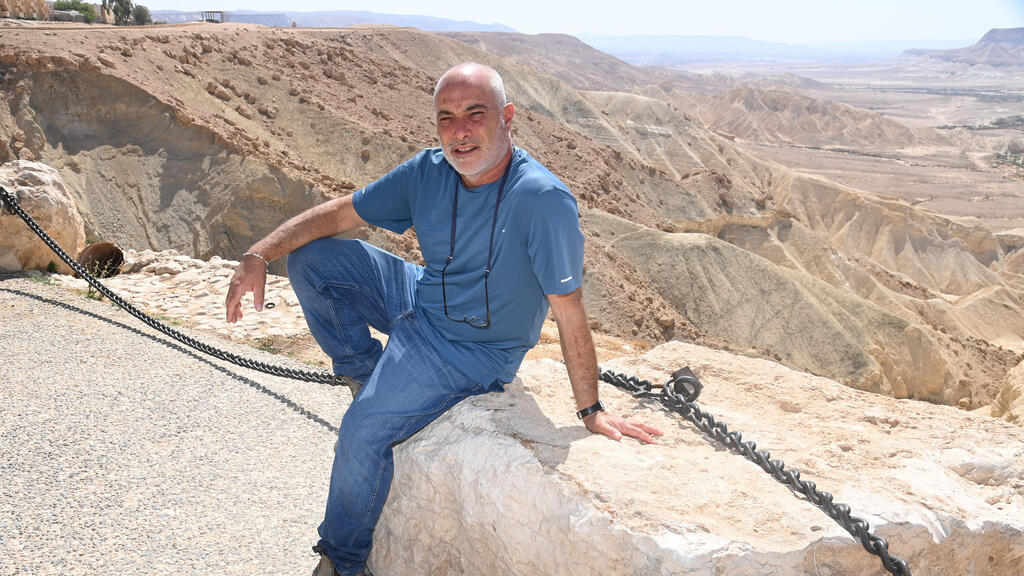
Raz Arbel
(Photo: Herzl Yosef)
At the same time, the survey found that about 49% of residents do not see the ibexes as a nuisance, while about 51% definitely do, whether in their neighborhood or across the community.
“I have no garden left,” one resident said.
“They destroyed the vegetation, including the almond tree,” another complained.
‘There are opinions on both sides’
The ibexes are almost everywhere. Residents document their presence through an app that reports sightings to the Israel Nature and Parks Authority, but also in WhatsApp groups.
“At least someone is weeding,” one resident wrote in response to a photo of a male ibex snacking on weeds.
Arbel is one of the most prominent opponents of ibexes inside the community, but among the roughly 2,000 residents of Midreshet Ben-Gurion, there are nearly as many opinions as people.
“There are those who came here because of the ibexes and are willing to bear the price,” said community manager Yifat Wenger. “And there are those who will say: ‘We came here for many reasons, but we never intended to have an ibex on the shed or outside the house, or one that destroys the whole garden.’ There are opinions on both sides.”
(Photo: Herzl Yosef)
The ibex committee worked for a long time to formulate a community position, she said, but no appropriate solutions have been reached.
“We went through all kinds of processes,” Wenger said. “Maybe we should get a dog and it will drive them away, like at air force bases where dogs keep birds away? But there is no bottom line. None of the solutions to keep the ibexes away received broad agreement. Do you drive them away with pots and pans? They break into a gallop, a stampede, and they do not see anything. Is that what we want? The issue is very complex. The Israel Nature and Parks Authority is responsible for the ibexes in its territory, but they do not really have any father or mother.”
If it seems, even briefly, that humans suffer more than the ibexes, the ibexes suffer from us much more.
A reservist major said that in army areas, ibexes would eat classified materials, between bites of occasional garbage and leftover snacks.
“From the residents’ perspective, there is no problem with the ibexes being in Ben-Gurion’s burial estate or on the lawn of the commercial center,” said Avital Benshalom, a member of the ibex removal committee. “But not on roads and in neighborhoods. People have learned to live with it. But one day something will happen and people will say, wait, why didn’t we stop this in time? Children have been trampled here. They flattened themselves on the road because the ibexes broke into a run. But these were only minor injuries. In my opinion, Mitzpe Ramon has given up.”
(Photo: Herzl Yosef)
Make no mistake: the ibexes were here first. Unlike peacocks in kibbutzim or wild boars in Haifa, we settled in their home. Human communities, including the Midrasha and Mitzpe Ramon, are changing the character of these desert wild animals.
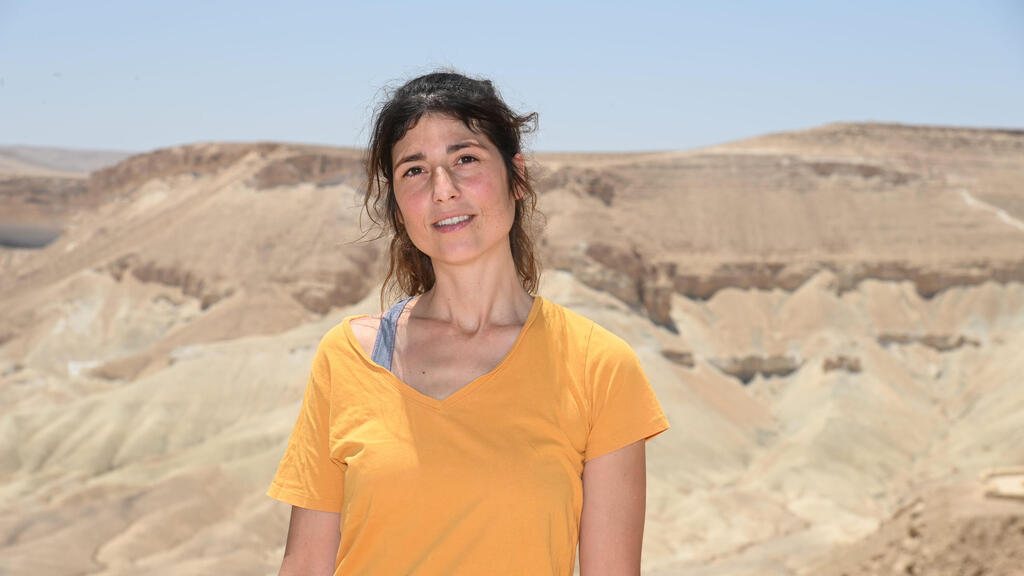
In her doctoral research in Prof. Oded Berger-Tal’s lab on animal behavior and conservation, Yuval Zuckerman studied ibexes. She found that ibexes in the Midrasha have a more fluid social structure, with females wandering and moving between groups in the community. In Mitzpe Ramon, by contrast, there is a clear division into fixed “social cliques,” with ibexes remaining in specific areas: the tourism clique around the hotels and commercial center, the residential-neighborhood clique and the field school clique. Each group is highly closed.
Yuval Zuckerman
(Photo: Herzl Yosef)
Prof. Oded Berger-Tal
(Photo: Herzl Yosef)
Ultimately, the ibexes in the Midrasha have become tolerant of human presence. One sign is their flight distance. It is almost possible to touch them before they flee, though flight remains a healthy instinct meant to protect them.
“I understand the residents’ frustration,” Zuckerman said. “I have lived here for almost a decade and also experience their presence. On the one hand, it is simply beautiful that we are able to live with such an amazing wild animal and not cause it to lose its habitat just because we decided to settle on the cliff. On the other hand, it is truly frustrating to invest so much in a garden, wake up one morning and find everything destroyed, or have your car bent because some ibex ran into it. I believe in efforts to reduce the conflict and keep the ibexes away as much as possible.”
‘The largest Nubian ibex population is here in Israel’
There is still no clear solution, but that does not mean residents have stopped trying.
“We brought in a company that specializes in dealing with invasive animals,” Arbel said. “They handled the wild boars in Haifa. They suggested paintballs, salt balls and various sensors. The Nature and Parks Authority blocked every move. They suggested border collies that would run along the cliff and keep the ibexes away, but maybe the ibexes would break a leg. So the authority opposed it.”
Dr. Tal Polak, head of endangered species conservation in the science division of the Israel Nature and Parks Authority, said the ibexes are an extremely important desert species.
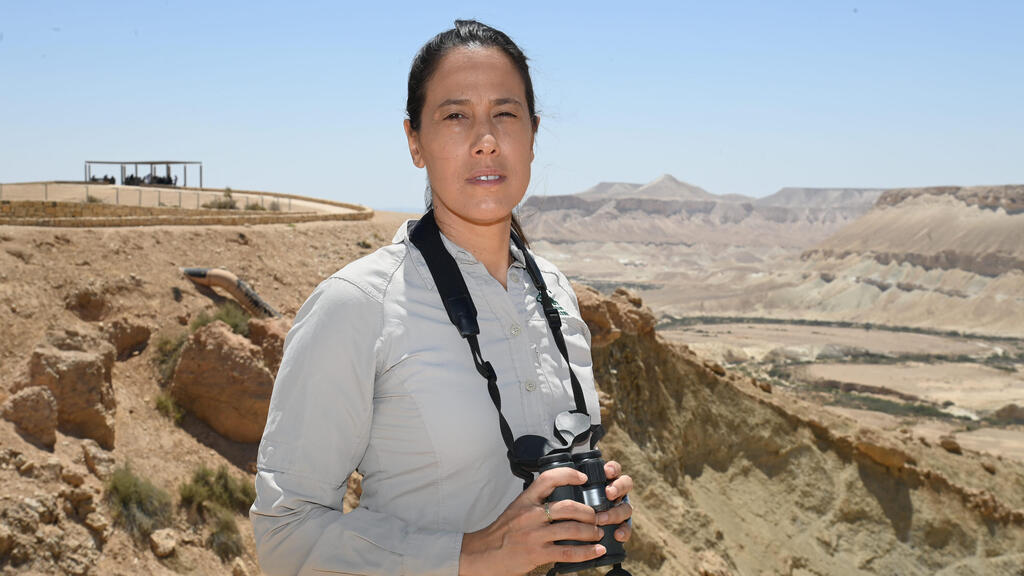
Dr. Tal Polak
(Photo: Herzl Yosef)
“The largest and best-preserved population of Nubian ibex is here in Israel,” she said. “That means the population has international importance. Some ibexes, unlike most desert species, are able to develop less fear of humans and animals around them. They are attracted to the community because of available resources such as water, grass and landscaping, which save them the need to search for food and water in the harsh desert.”
Ultimately, she said, this is a global conflict that occurs wherever nature and urban life meet, especially in beautiful and open places like communities on the edge of a cliff.
“Residents want to enjoy open nature and hike in the desert whenever they want,” Polak said. “But that means the desert can also enter their homes whenever it wants.”
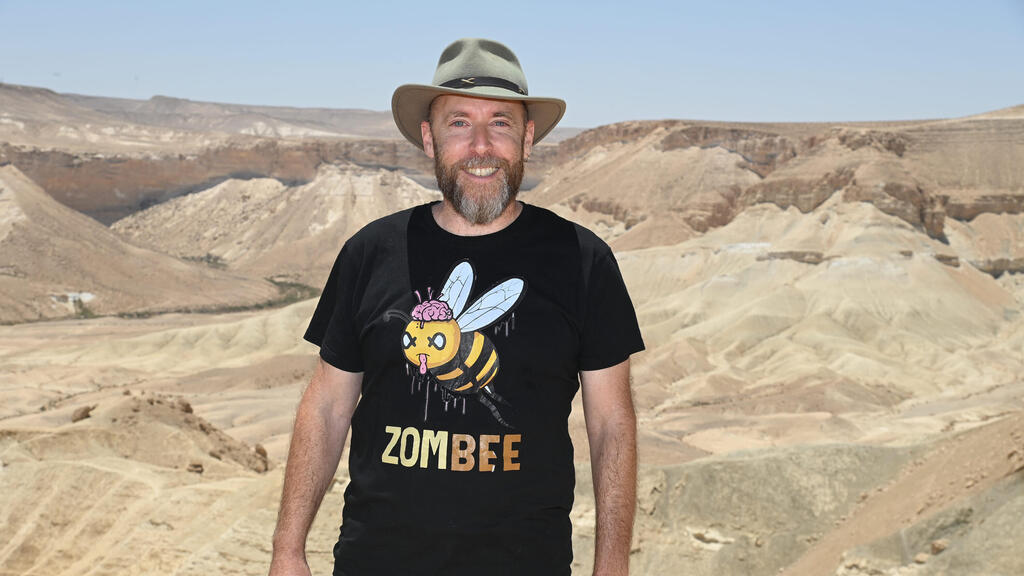
Prof. Berger-Tal said there is a growing global understanding that the solution must come from people and from a change in human behavior.
“People talk about a process of living together,” he said. “This is not about hugging each other. It is first of all about accepting the costs that may come with living with ibexes and trying to reduce them, and also trying to reduce the costs to the ibexes themselves. That means no bags on the ground that ibexes will eat and die from, not feeding ibexes, making sure trash cans are closed so they do not eat from the garbage and more.”
Living together requires tolerance, he said, but also behavioral change.
“My main fear, and I have been saying this for several years, is that the first time an ibex kills or injures a child, God forbid, and obviously not intentionally, no one will care that it was not the ibexes’ fault. Everyone will be out for blood against the ibexes,” he said.
According to him, the communities should try to find behavioral tools that allow ibexes to be kept away from towns through nonlethal means before more extreme solutions are needed.
Ramat Negev Regional Council head Eran Doron, himself a resident of the Midrasha, said the ibexes are protected wild animals and that the Zin cliffs, Ein Avdat springs and Nahal Zin are their natural habitat.
“Despite my frustration when I look at my own garden being eaten, there will be no choice but to adapt our gardening and way of life to the ibex herds,” Doron said. “Life in the Midrasha has great uniqueness, and it is no coincidence that every toddler here knows who Ben-Gurion was, what an ibex looks like and where Hod Akev is. Fencing the community, for example, is not practical. Shared life, ibex and human, is preferable.”
In Mitzpe Ramon, the ibex is already an icon
So what does that shared life look like? That is a good question for Mitzpe Ramon. There, unlike in Midreshet Ben-Gurion, residents have already understood that they cannot fight the ibexes, so perhaps it is better to join them, or at least see them as an asset.
“At the end of the day, you cannot get used to how cute they are,” said Mitzpe Ramon council head Elia Winter. “There is not a day when I do not post a story with ibexes. There are crazy things. They run on the road and the road is theirs. We replaced trash cans so they would not be able to open them. We have to work on the ability to live together.”
Asked what advice he would give Midreshet Ben-Gurion residents who fear becoming like Mitzpe Ramon, Winter said the truth is simple.
“Nature was here before us,” he said. “We came here, to the Negev, and we are settling and developing it, but they were here first. We speak a lot about the connection between people and the desert, about preserving the unique natural values of the desert, and that is exactly the issue of the ibexes. Besides, they have already become a kind of icon of Mitzpe Ramon. They appear on our logo. They are already part of us. We love them and are happy with them and their presence. At least we have natural lawn mowers. The ibexes eating the grass in Mitzpe’s square are a tourist attraction. I do not know a single tourist who comes to Mitzpe Ramon and is not charmed by the ibexes. They are truly a strategic asset.”
Polak said the behavior of the ibexes will change only if human behavior changes.
“It is not as if we can suddenly reeducate the ibexes,” she said. “It is not a matter of training. People need to see that their behavior can create a successful interface. We are trying to make the conflict less of a conflict.”
Berger-Tal is convinced there is still action to be taken.
“The problem is that it requires a lot of effort and consistency, and one of the things that does not exist here in the Midrasha is consistency, because everyone wants something different,” he said. “Then there is no determination to do what needs to be done. There needs to be a price for the ibexes’ presence in the community, and on the other hand, they need an alternative outside. The Nature and Parks Authority will not do this alone. Residents are reluctant about the idea of walking around the community and shooting paintballs at ibexes. There are enough people who are not interested in that.”
This week, residents of Midreshet Ben-Gurion and Mitzpe Ramon will mark Ibex Day. To cool the enthusiasm, it will not exactly be a celebration, but more of an activity for elementary school children on the lawn of the commercial center. The ibexes, by the way, love that lawn.
“This is their kingdom. It is that simple,” said a local photographer as she passed between homes on her way to the cliff promenade. “They were here and we invaded. Simple.”
Perhaps, as Polak said, when we settle on the edge of a cliff and go out into the desert whenever we want, we must understand that the desert will inevitably come into us whenever it wants.