

A spur-of-the-moment decision changed Hanna Cohen’s life forever. A little more than 44 years ago, she was sitting on the grass at Kibbutz Merom Golan, 26 years old and an “old maid” by the standards of the time. She had already told the kibbutz’s young-adults coordinator that she was leaving, hoping to find somewhere she might meet her future husband.
“Wait another week,” he asked her. “Four young men are coming here to pick apples.”
Gallery
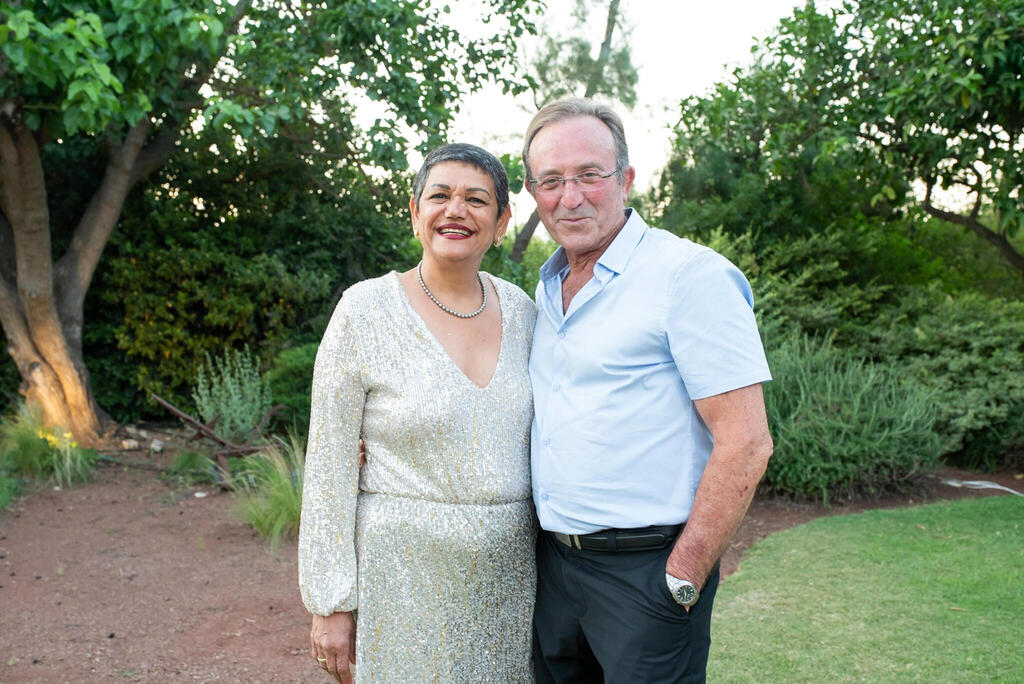
'As soon as I saw Zion, I said, "He’s going to be my husband."' Hanna and Zion Cohen
(Photo: Avihu Shapira)
She agreed.
When the bus in question arrived at the kibbutz, 30 single women were already sitting on the grass waiting for it.
“Four good-looking guys got off,” Hanna says with a laugh. “As soon as I saw Zion, I said, ‘He’s going to be my husband.’ I went over and introduced myself.”
How did he react?
“He fell in love with me from the first second and said, ‘You’re going to be the mother of my children.’”
Hanna is not only a beloved and well-known figure in the Golan Heights, but also the co-star of the documentary "HaGafruor" ("The Match"), which recently aired on Israel’s Kan 11 public television channel and is available on the Kan BOX streaming service. The film tells the extraordinary story of her partner, Zion Cohen, 74: how a retiree — a devoted father of four, a member of the kibbutz singing group and a man with no criminal record — became the central figure in a serious arson case that sent him to prison at age 70.
Hanna, who recently retired, is a devoted grandmother to eight grandchildren. Over the years, she held several jobs at the kibbutz, most recently managing the dining room at the local hotel, and raised the couple’s children, now 44, 42, 39 and 33. She divorced Zion 14 years ago, and since then they have separated and reunited several times. Today, they live together and are nurturing a relationship they have rebuilt.
How did all this happen? Perhaps it is best to start at the beginning.
He’s a Cohen, I’m a Divorcée
Hanna, 70, was born in Iran, the fifth of seven children. When she was 1, her family immigrated to Israel and settled in Beit She’an. Her mother died of cancer when Hanna was 10, after being ill for five years. Her father was unable to raise the children and the burden fell on her eldest sister.
“It was only when I gave birth that I understood what it means to have a mother and father,” she says.
At age 8, she was sent to a religious orphanage and later moved to another religious institution. Midway through high school, she returned to Beit She’an and worked at a textile factory until she was drafted into the military. After completing her service, she followed two of her sisters, who had moved to Kibbutz Lohamei HaGeta’ot, in trying kibbutz life and was sent to Merom Golan.
From the moment she met Zion, their love was intense. They married in the kibbutz dining hall when she was already pregnant.
“Our families came and everything was perfect. When our eldest daughter was born, he was a wonderful father and was so excited.”
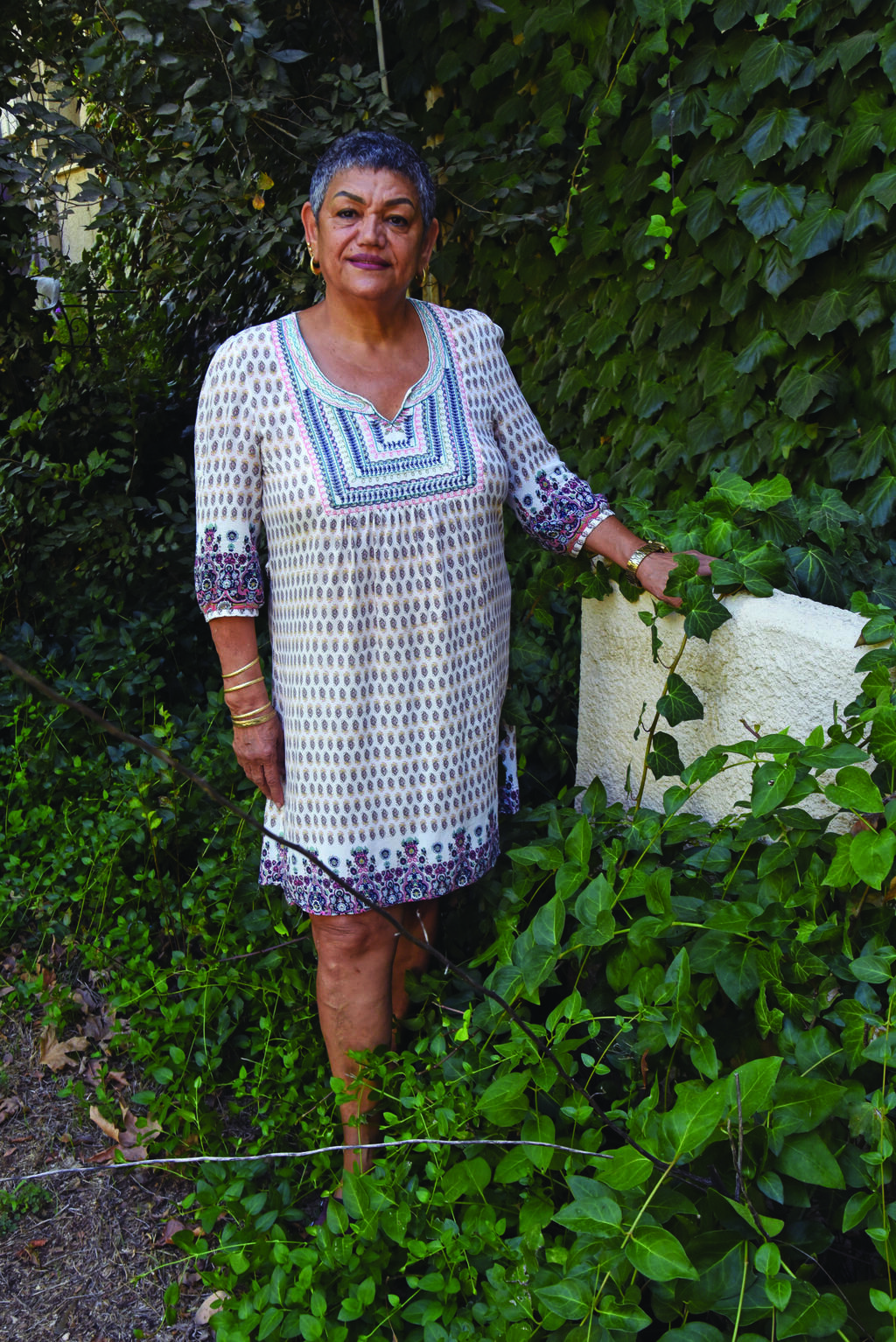
'He wasn’t an easy husband. His personality was difficult for me throughout the years.' Hannah Cohen
(Photo: Avihu Shapira)
The first crisis, she says, came in 1982, the first year of their marriage. After four months of reserve duty in Lebanon, Zion decided he would no longer serve and was sent to prison.
“The kibbutz didn’t forgive him at the time for refusing to serve,” she says. “It was a huge crisis. After what happened, people couldn’t stand him, and even though he is, by definition, a genius, they didn’t make use of even 50% of his abilities. He was assigned all kinds of jobs, including in the kibbutz carpentry shop.”
What was married life like?
“He wasn’t an easy husband. His personality was difficult for me throughout the years, but I didn’t care. The main thing was that I had a family. Zion is a very closed-off person who doesn’t talk, and when he withdrew into himself, I was afraid to approach him. He could spend entire days reading books, and I couldn’t ask him what he was reading because I don’t understand any of it. But even though there were gaps between us — he’s a genius and I’m a woman who never studied — he found a home in me. We complemented each other.”
What kept you together?
“There’s incredible passion between us. Nobody knows how to play my body the way he does. But we’ve been through a difficult journey.”
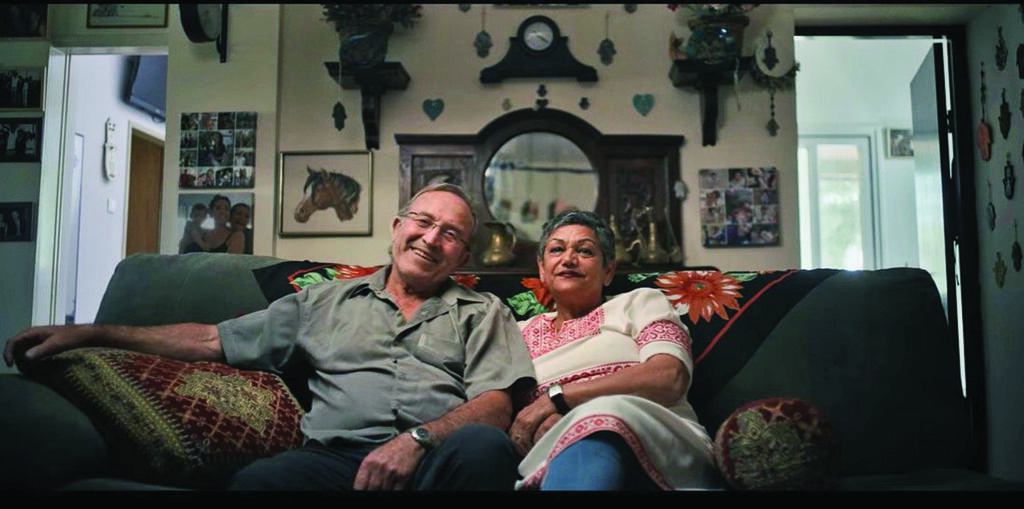
The couple, from the documentary 'HaGafruor' (The Match)
(Photo: Avner Shahaf)
One day, the couple watched a television report about a young agunah, a Jewish woman whose husband refuses to grant her a religious divorce, or get. Zion, who was already retired, was deeply affected. He wanted to spur the Israeli public to protest the lack of separation between religion and state. When the social justice protests erupted in 2011, he saw an opportunity. He went to Tel Aviv for the mass demonstration known as the “March of the Million,” handing out flyers calling for a civil state not controlled by religious authorities, but returned disillusioned. The situation in the country caused him to withdraw further into himself. He became increasingly distant from everyone around him.
In 2012, Hanna decided she wanted a divorce.
“I felt alone and decided I would learn to love myself,” she says. “Zion took it hard. At the rabbinical court, the rabbis told us that if we ever wanted to get back together, we would never be able to, because he is a Cohen and I would be a divorcée.”
Under traditional Jewish law, a Cohen — a male descendant of the ancient priestly class — is prohibited from marrying a divorced woman.
“We left with a very difficult feeling. Within a few days, I already regretted it and we got back together, but there was no turning back.”
“Even though Zion is a genius and I’m a woman who never studied, he found a home in me. There’s incredible passion between us. Nobody knows how to play my body the way he does.”
It was from there that Zion’s decision to wage war against the religious establishment took hold. He decided that no ultra-Orthodox person would dictate how he should live his life. For about two years, without his partner’s knowledge, he began planning a major protest action: setting several rabbinical courts on fire in a single night.
He prepared meticulously. He learned online how to build an incendiary device activated by a timer, trained by running and lifting weights and recorded his plans in a secret diary.
On the night of May 16-17, 2020, disguised as a homeless man, Zion planted four devices that detonated at rabbinical courts in several locations across Israel, causing extensive damage. Police found traces of his DNA and patrol cars arrived at the kibbutz. A month after the night of the attacks, he was indicted. In September 2021, he was sentenced to three years in prison.
“If I had known,” Hanna says in the film, “I don’t know what I would have done. Maybe it’s a good thing I didn’t know. When you don’t suspect anything, you have no reason to look. Honestly, if he had been cheating on me with women, I would have been less angry.”
'They transported me in a prisoner van'
On the morning Zion Cohen was arrested, police investigators also arrived at the dining hall where Hanna worked. She was detained for questioning on suspicion of arson and assisting in the commission of an offense.
“Police officers came and arrested me,” she says. “When they told me what Zion had done, I didn’t understand what they were talking about. I was in shock. I didn’t know anything. They handcuffed my hands and shackled my legs, and it was deeply humiliating. They took me home, and there were 50 police officers with dogs who turned the entire house upside down. Zion had just been brought home too, also in handcuffs, and all I said to him was, ‘My love.’ That was it. He didn’t have time to say anything to me, and from that moment on, I didn’t see him.
“They transported me in a prisoner van and held me at Neve Tirza prison for two days. It was awful. Suddenly I was with all kinds of bizarre people. It was a real culture shock. Fortunately, I had taken Klonopin from home before they took me there. In the end, Zion gave them the diary he had written, which contained conclusive evidence that I had nothing to do with it. Otherwise, they wouldn’t have believed me. The kibbutz members were shocked and supported me.”
How do you explain the fact that you knew nothing about his plan?
“In our relationship, each of us has our own life. I’m a woman who gives a lot of freedom. I don’t snoop through his things. It doesn’t interest me. Even now, during this interview, he isn’t home and I don’t know what he’s doing. I don’t keep tabs on him.
“When I looked back, I remembered how Zion, who is an amateur musician, would constantly tell me, ‘Hanna, I’m going to play music on the street in Tel Aviv.’ He would take a guitar and I would pack him a bag with sandwiches, and the next night he would sleep in the car by the beach. I don’t know where he was. I was happy that he was happy. I also got a little peace and quiet for a few days, and I liked that. In retrospect, it turned out he wasn’t going to play music. If I had known beforehand, I would have been very angry.”
Nothing made you suspicious?
“No. When you don’t suspect anything, you don’t look for anything either. The two years before what happened were a frustrating period. During that time, he would come into the house like a ghost. He was frightening. Throughout that whole period when he was building the bombs, he was unbearable. He was like a ticking time bomb. I didn’t know why he was like that. I thought maybe he hated me.”
When Zion was in prison, you chose to cut off contact for a while.
“That’s right. I was in such shock that I told him, ‘I don’t want to hear about you. I’m not visiting you and I’m not coming to see you.’ I cut off contact. He said that was the hardest part of the entire ordeal for him. It was hard for me too. I wanted a new life. I said, ‘Now I’m going to choose my man.’ For a year, I went out, looked around and experienced things, and in the end I discovered that I love my husband. That idiot is good for me.
“He told me that in prison he was constantly performing rituals so I would come back to him. He lit candles and prayed. He said he had never loved a woman the way he loved me. So I said to him, ‘Why did it take you 40 years to tell me that? Why didn’t you say it from the beginning?’”
You say in the film, “If he invests half as much in me now as he invested in the bombs, I’ll be happy.”
“And truly, since he was released from prison and we got back together, our love life has been incredible. He tells me he loves me many times a day. It’s a complete transformation. He hugs me, embraces me and loves me, and suddenly surprises me with a kiss. He told me, ‘I knew that if I didn’t improve this, I would lose you forever, and I had to work on myself.’
“Today, I can tell you that I’m in love and I’m loved. We spend a lot of time together. We exercise together, we go swimming together and, above all, we are together in spirit. It’s as though I got married all over again. Out of the rupture grew a pure love. We have the same passion between us that we had when we first met.”
“Throughout that whole period when Zion was building the bombs, he was unbearable. Like a ticking time bomb. I didn’t know why he was like that. I thought maybe he hated me.”
What is your status as a couple today?
“Today, I’m his common-law partner. After Zion was released, we went to a judge in Kiryat Shmona and drew up a financial agreement between us. We wanted to make sure we had all our rights. After the judge approved the agreement, we went to eat falafel at a restaurant owned by a friend of mine. I told her, ‘I kind of just got married,’ and she laughed and said, ‘And this is what you’re eating?’”
Why did you agree to appear in a film about the case?
“Because of the message. Like Zion, I also think religion and state should be separated. It really angers me how religious people control us. On the other hand, if it were up to me, I wouldn’t take any violent action over it.”
What reactions did you receive after the broadcast?
“My friends who watched the film called me and said I was a real star and adorable. I know Noga, the director, received some difficult reactions.”
What message do you want to give other women?
“Before breaking up a marriage, it’s important to try everything to save it. Only if you can’t save it and you’re alone in wanting to, then leave. Today I also tell every woman I meet, ‘Love yourself. What you can’t change in the other person, change in yourself.’”
 Noga NetzerPhoto: Jacek Olejnik
'I envy Hanna’s ability to forgive'
“I heard about the Cohens’ story through a report on one of the news channels and was immediately captivated,” says Noga Netzer, the film’s director. “I saw so many layers in it — a love story that spun out of control, a man betraying his wife not with another woman but with a grandiose, criminal and dangerous act, and a betrayed wife who knew nothing about what was happening right under her nose for two years.
“What surprised me most, and something I witnessed while working on the film, was the turn their relationship took. Hanna forgave him, and their relationship actually grew stronger. Zion didn’t manage to save the world, but he ‘got the girl.’ Hanna was very reluctant and opposed to the film at first, but little by little the walls came down and she agreed to take part. We discovered an amazing woman with tremendous inner strength, compassion and a great deal of self-deprecating humor.”
What was your impression of Hanna and Zion’s relationship?
“I was stunned by how different these two people are from each other. I couldn’t understand how it could possibly work. He is quiet and mysterious. You can’t really understand what’s going on in his head. She is down-to-earth, talkative and sociable. They both became like family to me.”
What did you learn from working on the film?
“On a personal level, the film taught me about the profound meaning of forgiveness. How can you forgive someone for something like that? It’s the ultimate betrayal — two years of lies and the destruction of the family for the sake of an ideological act that seems insane. Everything Hanna went through because of Zion, from being arrested in front of everyone in the dining hall to the enormous humiliation in front of all their acquaintances, friends, extended family and fellow kibbutz members. The interrogations she went through while being held at Neve Tirza — it was a genuine trauma that still reverberates with her to this day. And yet she chose to stay with him, to forgive him and to take their relationship to a stronger, healthier place. That ability of hers, which comes from a place of strength, is something I deeply envy.”