


On paper, Yaniv Frister was supposed to be a romantic success story. By fifth grade, he already had a steady girlfriend — the pretty girl from the parallel class. “We were very unusual, because at that age it wasn’t common to be a couple yet,” he recalls. “The kids were impressed, the adults were charmed.” But what seemed like a promising beginning later turned out to be the peak: until he turned 30, that fifth-grade girl remained the only relationship of his life. In fact, since seventh grade, his diary was empty. While his friends fell in love, broke up and got married, he earned the nickname “Yaniv the bachelor,” the one who needed help.
Frister, 47, now married with three children, is a former broker who in recent years has become a relationship mentor. The path there began long before he dared advise others — at the point where, he says, everything got stuck. And everything, he insists, was because of that girl.
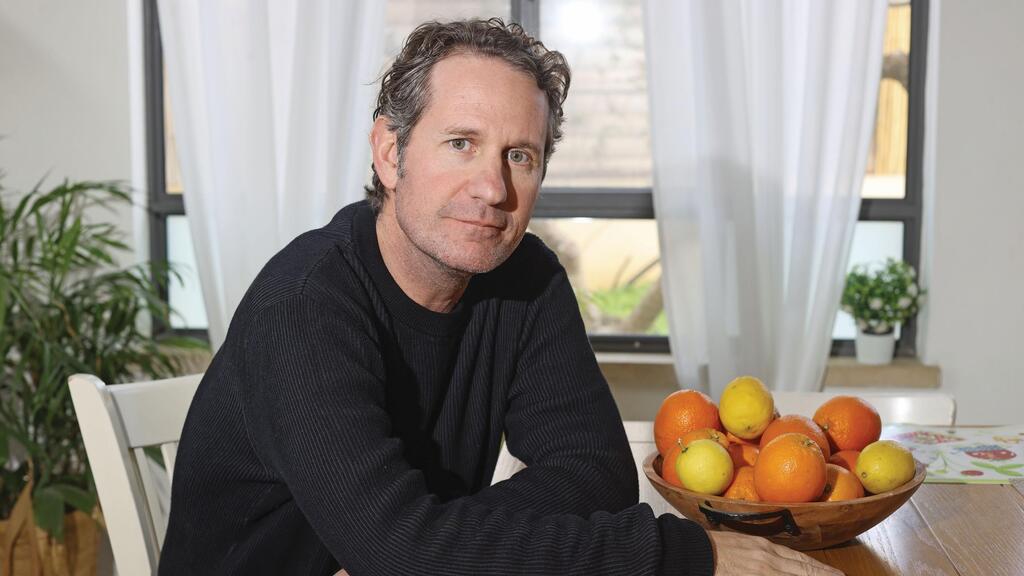
“It happened in the elementary schoolyard in Ra’anana, by the water fountain,” he says. “I saw her for the first time and thought, wow, who is this stunning girl? One thing led to another and we became a couple. I bought her a towel with the word ‘love’ printed on it. At the beginning of seventh grade, the relationship ended, but on good terms. We were kids, the most unripe love there is. Everything was fine — until 10th grade, when I had a dream. From there, everything started.”
Intriguing.
“In the dream, she and I were lovers, and the level of connection and love between us was unimaginable — the ultimate relationship. I woke up shaken, sweating, with my heart pounding. It wasn’t a sexual dream at all, just a very clear knowing that she and I were meant to be together, that she was my soulmate.
“The next day, I told her about the dream. I said, ‘Listen, you and I are meant to be. This is wow.’ But she looked at me and said, ‘Sorry, I’m really not there.’ I said, ‘You don’t understand. We’re the thing!’ And she said, ‘I adore you, but as a friend.’
“I left feeling sad, but I comforted myself — I wasn’t even 16 yet. I told myself, ‘OK, there’s time. I’ll just wait for her.’ That was the moment that changed my life, because from then on, for many long years, I was obsessive about her. Other girls didn’t interest me. I didn’t remain a virgin, I had experiences, but no real relationship. I constantly imagined the moment when she would finally realize we were meant to be together and we would become a couple.”

(Photo: Yariv Katz)
And during all that time, you stayed in touch?
“Yes. She even met someone and told me about him. Very quickly, it became serious between them, and I, like a masochist, listened as she told me how she never imagined you could love like that, what an amazing person he was and how incredible the sex was. I nodded and in my heart told myself, ‘In the end it’ll be over, they’ll break up.’”
And they didn’t.
“When I was 27, she came to me with an invitation to their wedding, and that was the biggest crisis of my life. After she left, I tore up the invitation and told myself I wouldn’t go to that wedding. I cursed the heavens, God — I collapsed mentally.
“Later they moved to Australia, and only then did I finally understand that the dream was probably a case of mistaken identity, that she wasn’t really my soulmate and that I had to do something to let her go.”
Race to a million
To understand how he did that, you have to go back. After the rejection in high school, Frister sank into depression and his studies collapsed. “By a miracle, I finished 12 years of school,” he says, “but without a matriculation certificate. I was drafted into the army with a Profile 24 because of asthma and served as a quartermaster. I started imagining what my life would look like as an adult and realized that without a diploma, I was done for. So I completed my matriculation exams during my service. After my discharge, I studied economics and started working as a broker.
“By age 26, I was already earning 15,000 shekels a month and I became hungry. I wanted to make money — a lot of money. I told myself, ‘Within a year, I want to earn a million.’ But there was a problem. I worked at a not particularly large investment firm, where my boss earned 25,000 a month and his boss earned 40,000. On top of that, I wasn’t a particularly successful broker.”
Definitely a problem.
“Here you have to understand the home I grew up in. My parents are very spiritual. My father worked in insurance and my mother managed a health institute, until,, at a certain point my mother became a homeopathic therapist and my father a medium. They constantly talked about the subconscious, about growth, about dreaming big, and we had tons of books on personal development. I started reading everything, to the point that I completely gave up my social life. But at some point, I realized that all those books were laundering material that quoted ancient texts, and I wanted to read the sources.
“It turned out that through the internet, you can buy PDF files in English from special archives of ancient books. I read hundreds of such books, written between 1850 and 1900, when the New Age period began in the West. I started applying the methods I learned to create the reality I wanted.”
What methods?
“The main exercise was autosuggestion — a psychological process of self-persuasion. I recorded myself talking to myself. I said, ‘Yaniv, good morning. You’re going to earn a million shekels. It’s going to happen soon.’ I listened to it and felt nothing, because creating reality only happens when you get fired up. Only when your heart rate rises do the forces come out of the closet.
“So I recorded myself again, this time with enthusiasm. I said, ‘Yaniv, listen to me carefully. You’re going to make a million shekels this year. There’s no chance it won’t happen. You’re a king. You’re amazing. You deserve great things.’ On the one hand, it was embarrassing, on the other, I was determined. I listened to it several times a day, until at some point it started to work. I felt that I really deserved it, that it was really going to happen.”
And did it happen?
“There were only four big companies in the market where you could really make big money. One day, a friend from my studies told me he’d been hired at one of them and that they were looking for another broker. I went to an interview and they agreed to give me 23,000 shekels a month including a car. Definitely a promotion, but still far from a million. Then the boss added, ‘Oh, and at the end of the year we also have bonuses.’ Bottom line, by the end of that year, I reached a million. More precisely, 966,000 shekels on my 106 tax form.”
Back to the future
Frister continued to advance in his career, but his romantic life was still at rock bottom. At 28, after realizing that the woman he had been waiting for was no longer an option, he decided to use those same spiritual tools to get over her.
“The first thing I did was go back to the first place where we met,” he says. “Late at night, I drove to the elementary school where I studied, jumped over the fence and sat down next to that same water fountain. I meditated and imagined myself going back in time — how I, adult Yaniv, tell little Yaniv, just before he approaches that girl, ‘Stop. She’s stunning, but she’s not ours. The emotional price you’re going to pay because of her is enormous. We don’t really want her.’ Already then, a huge weight lifted off my heart.”
And that was it? That was the end of it?
“No. I wrote myself letters explaining why it was time to let her go, and like with the million, I recorded myself. I explained why she and I were not actually meant to be together.
“Today, this is what I teach anyone who wants to get over an ex: as long as your heart is occupied by someone else, no one new will come along, because your frequency is broadcasting to the universe that you’re on standby. It’s exactly like a parking lot with green and red lights. As long as the light is red, from the universe’s perspective you’re blocked. It won’t send you the person who’s right for you.”
After he felt he had managed to let go, Frister started dating, but still didn’t find the one — until one evening, when he was already 30 and a half. A friend who lived in Herzliya invited him to a housewarming party.
“With a few friends we drank beers, and toward midnight I told him I was heading out. The friend said, ‘No way, we’re continuing to a bar.’ We sat down, the friend went to get drinks and when he came back he said, ‘Get up, we’re moving to the other side,’ explaining that he’d seen two women in the corner and was interested in one of them. That was Yehudit, who became the first and only girlfriend of my adult life — and who is now my wife.”
But your friend was interested in her.
“True. But when he started talking to her, she immediately said, ‘Introduce me to your friend.’ He let it go, introduced us, and from the first moment, there was a click between us. Today I tell everyone: when two people are meant to meet, all the agents in the universe organize themselves to cooperate so it happens.”
On the mailbox of the rental apartment he lived in Netanya was written “Roth,” the landlords’ last name. It soon emerged that Yehudit’s last name was also Roth. And that wasn’t the only coincidence. It turned out that Yehudit, who is 10 months older than him and was already 31 at the time, had gone a year earlier to a relationship mentor who gave her an exercise: go to a bridal salon, put on a wedding dress and say, “This is happening.”
“The salesperson in the salon asked her what her wedding date was,” Frister says. “She just threw out March 17. Not only is that my birthday, it’s the date I proposed to her. When I handed her the ring, she was in shock, and then she told me the story.”
They married, had three children, now 13, 12 and 8, and today live in Kfar Netter. Yehudit worked in human resources at high-tech companies, while he took a gamble on an enticing job offer that turned out to be a mistake, found himself unemployed at home for a year, and then came the coronavirus pandemic.
“Yehudit told me, ‘There’s no point in looking for another job right now. Unemployment is at its peak. But you’ve always said that one day you’d work in a spiritual field — maybe this is the time.’ In hindsight, I know that everything that happened was meant to happen, to push me out of my comfort zone.”
The field Frister specializes in, he says, is “mind theory”: how thoughts influence what happens, how to reprogram the subconscious and how to create reality. “I published dozens of posts on Facebook, opened a dedicated group and very quickly it took off. The fact that it was exactly during the pandemic and many people were at home definitely helped. It was perfect timing. After two years, the business exploded to the point that I could no longer manage it alone. Yehudit left her job and became the head of marketing and social media.”
Today he gives lectures on Zoom, online courses and private sessions. Most of the courses deal with love and relationships, and on his various platforms, he always addresses women.
Why not also address men? You of all people know they also struggle to find relationships or get over an ex.
“There’s no deliberate marketing move behind it. Reality just took it there. To this day, when I do Zoom sessions with 250 people, only about three in the audience are men. So what should I say? Why don’t men seek help the way women do? Honestly, I don’t know.”
In your lectures, you say things like, “He’s just not right for you and it has nothing to do with you,” or “For it to happen, you really have to want it.” Between us, we all know that.
“Those sentences are indeed cheap slogans, but that’s also out of context, because the knowledge I share goes far beyond that. I explain what’s behind them.
“For example, when a woman can’t find a relationship, it’s only because something inside her is resisting, and I help her understand what: whether it’s because she hasn’t gotten over her ex, or because the previous relationship was very bad for her and she’s afraid of being hurt again. During the process, a lot of pennies drop, and at the same time, I give assignments. Ultimately, I don’t teach people how to find love. I teach them how to remove the blockage. Love will arrive on its own.”

(Photo: Shutterstock)
How to let go of an ex*
- Zero contact. Don’t follow him on social media, don’t ask about him. You’re in withdrawal. Disconnect the pipe to him.
- Respect his choices and don’t ask him to choose differently. This isn’t surrender. It’s agreeing to let go.
- Every time you say, “Maybe I was wrong,” “Maybe he’s changed,” you’re poisoning yourself. Stand tall, remember who you are. You’re not dependent on him — he was just a step on your ladder.
- Don’t wait to let go of him in order to start living. Be the one who already let go long ago: how do you think, speak, walk and behave? That’s the new you.
- Remember that you don’t actually miss him, but rather the imaginary version of him that never materialized. You’re in love with “what could have been,” but that’s just an obsessive fantasy. Don’t be addicted to potential.
* The tips apply to women and men
How to raise your frequency and find a relationship
- Put yourself into a new mental code: you’re not the one searching for love — you’re the one love is searching for. You’re not “hoping it will happen.” You’re the one it happens to.
- Tell yourself: “There’s no chance this won’t happen for me soon.”
- Don’t focus on how it will happen, where or when. When it happens, it happens in the blink of an eye.
- Don’t be afraid to turn down offers that aren’t right for you. Not everyone is right for you, and you don’t need to try everyone. Trust your intuition. You know he’s on his way to you, and you’ll recognize him.
- Don’t beg for a relationship, don’t plead, don’t overexert yourself. Finding love shouldn’t be an effort. Declare that you’re ready to meet him and trust that there’s a force that knows how to bring you together at the right place and time. There’s no question about it. It’s happening for you — soon.