

Hush-hush diplomacy. In-person visits. And a very public no-surprises agreement on Iran.
U.S. Secretary of State Antony Blinken and Foreign Minister Yair Lapid were to meet in Rome on Sunday as their new governments looked to turn the page on former president Donald Trump and former prime minister Benjamin Netanyahu, whose close alliance aggravated partisan divisions within both countries.
Now, with Trump sidelined in Florida and Netanyahu leading the opposition, President Joe Biden and Prime Minister Naftali Bennett are focused on pragmatic diplomacy rather than dramatic initiatives that risk fomenting opposition at home or distracting from other priorities.
Gallery
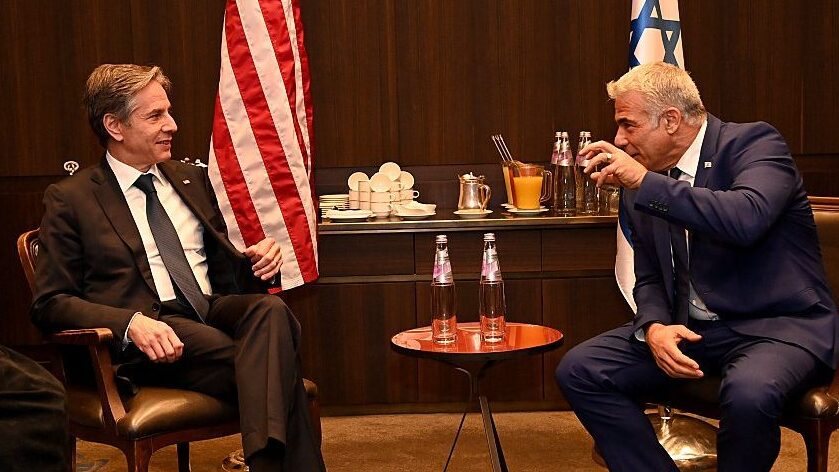
Then-opposition leader Yair Lapid meeting with U.S. Secretary of State Antony Blinken in Jerusalem, May 2021
(Photo: U.S. Embassy in Jerusalem)
That means aiming for smaller achievements, such as shoring up the informal cease-fire that ended last month’s war with Gaza’s Hamas rulers and replenishing Israel’s Iron Dome missile defense system.
A major push to revive the long-dormant peace process between Israel and the Palestinians could unsettle the delicate balance.
“Nobody thinks it’s a good idea to start charging through on a major new peace initiative,” says Ilan Goldenberg, a Mideast security expert at the nonprofit Center for a New American Security.
“But there are things you can do quietly under the radar, on the ground, to improve the situation.”
That approach — of managing the conflict rather than trying to solve it — may succeed in papering over domestic divisions. But it also maintains a status quo that the Palestinians say is increasingly oppressive and hopeless, and which has fueled countless cycles of unrest.
The Americans and Israelis will try to work out differences away from the public, as in Biden’s “quiet” diplomacy, when he privately urged Netanyahu to wind down the Israel-Hamas war ahead of a truce that took effect May 21.
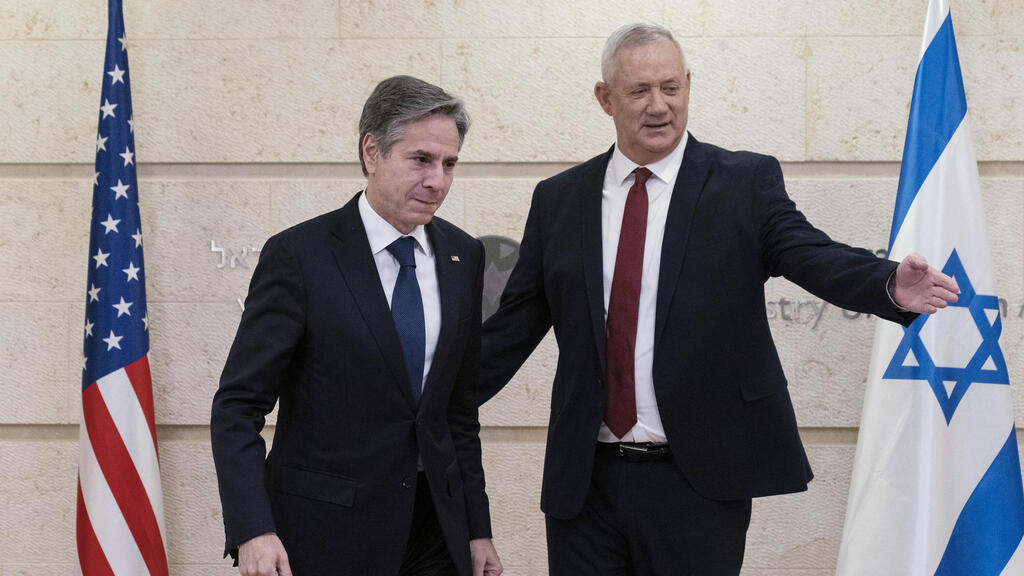
Antony Blinken meeting with Benny Gantz during a visit to Israel in May
(Photo: AP)
“They know you can have a pitched battle, or handle it behind closed doors and try to move the policy,” says U.S. Democratic pollster Mark Mellman, who worked as a consultant on Lapid’s campaigns.
Both governments will try to preserve Israel’s fragile governing coalition, in part by reducing provocations that played a part in sparking the 11-day war that claimed at least 254 Palestinian lives and killed 13 people in Israel.
The new coalition in Israel shares little beyond the conviction that Netanyahu had to go. It’s composed of eight parties, each effectively with veto power on decisions. So if even one party bolts, Israel’s government would be at serious risk of collapse, with Netanyahu waiting just offstage.
At least in the short term, Lapid, a centrist, will be Israel’s point man on repairs to the tattered relationship with Biden and the Democrats. The party controls both houses of Congress but is increasingly divided on the Mideast conflict, with progressive members calling for the U.S. to exert more pressure on Israel.
“What they’re building now is mutual trust,” s Michael Oren, former ambassador to the United States under Netanyahu. “I expect a change of tone rather than of substance... but there’s a possibility that it could produce something better for Israel.”
Topping the agenda in both countries are talks in Vienna over reviving Iran’s 2015 accord with world powers to limit Tehran’s ability to develop nuclear weapons. Trump, with Netanyahu’s backing, pulled the U.S. out of the deal in 2018 and imposed sanctions on the Islamic Republic. Biden promised to restore and expand the agreement.
Though opposed to a new accord, Israel’s new government seems intent on trying to influence the talks rather than scuttle them altogether. Netanyahu enraged many Democrats when he condemned the “very bad deal” before a joint session of Congress in 2015.
Netanyahu’s defiance of the Obama administration, followed by his close ties to Trump, was widely seen as having undermined the traditional bipartisan U.S. support for Israel. And while Israelis welcomed Trump’s diplomatic gifts to Netanyahu over the years, their timing often led to suspicions that he was trying to keep the prime minister in power through deadlocked elections and an ongoing corruption trial.
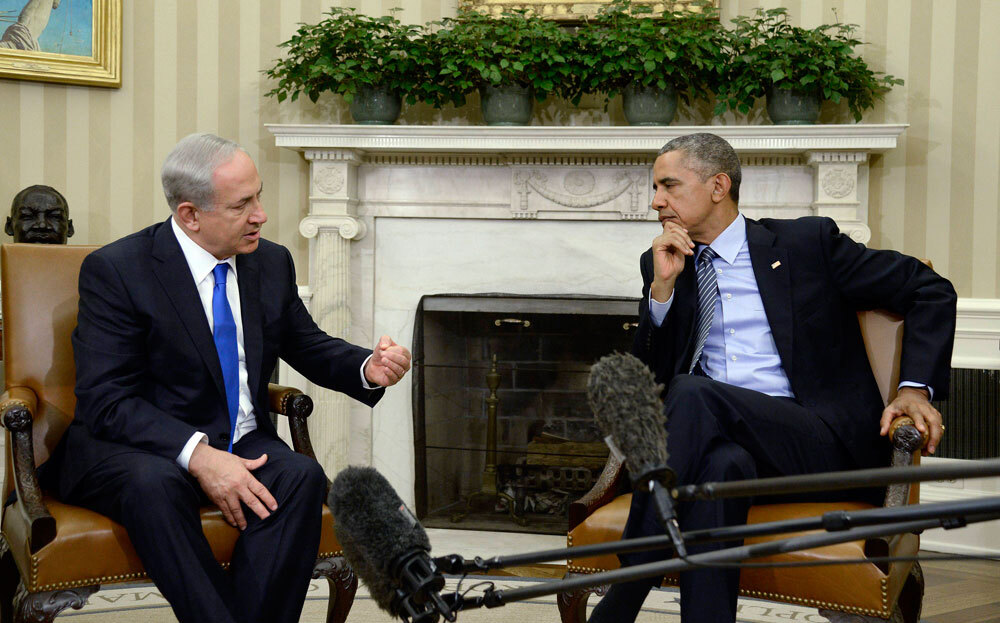
Benjamin Netanyahu and Barack Obama meeting at the White House in 2015
(Photo: EPA)
In contrast to Netanyahu’s approach during the Obama era, Lapid recently announced that he and Blinken had agreed to a “no-surprises” policy in an effort to keep the lines of communication open. The two are expected to discuss the issue Sunday in Rome.
Even the right-leaning Bennett, who is ideologically aligned with the hawkish Netanyahu, has toned down the rhetoric on Iran.
“We will continue to consult with our friends, persuade, discuss, and share information and insights out of mutual respect,” Bennett said Thursday. “But at the end of the day, we will be responsible for our own fate, nobody else.”
Tamping down tensions — or at least not inflaming them — is a key strategy, the officials said. For example, Bennett is a religious nationalist who supports settlement expansion in the occupied West Bank. But he risks losing his job if he alienates his dovish coalition partners.
Officials expect there will be little settlement expansion beyond so-called “natural growth.” But that’s a vaguely defined term that could allow for considerable construction, as well as moving ahead with major infrastructure projects that pave the way for explosive future growth.
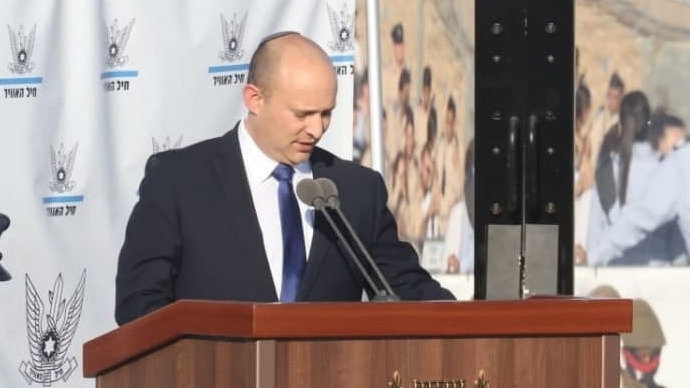
Prime Minister Naftali Bennett speaking at graduation ceremony for IAF pilots on Thursday
(Photo: Moti Kimchi)
A Defense Ministry body advanced plans for 31 settlement construction projects last week, including a shopping center and a special needs school, Israeli media reported.
On the U.S. side, the Biden administration has made clear it wants to extricate the country from intractable conflicts in the Middle East and focus on other challenges, such as climate change and competition with China.
On Monday, outgoing President Reuven Rivlin is to visit Washington at Biden’s invitation. A group of House Democrats are planning an official trip to Israel as soon as Congress’ July 4th recess.
There’s even talk of Lapid and Bennett traveling to Washington later in the summer, separately or together, the officials said. Bennett will serve as prime minister for the first two years, followed by Lapid, the architect of the coalition.
All the officials spoke on condition of anonymity to discuss administration plans and logistics, which have not been finalized.
So far, the reset seems to be functioning. But with the coalition barely two weeks old, significant challenges loom.
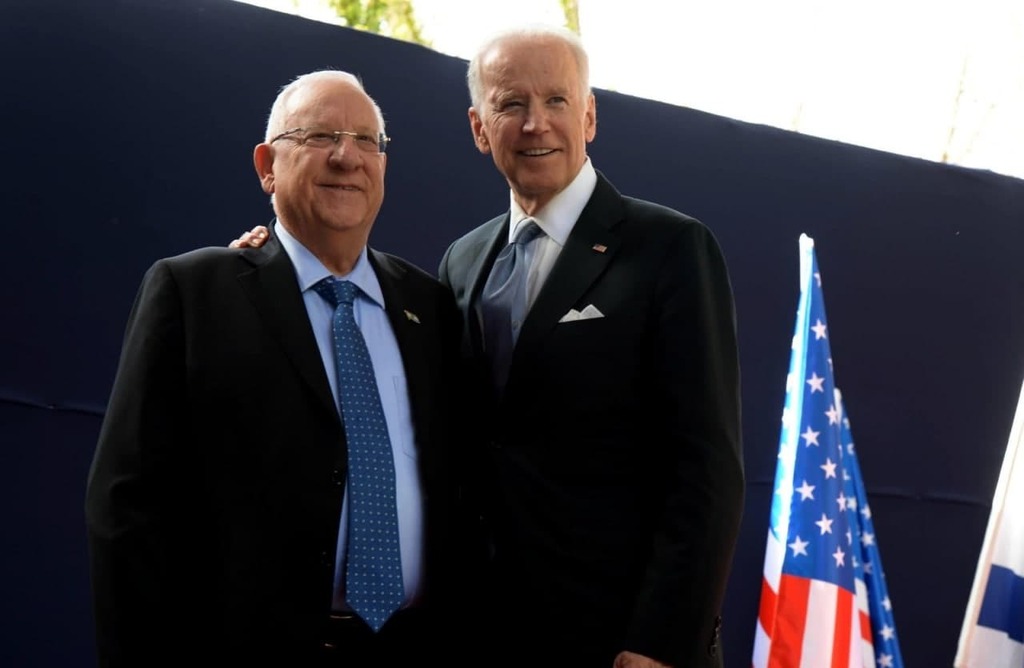
Then-U.S. Vice President Joe Biden meeting with President Reuven Rivlin in Jerusalem in 2016
(Photo: GPO)
Biden has moved to reverse Netanyahu-backed Trump policies that alienated the Palestinians, and the administration has said Israelis and Palestinians should enjoy equal measures of security and prosperity.
But the U.S. has yet to explain how it intends to bring that about without ending Israel’s half-century military rule of the West Bank, its blockade on Hamas-ruled Gaza and policies in Jerusalem that fueled a spring of unrest.
On the Israeli side, making peace with the Democrats appears to be the more urgent priority.
“They are angry,” Lapid said as he took the helm of the Foreign Ministry. “We need to change the way we work with them.”