

Hours before U.S. President Donald Trump’s dramatic announcement of a breakthrough in negotiations between Iran and the United States, recent developments on the Iranian and Lebanese fronts threatened once again to drag the region into a full-scale war.
The brief round of fighting between Iran and Israel marked the peak of an Iranian attempt to impose a new equation on Israel: a direct response against Israel following an Israeli strike in Beirut. From Tehran’s perspective, Hezbollah is not merely a regional ally but a central component of Iran’s national security doctrine.
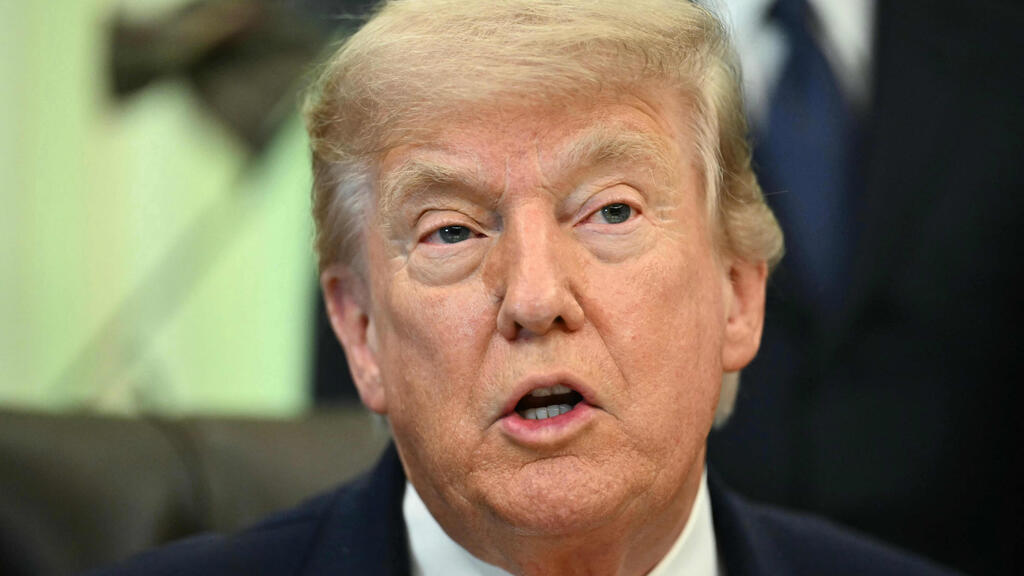
US President Donald Trump
(Photo: Kent NISHIMURA / AFP)
Recent commentary published in Iran reflected the growing view that, after Operation Roaring Lion, greater importance should be assigned to preserving Iran’s connection with the “axis of resistance,” and especially with Hezbollah.
It is still too early to assess whether Israel’s strike in Beirut succeeded in severing the link between the Iranian file and the Lebanese one. A more definitive assessment will be possible only the next time Israel carries out a strike in Beirut, and according to Iran’s response.
In any case, Iran’s considerable influence over Hezbollah allows it to regulate the level of escalation against Israel. For now, Beirut also understands that the key to implementing the cease-fire is not in the hands of the Lebanese government, but in Hezbollah’s hands and, to an even greater extent, in Tehran’s.
The remarks of Simon Karam, the head of Lebanon’s negotiating delegation with Israel, reflected that reality well. Speaking to reporters, Karam expressed doubt that negotiations with Israel could move forward as long as Hezbollah does not commit to the emerging arrangements.
At the same time, Hezbollah also continues to present its alliance with Iran as an unquestioned strategic asset. Lebanese journalist Ibrahim al-Amin, who is affiliated with the organization, argued in recent days that Tehran does not intend to abandon Hezbollah and that its commitment to the group is an inseparable part of the Islamic Republic’s political doctrine.
According to him, Iran’s direct strike against Israel was not a one-time event but an expression of a new policy that could be repeated in the future.
Meanwhile, inside the Iranian arena itself, the confrontation with the United States has entered a new stage of attrition. Trump, frustrated by Tehran’s delay in responding to the latest American proposal and by its refusal to yield to his demands, decided to adopt a new policy of negotiating under fire and increasing military pressure alongside economic pressure.
The U.S. strikes in Iran in recent days were intended to degrade Iranian military capabilities that could be used to disrupt tanker traffic in the Strait of Hormuz and that could also serve Iran in the event of renewed war. More importantly, they were meant to apply pressure that would lead Iran to show flexibility in negotiations and agree to close a deal with the United States.
Despite Trump’s announcement of an emerging agreement with Iran, there is serious doubt that the American strikes achieved the desired diplomatic goal. Iranian media repeatedly stressed this week that Iran will not grant at the negotiating table what it refused to accept under fire.
A commentary article on the Tasnim news site, which is affiliated with the Revolutionary Guards, responded to the renewed wave of U.S. strikes and argued that Iran must respond to “American stupidity” in a way that deters the United States, not through diplomatic concessions. The purpose, it said, should be to break American illusions that repeated attacks can squeeze concessions out of Iran.
Some in Israel viewed the growing confrontation between Iran and the United States as a positive development, one that could wear Iran down, gradually erode its capabilities, deepen its distress, force it into significant concessions and distance the possibility of an agreement that would not be expected to meet Israel’s demands, especially on the nuclear issue, while also funneling billions of dollars into the Iranian regime’s dwindling coffers.
Still, there is serious doubt that what 40 days of intense fighting and long weeks of sustained economic pressure failed to achieve could be achieved through continued strikes in the current format. The Iranian regime continues to pay economic prices for the ongoing naval blockade, but at this stage there is no evidence that it is prepared to soften its positions.
Moreover, even if these confrontations ultimately led to a renewed full-scale war, it is far from certain that such a war would advance Israel’s central strategic objective: blocking Iran’s path to nuclear weapons.
Without an operational move, one that would not be risk-free, capable of significantly damaging the underground nuclear facilities and removing the stockpiles of highly enriched uranium still in Iran’s possession, another round of war could also end without a satisfactory solution to the nuclear problem.
 Dr. Raz Zimmt
 Ultimately, the current state of “neither war nor peace” may have delayed the possibility of reaching an arrangement that could be problematic for Israel, but it is far from desirable over time.
Iran’s new leadership continues to display self-confidence, a willingness to take risks and adherence to the ideology of resistance. As long as the nuclear issue is not resolved, whether through a diplomatic arrangement or effective military action, it is hard to see how continuation of the status quo serves Israel’s interests.
The partial progress Iran achieved in its nuclear capabilities in the months between Operation Rising Lion and Operation Roaring Lion proves that even the significant damage inflicted on its uranium enrichment capabilities during the 12-day war does not necessarily prevent their recovery over time, especially given the Tehran regime’s growing motivation to obtain nuclear weapons.
Beyond that, it is doubtful whether Israel can afford to continue a policy of frequent rounds of fighting against Iran without a clear decision.
If it were possible to guarantee that the Iranian regime would not survive for long, Israel could continue for now without an arrangement and under the closest possible intelligence monitoring. But despite the many challenges facing the Islamic Republic, there is currently no indication of an immediate and significant threat that could destabilize the regime.
In such a reality, time is not necessarily working in Israel’s favor. That is especially true given the growing voices in the United States objecting to the latest war, which could make it harder for Israel to once again enlist Washington’s active involvement in another military campaign.
Dr. Raz Zimmt is director of the Iran and Shiite Axis Program at the Institute for National Security Studies INSS