

All that remains of Iran is the comb, and that, at best. The head is already severed from the body. The body still runs, but without direction. There is no army. No economy. Hardly even a state. Iran is fading. It will collapse. So why do so many seasoned commentators insist that Iran is winning?
Because they see only the comb. And the Iranians have perfected, more than any nation, the art of appearances. They polish the comb. Masters of illusion, deception, and fraud. Persian is one of the richest languages in the world; in a single sentence, they can deliver opposing messages to everyone in the room—without provoking resistance. Each listener hears what they wish. It is all wrapped in elegant discourse, laced with musical cadence, like a sonata at dusk. But in truth, you’ve been sealed inside an airtight chamber, where only Shiite Iranians are allowed to breathe. And the rest of the world? Let it suffocate.
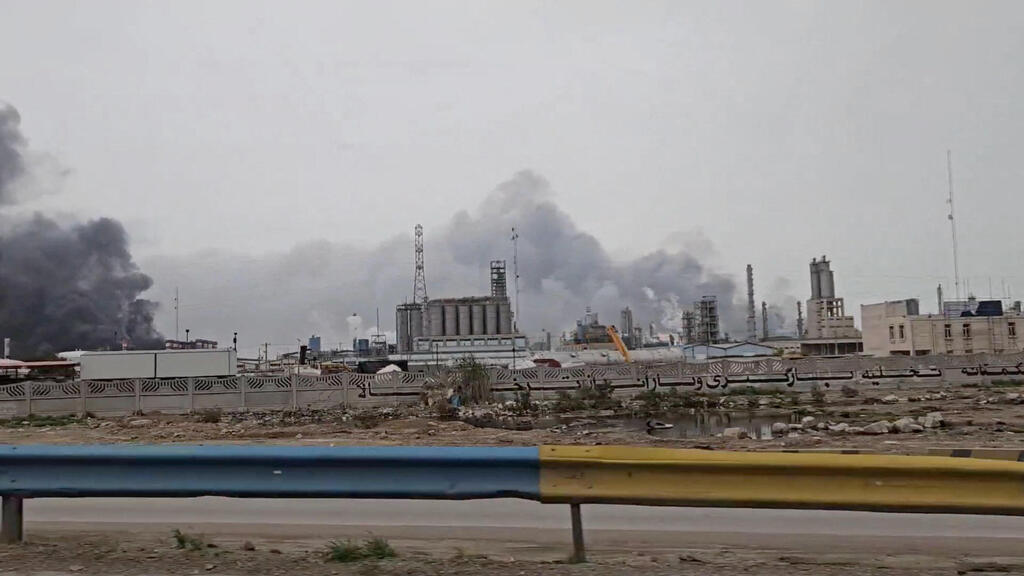
Smoke rises after strike on petrochemical complex
(Photo: Social Media/Reuters)
Vance, an intellectual and a man of manners, spoke firmly and eloquently at the press conference following the latest round of talks. But somewhere along the way, he lost control. Hollywood will one day tell the story of the 21 hours he spent, one of the administration’s most prominent anti-war voices, a representative of isolationism, locked in a room with seasoned Iranian deceivers. Carpet merchants in a shop with no prices. His delegation fled Islamabad in haste. That genius Trump, no doubt already arranging new delegations to meet the Iranians. Perhaps he’ll ask France’s President Macron or Britain’s Prime Minister Starmer to lead them next.
I am no critic of the Israeli media, not at all. It does not side with our enemies. Rather, the average Western mind, trained in basic assumptions of trust and human decency—simply cannot grasp this reality. And to the conservative right in Israel, a word of advice: calm down. When explaining, there is no need for insult or rage. The facts speak clearly enough. Let’s lay them out.
Donald Trump emerges as the most effective statesman since World War II. I listen at length to the refined voices of the East Coast elite, clucking in disapproval—alarmed by his bluntness, his unpredictability, his inconsistency. They are right about the facts. But wrong in their conclusions. They are living in yesterday’s world.
Trump acts according to circumstance. You enter a boxing match with fists, not feathers. He is the only Western leader who, with remarkable assistance from Israel, has managed to outmaneuver the Iranians—to throw them off balance. At every turn, they falter. After years of paralyzing fear of Iran, “the two best air forces in the world,” as U.S. Secretary of Defense Pete Hegseth put it, brought the country to the brink of collapse.
So why did Trump initiate a ceasefire?
Contrary to the conservative narrative, it was the White House, not Iran, that drove the ceasefire. The media reported accurately that the U.S. appeared to retreat from its position. But to interpret that as weakness is childish.
The ceasefire was necessary. And here lies the strategic divergence between the United States and Israel: for Israel, the fall of the Iranian regime is existential. For the United States, it is a step along the path to its true confrontation. The White House has not taken its eyes off the real adversary of Western civilization.
The “axis of evil” may include radical Muslim states, but with the collapse of Iran’s regime, they would suffer a fatal blow. That axis, the Americans say, will be dismantled. But America’s central challenge lies elsewhere, with China.
And against China, the United States cannot stand without NATO.
For Washington, the war in Iran has been a rehearsal, a test of power projection, both military and diplomatic. Militarily, the U.S. and Israel delivered a devastating, long-term shock across the Eastern Hemisphere, stunning Gulf states and striking at Chinese confidence. Israel reduced to dust the Chinese-built defense technologies that had shielded Iran. The display of force was so overwhelming that China quickly announced it would cease supplying arms to Iran.
But diplomatically, cracks began to appear in the American-Israeli warship—threatening to sink those military achievements.
What delayed the fall of the Iranian regime were condemnations and withheld tactical support from within NATO. For a regime already in its death throes, that was enough. Instead of collapsing under pressure, Iran convinced itself the enemy was divided—that survival was only a matter of time. Just hold on a little longer.
Israel understood the need to realign NATO ranks, and thus supported the ceasefire. Notably, Trump’s first meeting after announcing it was with NATO Secretary-General Mark Rutte, a staunch supporter of the administration’s policies and of Europe’s debt of gratitude to the United States. Without American intervention against Nazi Germany and Soviet Russia, Europeans today might be speaking German, or Russian.
Since returning to Europe, Rutte has been working to tighten NATO’s cohesion. In the coming weeks, we will likely see increased support from most NATO countries for U.S. actions against Iran, particularly in enforcing the blockade of the Strait of Hormuz, where early signs of cooperation are already emerging.
Iran has no cards left. Only the comb.
Negotiations will resume, and the campaign to topple the regime, through diplomacy or force, will continue. Iran will once again provide the justification for its own downfall. Muslims may not drink alcohol, but they are intoxicated—drunk on a sense of Aryan superiority and racial dominance. Worse than the Nazis, as we will soon explain.
 Rami Simani
 This is what Prime Minister Benjamin Netanyahu understood years before anyone else, with wisdom and courage. It was not easy to stand alone on that stage. When I hear the hollow interviews of Hillary Clinton and John Kerry, boasting of how they resisted Netanyahu’s calls to dismantle the ayatollahs and “save the world,” I can only say: thankfully, Israel was spared destruction. Credit where it is due.
The ayatollahs are more dangerous than the Nazis—more sophisticated in their deception. Fueled by a fervent, mystical belief in bringing destruction upon the world, they leave no room for coexistence. Like the Nazis before them, they have brought this upon themselves. Only the regime’s destruction will suffice.
As for us, the moral civilization of the West, Israel has been right since its founding: to preserve the good, one must sometimes wield the tools of evil.
But above all, never trust the comb.