

Whether the talks between Iran and the United States lead to a permanent ceasefire and the end of the war or collapse into renewed fighting, it is clear that the Islamic Republic will not emerge from the current conflict unchanged. The war erupted at a time of profound internal upheaval in Iran, following the most significant wave of protests since the 1979 revolution.
The regime faces a deep and ongoing legitimacy crisis stemming from a widening gap between the authorities and the public, particularly younger generations, alongside a worsening economic crisis and growing shortages of water and electricity.
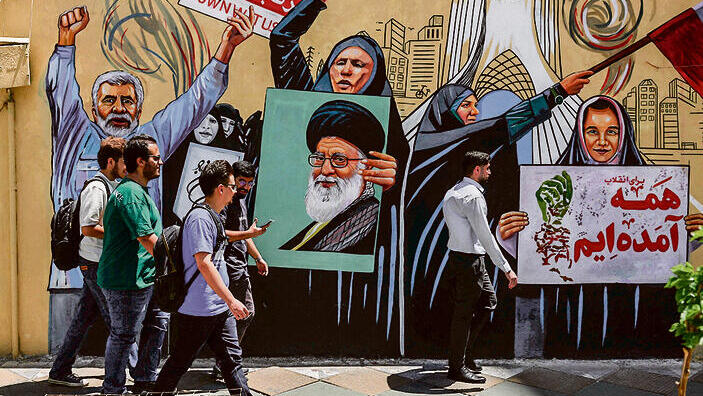
Tehran
(Photo: Majid Asgaripour, via REUTERS)
In recent days, officials in Israel’s security establishment told Army Radio that a protest in Tehran’s bazaar was further evidence of mounting economic pressure. Still, sporadic protests alone should not be taken as an indication of the future of Iran’s protest movement. Demonstrations are a constant feature of life in the country. A recent Stanford University study found that between 2009 and 2024, Tehran averaged one protest every three days.
In any case, a genuine threat to the regime’s survival depends not only on millions of Iranians taking to the streets and forming a broad, organized social coalition, but also on a shift in the balance of power between the authorities — which still possess effective means of repression and loyal security forces — and their opponents, who have yet to translate public discontent into an organized and sustainable political alternative.
Moreover, during the war, voices within Iran expressed reservations about the intentions of the United States and Israel. Continued strikes on national infrastructure and universities, President Donald Trump’s threats to “bomb Iran back to the Stone Age,” and reports of efforts to encourage subversive activity among ethnic and linguistic minorities, especially the Kurds, were perceived as attempts to dismantle the Iranian state. Those developments sparked strong reactions even among regime opponents, reflecting nationalist and patriotic sentiments.
Iranian philosopher Bijan Abdolkarimi recently argued that while citizens seek better lives, many now believe, in the wake of the war, that preserving Iran’s political independence is a necessary condition for achieving that goal. In their view, efforts to dismantle the state threaten not only the Islamic Republic’s regime but also Iran’s independence.
Nevertheless, it is clear that Iran’s leadership is acutely aware of the severity of the economic crisis and its potential to reignite protests. An Iranian sociologist recently warned of the continued erosion of the middle class under mounting economic pressure. According to him, society is becoming increasingly polarized between a small wealthy elite and a majority drawn from the lower classes. He said criticism of the economic situation has not yet fully surfaced because of the war, but if a ceasefire is reached, it is expected to return with greater intensity, and deeper crises — particularly economic ones — could erupt.
Even if a future agreement between Iran and the United States leads to significant sanctions relief, that alone will not solve the deeper crisis. Iran’s struggling economy has long suffered from structural problems including corruption, mismanagement and excessive control by state or State-affiliated institutions. Lifting sanctions may help the regime cope with worsening hardships, but without major reforms, it is doubtful Iran will be able to escape the severe financial crisis in which it is mired.
New leadership
Facing these challenges is a new Iranian leadership that will be required to respond to public demands immediately after the war. The “Third Islamic Republic,” which replaced the “Second Islamic Republic” led by Ayatollah Ali Khamenei from 1989 until his death, is characterized by a transition from religious theocracy to authoritarian military rule centered on the growing dominance of the Islamic Revolutionary Guard Corps.
For now, the leadership in Tehran is focused primarily on survival, preparing for the possibility of renewed war and efforts to bring the conflict to a definitive end. Once the war ends, however, it will have to direct most of its efforts toward rebuilding the country.
Additional reports published in recent days point to the extensive damage Iran sustained during the war, repairs that are expected to take years. The governor’s office in Tehran said about 60,000 housing units in Tehran province alone were damaged. A senior official in Iran’s energy sector said at a conference that major damage was also inflicted on infrastructure and that it could take about two years to restore conditions to their prewar state. He warned that next winter would be difficult and challenging in terms of meeting energy demands for manufacturing, industry, agriculture and services, and said there would be no choice but to sharply reduce private-sector consumption by about 40%.
The end of the conflict could also intensify internal divisions within Iran’s leadership, which has so far managed to maintain a high degree of cohesion, largely because of wartime conditions. Studies of authoritarian regimes dominated by armed forces have found they tend to be less resilient in the face of economic crises because their leaders are trained primarily to achieve military objectives rather than manage major civilian challenges. Such regimes are also more prone to internal splits and factionalism within the officer corps, especially during periods of crisis.
Iran’s new leader, Mojtaba Khamenei, may also face growing criticism sooner than expected. It is still too early to determine whether he will be able to consolidate enough power to establish himself as supreme leader, especially given unresolved questions surrounding his health. It is possible that criticism — perhaps muted until now — will emerge after the war regarding his ability to succeed his father, particularly amid reports that his father himself allegedly opposed the prospect of hereditary succession. Such an appointment is viewed by many as a departure from the Islamic Republic’s founding principles regarding dynastic rule.
 Raz Zimmt
What is clear is that the end of the war is unlikely to resolve the fundamental problems facing the Islamic Republic, which have intensified in recent months amid protests and conflict. Even if regime change does not currently appear likely, the end of the war could force Iran’s new leadership to confront the realities of daily life, and it remains doubtful whether it has solutions to the country’s deepening crises. In the coming months, it will likely become clear whether the war halted — even temporarily — the regime’s decline or accelerated internal processes that could ultimately lead to the long-awaited political change.
Dr. Raz Zimmt is director of the Iran and the Shiite Axis Program at the Institute for National Security Studies (INSS).