

International Women’s Day was supposed to arrive wrapped in pastel branding and corporate empowerment slogans. Instead, it arrived in flames.
Not symbolic flames, but real ones - hijabs burning in Tehran. Women standing unveiled in defiance. Videos traveling faster than censorship can contain them.
Gallery

Fans hold signs reading 'Freedom for Iran' and 'Woman, Life, Freedom' during a 2022 World Cup match, in support of protests in Iran, in this widely circulated image taken after demonstrations erupted following the death of Mahsa Amini
(Photo: Oz Moalem)
For years, the West has framed its confrontation with Iran around centrifuges and uranium stockpiles. But the most destabilizing force in the Islamic Republic does not spin underground. And this force walks in the streets without a headscarf.
Feminism - but only when it’s comfortable?
Since the death of Mahsa Amini in 2022, after her arrest by Iran’s “Guidance Patrol” for allegedly wearing her hijab “improperly,” three words have shaken a regime: ״Woman. Life. Freedom.״
Three words. A structural threat. Because when a woman burns her hijab in Tehran, she is not performing for social media. She is deconstructing a pillar of state ideology.
And yet, parts of Western progressive discourse appear strangely hesitant. They condemn repression, but resist alignment. They denounce authoritarianism, but hesitate when liberation complicates geopolitical narratives. Which raises an uncomfortable question: Is feminism universal? Or does it expire at ideological borders?
Iranian feminism vs. Instagram feminism
Narges Mohammadi, the imprisoned Iranian human rights lawyer and Nobel Peace Prize laureate, once wrote: “The Islamic Republic fears women more than it fears sanctions.”
That is not a metaphor. It is a diagnosis. Authoritarian systems often anchor legitimacy in visible control, and few symbols are more visible than the regulation of women’s bodies. In Iran, the hijab is not merely a religious expression; it is state enforcement stitched into daily life. Remove it, and the regime’s moral architecture trembles.
Meanwhile, in parts of the West, feminism often thrives as discourse rather than danger. It trends. It convenes. It brands.
In Tehran, it risks imprisonment. The difference is not sophistication. It is at stake. When freedom becomes existential, theory dissolves.
The CNN effect is dead. Long live the algorithm!
Once, revolutions required satellite trucks. Political scientists called it the “CNN Effect” - the power of broadcast media to shape foreign policy agendas. Today, revolutions require Wi-Fi.
Platforms like X, Instagram and TikTok have become diplomatic battlegrounds. The algorithm is not neutral; it is catalytic.
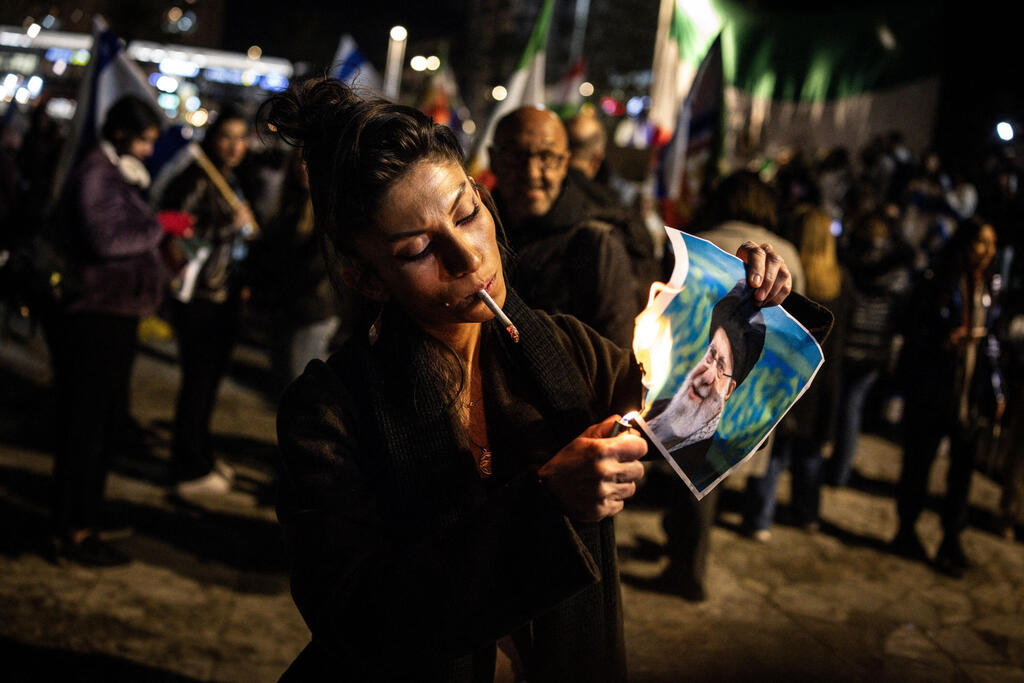
A demonstrator in Holon, Israel, lights a cigarette with a burning picture of Iran’s Supreme Leader Ali Khamenei, recreating a viral protest photo, Jan. 15, 2026
(Photo: JOHN WESSELS / AFP)
A single act of defiance - a young Iranian woman lighting a cigarette with the burning image of Supreme Leader Ali Khamenei - can move from Tehran to Jerusalem to Washington in seconds. No newsroom approval required.
The regime understands this. That is why internet shutdowns accompany protest waves. Control the narrative, control legitimacy. But legitimacy is eroding.
Not about fabric. About power.
The burning hijab is not a cultural insult. It is a political declaration. It says: My body is not state property.
For Israel, which often confronts Iran primarily through the lens of nuclear threat and regional aggression, there is a temptation to see this struggle only strategically. But it is also moral.
The Iranian regime’s greatest vulnerability may not be external pressure. It may be internal defiance, led by women who refuse to embody obedience. Missiles deter armies. Women dismantle narratives. And narrative collapse can be more destabilizing than military confrontation.
The real obituary
The new feminism was not born in Manhattan streets. It was born in Tehran, in risk, in fire, in consequence.
If it died anywhere, it died where it became performative. Where it mistook visibility for courage. Where slogans replaced sacrifice. Because feminism that costs nothing threatens nothing. And the feminism unfolding in Iran threatens everything.
Author’s note: This article is dedicated to my grandparents, who immigrated from Iran to Israel and still speak with longing of their beautiful homeland.
- Nitzan Fux is an entrepreneur, lecturer and communications strategist specializing in human impact. She is the granddaughter of Iranian immigrants.