

The Knesset, sitting as a constituent assembly, enacted a new chapter in Israel's constitution during its final week in session: the Basic Law: Torah Study. It is probably the shortest Basic Law in the state's history, consisting of a single sentence: "Torah study is a foundational value in the heritage of the Jewish people and in the State of Israel." Yet despite its apparent simplicity, it marks a dangerous constitutional turning point.
The law's content is not the only cause for concern. Equally troubling is the manner in which it was enacted. A Basic Law, which is meant to form part of Israel's future constitution, was not debated in the Knesset Constitution, Law and Justice Committee — the natural forum for shaping the country's constitutional rules — but rather in the House Committee.
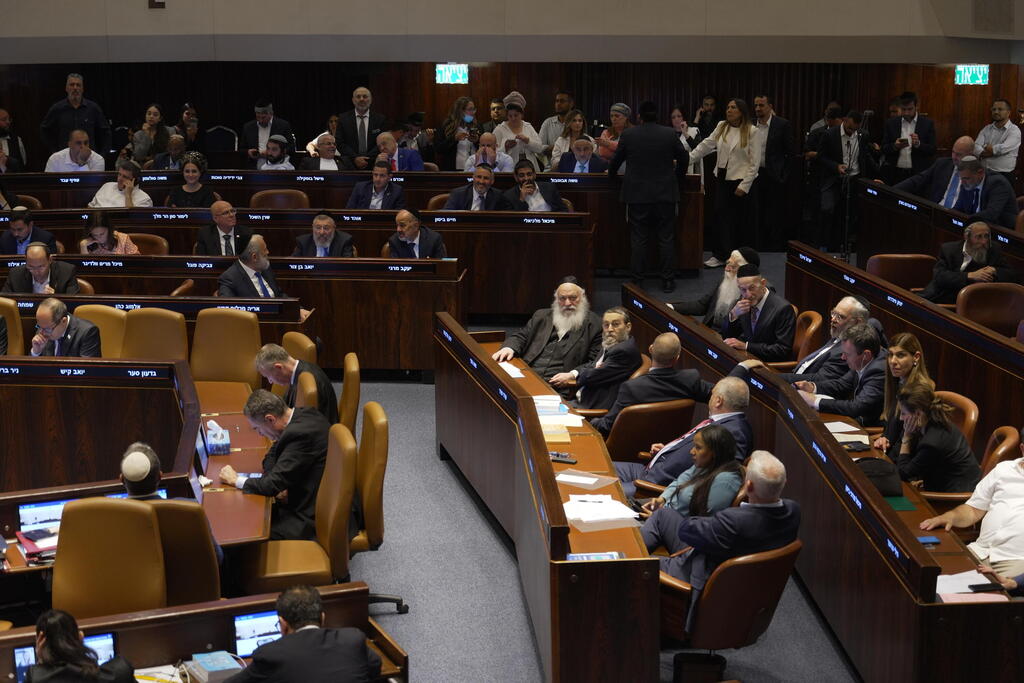
The Knesset, sitting as a constituent assembly, enacted a new chapter in Israel's constitution during its final week in session: the Basic Law: Torah Study
(Photo: Alex Gamburg)
It was rushed through without meaningful public or political debate over its constitutional implications and ultimately passed by a coalition majority of 63 Knesset members to 52. Thus, through a hasty process and without broad consensus, a new constitutional cornerstone was added to Israel's constitutional framework.
The Basic Law: Torah Study, enacted out of narrow political considerations, should be repealed. But as long as it remains in force, it also offers an important lesson about one of the proposals that has gained traction in public discourse in recent years: the idea of a "thin constitution." According to this approach, the first stage of constitution-making should be limited to regulating the institutional and procedural rules of the game while avoiding, as much as possible, contentious value-based questions. Those ideological disputes, proponents argue, can be postponed.
An idea built on an illusion
There is no such thing as a "neutral" constitution. Those who propose freezing the current constitutional status quo and avoiding the addition of new values are, in effect, seeking to entrench the values that have already found their way into the Basic Laws. In other words, a "thin constitution" is not an avoidance of value judgments. It is itself a value judgment — one in favor of preserving the existing constitutional order.
 Prof. Tamar Hostovsky Brandes
And that existing order is far from neutral. It means that the right to equality will continue to lack explicit constitutional protection; that the Basic Law: Israel as the Nation-State of the Jewish People will remain without the necessary balances and amendments; that the "preservation of laws" clause in the Basic Law: Human Dignity and Liberty will continue to shield outdated religious arrangements dating back to the 1950s; and now, that the Basic Law: Torah Study will also become a permanent part of Israel's constitutional fabric.
Even before this constitutional maneuver, the idea of a "thin constitution" was problematic. After it, the idea has become untenable. It is impossible to speak of freezing the constitutional status quo immediately after the coalition has added a new constitutional chapter that represents nothing but an abuse of the Knesset's constituent authority. This is a Basic Law designed to advance narrow political interests, confer a constitutional advantage on one sector at the expense of others and create a normative foundation for legislation that would perpetuate the exemption of the ultra-Orthodox public from military service while entrenching the distinction between those who bear the burden and those who are exempt.
Moreover, now that the Basic Laws include both the Nation-State Law and the Basic Law: Torah Study, it is difficult to accept the claim that the principle of equality should not be enshrined in the Basic Laws because it is "controversial." If the Knesset is willing to constitutionalize values carrying a clear ideological agenda, there is no justification for continuing to portray equality — one of the foundational principles of every liberal democracy and the principle on which majority rule itself rests — as an issue that must remain off limits.
 Yaniv RoznaiPhoto: Oz Moalem
The Basic Laws are not merely a technical instruction manual for the operation of the branches of government. They embody the social compact on which life together in the State of Israel depends. If the Basic Law: Torah Study is not repealed, the appropriate response is to balance it by enshrining in the Basic Laws the democratic values of the state, in the spirit of the Declaration of Independence: equality, the rule of law, separation of powers and the independence of the judiciary.
A constitution cannot be merely a mechanism for exercising power. It must also be a document of shared values. Without those constitutional anchors, Israel will not have a thin constitution. It will have an incomplete and one-sided constitution.
- Yaniv Roznai is a full professor at the Harry Radzyner Law School at Reichman University. Prof. Tamar Hostovsky Brandes is an associate professor in the Faculty of Law at Ono Academic College.