

President Recep Tayyip Erdogan’s visit to Saudi Arabia this week is not a dramatic geopolitical shift, but another step in Riyadh’s long-running strategy of hedging risks in an increasingly unstable regional environment.
Contrary to claims that Saudi-Turkish rapprochement reflects ideological alignment or Saudi Arabia joining a bloc associated with the Muslim Brotherhood, the reality is far more pragmatic and far less surprising.
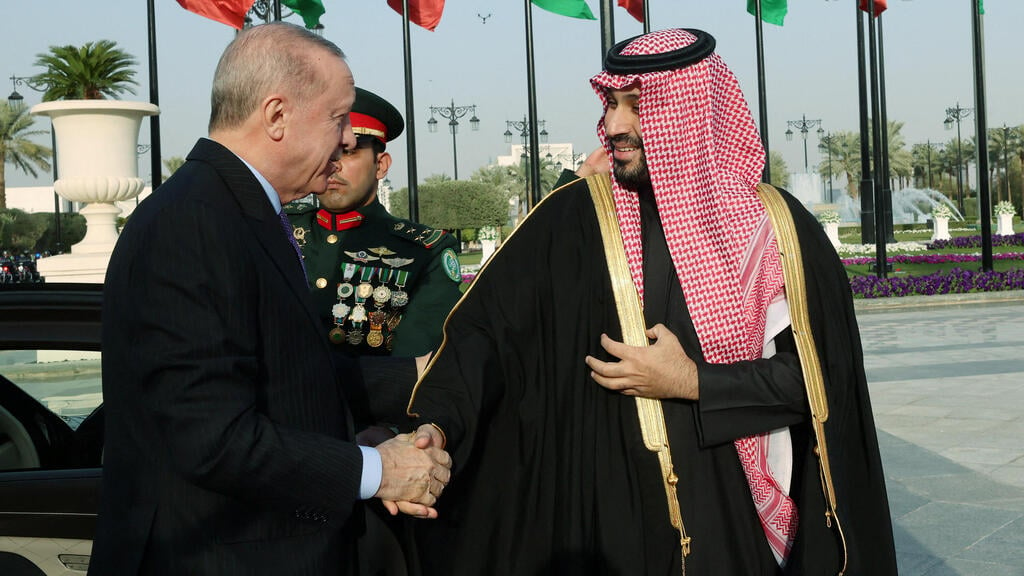
Turkish President Recep Tayyip Erdogan and Crown Prince Mohammed bin Salman
(Photo: Murat Cetinmuhurdar/Turkish Presidential Press Office/ Reuters)
First, the warming of relations between Riyadh and Ankara did not begin recently. It is a process that has unfolded over roughly five years, following a period of sharp tension. Since 2021, both sides have invested considerable effort in rebuilding ties, a process that culminated in 2023 with Turkey's largest defense export deal. That agreement included unmanned aerial vehicles, technology transfers and joint production. What is happening now is consolidation and deepening, not a sudden breakthrough.
At the core of the rapprochement lies a hedging strategy. In the face of mounting uncertainty, including tensions between the United States and Iran, the war in Gaza, instability in Yemen and Sudan, Syria and the Horn of Africa, Riyadh seeks to broaden its portfolio of political, economic and security partnerships without entering binding alliances.
Turkey fits this logic well. It is a regional power with significant industrial, military and diplomatic capabilities, but without some of the constraints and costs that often accompany close partnership with the United States. There is also a near-structural doubt in Riyadh regarding Washington’s long-term security commitment, a doubt that likely deepened after Crown Prince Mohammed bin Salman failed to secure a formal defense pact from President Donald Trump modeled on U.S. treaties with Japan or South Korea.
Saudi Arabia has shown pragmatism in the past in its dealings with Muslim Brotherhood-linked actors in Yemen and even with Hamas. But this does not amount to joining a new ideological axis. Riyadh has not abandoned its deep suspicion of the Muslim Brotherhood, which remains outlawed in the kingdom, nor has it adopted Erdogan’s worldview. The relationship is transactional.
 Yoel GozanskyPhoto: INSS
Geopolitical considerations matter, but they are sometimes secondary to economics. Saudi and Turkish officials speak openly about deep cooperation based on concrete projects aimed at raising bilateral trade from about $8 billion to roughly $30 billion.
From a regional perspective, the rapprochement also touches on post-Assad Syria. Here, too, both sides appear aligned in supporting Ahmad al-Sharaa. Once again, ideology matters less than realpolitik. Saudi Arabia and Turkey share an interest in preventing Syria’s return as an arena of Iranian influence, state collapse or renewed jihadist chaos.
The Saudi-Turkish warming does not take place in a vacuum, and Saudi suspicion toward Turkey’s regional ambitions has not disappeared. Another challenge involves Turkey’s relations with the United Arab Emirates, which is a more significant trading partner for Ankara than Saudi Arabia. Turkey will need to balance between Gulf rivals without choosing sides.
Reports have also surfaced about Pakistan, a nuclear-armed state, joining a form of “Arab NATO” alongside Turkey and Saudi Arabia. Pakistan and Saudi Arabia maintain a special strategic relationship that may include nuclear guarantees. Ankara and Islamabad do not share ties of that depth, and it is unlikely Pakistan would extend a similar deterrence umbrella to Turkey.
Erdogan’s visit underscores the growing complexity of Middle Eastern diplomacy. Riyadh is not replacing one partner with another. It is adding layers of relationships to strengthen its security. The goal is security. The method is economic and strategic risk hedging among multiple actors, aimed at reducing exposure to shocks, pressure and overdependence.
From an Israeli perspective, the central takeaway is that Saudi-Turkish cooperation should be interpreted through the lens of risk management, not ideological drift. Riyadh is hedging, not changing course. If the past five years are any indication, this trend is likely to deepen gradually, quietly and pragmatically, rather than crystallize overnight into a new regional axis.
Dr. Yoel Guzansky is a senior researcher at the Institute for National Security Studies and a former official at Israel’s National Security Council.