


On December 27, 1925, a son was born in Lithuania to a dentist and an industrialist. The family moved to Latvia, and during his adolescence, they emigrated to the United States. There he became an aeronautical engineer and a senior figure in Betar, a right-wing youth movement, and from where he left for Israel in 1948. These are the roots of Moshe Arens, universally known as Misha, whose 100th birthday will fall two days before Netanyahu’s sixth government marks three years since its formation.
For a year and a half (1989–1990), when Arens was foreign minister, I was an assistant in his office, and went through countless colored markers highlighting passages in documents. As a junior staffer, I was not involved in shaping policy positions, let alone political decisions involving the Likud party, or coalition affairs. But I observed closely, and saw a man who was intelligent and, above all, decent and principled.
Gallery
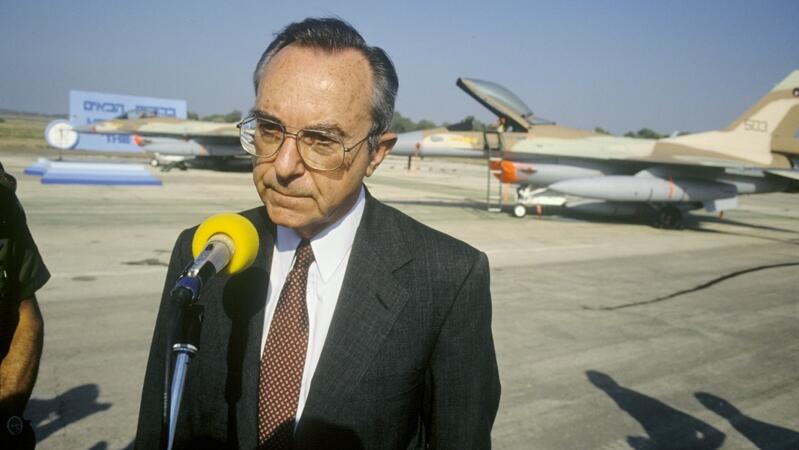
Then Defense Minister Moshe Arens at the arrival of C-F16 aircraft from the United States
(Photo: 'In the Camp', Uzi Foundation, collection of the IDF Archives and the Defense Establishment)
One can argue with his positions over the course of his public career. For example, was he right to push for an attack on Iraq during the First Gulf War in 1991 (which Israel ultimately refrained from carrying out)? Or one might speculate what would have happened had he not succeeded, as Prime Minister Yitzhak Shamir’s envoy, in recruiting American backing to derail the 1987 London Agreement between Foreign Minister Shimon Peres and King Hussein of Jordan - imagine negotiations over the future of the territories conducted with a Jordanian delegation that included Palestinian representation, rather than with the Palestinian Authority seasoned with Hamas, or vice versa.
One can also weigh the pros and cons of developing a fighter jet independently: Arens, formerly deputy CEO of Israel Aerospace Industries and an associate professor at the Technion, was among the strongest advocates of developing the Lavi fighter for the Israeli Air Force.
But Arens’s integrity cannot be denied. Thus, in 1987 he resigned from the government following the decision to cancel the Lavi project (he returned later). In 1980, after Ezer Weizman resigned, he refused Menachem Begin’s offer to appoint him defense minister, as he would not carry out the evacuation of parts of the Sinai, as required by the Camp David Accords.
It was clear to everyone that he was guided by no personal considerations, neither advancement or publicity, nor any personal gain, but solely by the merits of the matter and the good of the state.
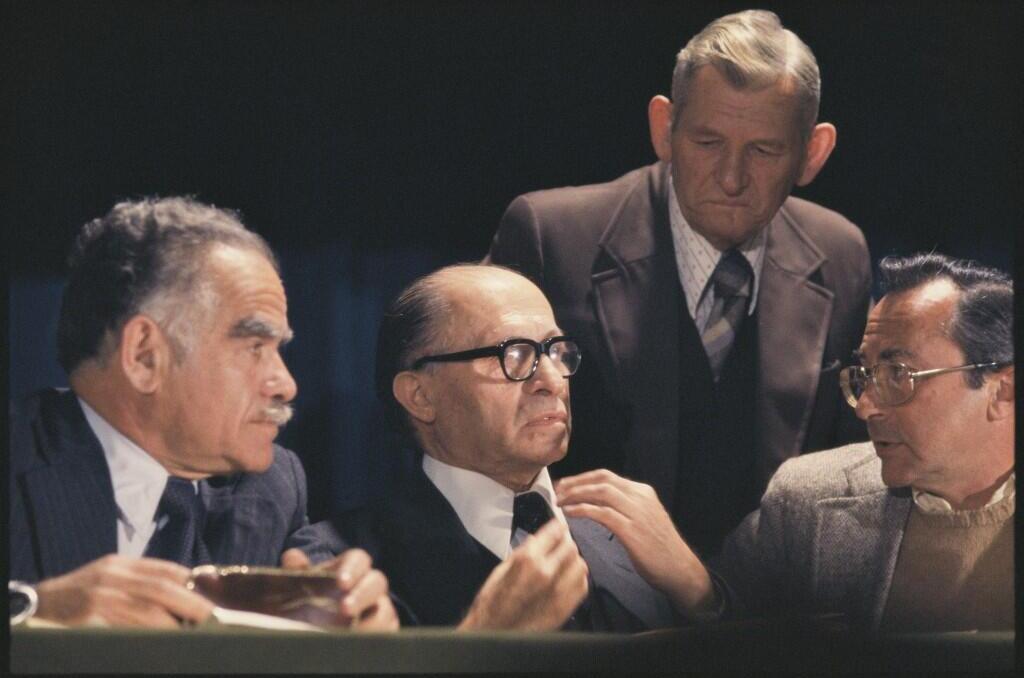
Menachem Begin talks with Yitzhak Shamir, Moshe Arens and Eitan Livni in November 1977
(Photo: Alon Reininger, Courtesy of Contact Press Images NY)
Principles have consequences. As an engineer (some would say, also by temperament), he defined problems and sought solutions, and he did not evade conclusions, as if difficulties would simply evaporate on their own. Thus, he did not rule out granting citizenship to residents of the territories. In an op-ed (Haaretz, June 2, 2010), he wrote that the Muslim minority, 17% of the state’s population, still does not feel at home in the State of Israel and is far from enjoying equal opportunity. He further stated that a large share of the blame for this situation rests on the shoulders of successive Israeli governments, which failed to initiate effective action to integrate Muslim citizens into the state. Regarding the future of the territories and their residents, he suggested that adding one and a half million Muslim residents of Judea and Samaria to the state would, of course, exacerbate the situation, but then went on to discuss the consequences. He asked: Would a Muslim minority of 30% create a challenge that Israeli society could not withstand? Arens concluded: That is the question Israeli politicians - and all Israelis, Jews and Arabs alike - must contemplate.
Moreover, Arens published articles criticizing the Nation-State Law, which passed several months before his death, as unnecessary and harmful. During his tenure as defense minister, he insisted on opening elite military tracks to Druze soldiers. More broadly, as someone raised on Jabotinsky’s liberal legacy, respect for every human being was a guiding light for him. Even toward political rivals, he was a gentleman who upheld decorum, thereby contributing to respectful public discourse.
 Tova Herzl
I do not recall him ever raising his voice in the ministry; no one complained of being humiliated or offended. In professional meetings he listened to everyone, senior and junior alike, even when they disagreed with him. As befits a leader, he did not surround himself with flatterers but with capable people whose talents he appreciated – he understood that they did not threaten him or undermine him, but rather served him. Among them stood out Benjamin Netanyahu, his eloquent and energetic deputy at the Foreign Ministry, who had also served as his deputy when Arens was Israel’s ambassador to Washington (1982–83). Arens pulled him out from relative obscurity, and the rest is history.
Moshe Arens, Misha, died on January 7, 2019, aged 93, and we can but long for politicians of his ilk.
- Tova Herzl is a former Israeli ambassador to South Africa and the Baltic countries, and served as liaison between the U.S. Congress and the Israeli Embassy in Washington.