

The most striking outcome of the latest election is the recognition that Israel has an enormous Arab electorate that, until now, had not fully realized its electoral potential. Once it does, it becomes a significant political force that cannot be ignored.
On the other hand, when we hear how many of its leaders struggle to condemn the Hamas terrorists responsible for the massacre in Israeli communities near the Gaza border three years ago, and oppose defining Hamas as a terrorist organization, it becomes clear that they cannot be relied upon to help form a government that may have to confront threats from Hamas, Hezbollah or Iran.
Gallery

Supporters celebrate at the Joint List's election headquarters in Nazareth following the release of exit polls
(Photo: AHMAD GHARABLI / AFP)
What, then, should be done in this complicated situation?
This week's Torah portion, Vayera, presents us with a somewhat similar challenge.
After many years of infertility, Abraham and his wife Sarah finally have a child together, Isaac. Abraham already has an older son, Ishmael, born to Hagar, Sarah's Egyptian servant. The two boys grow up together, with a 13-year age difference between them.
One day, Sarah notices that something troubling is happening between the children. As the Book of Genesis recounts: "Sarah saw the son of Hagar the Egyptian, whom she had borne to Abraham, mocking."
The precise meaning of the Hebrew word metzachek, translated here as "mocking," is not entirely clear, but it certainly carries a negative connotation. Some interpretations suggest sexual misconduct. Others suggest that Ishmael was attempting to introduce Isaac to idol worship, or that Sarah witnessed Ishmael trying to physically harm Isaac, perhaps even endangering his life.
Whatever the case, Sarah demands that Abraham expel Ishmael from their home. Her position is unequivocal: This child cannot continue living under the same roof as her precious, beloved son.
Abraham, to put it mildly, is hardly enthusiastic about the idea. As the biblical verse puts it: "The matter was very distressing to Abraham on account of his son."
God intervenes in the dispute and rules in Sarah's favor. The children must be separated. Ishmael has rights and deserves to live and flourish, but not alongside Isaac.
Reluctantly, Abraham obeys. He provides Hagar and Ishmael with food and water for their journey into the wilderness, and they set out.
But then the story takes a dramatic turn.
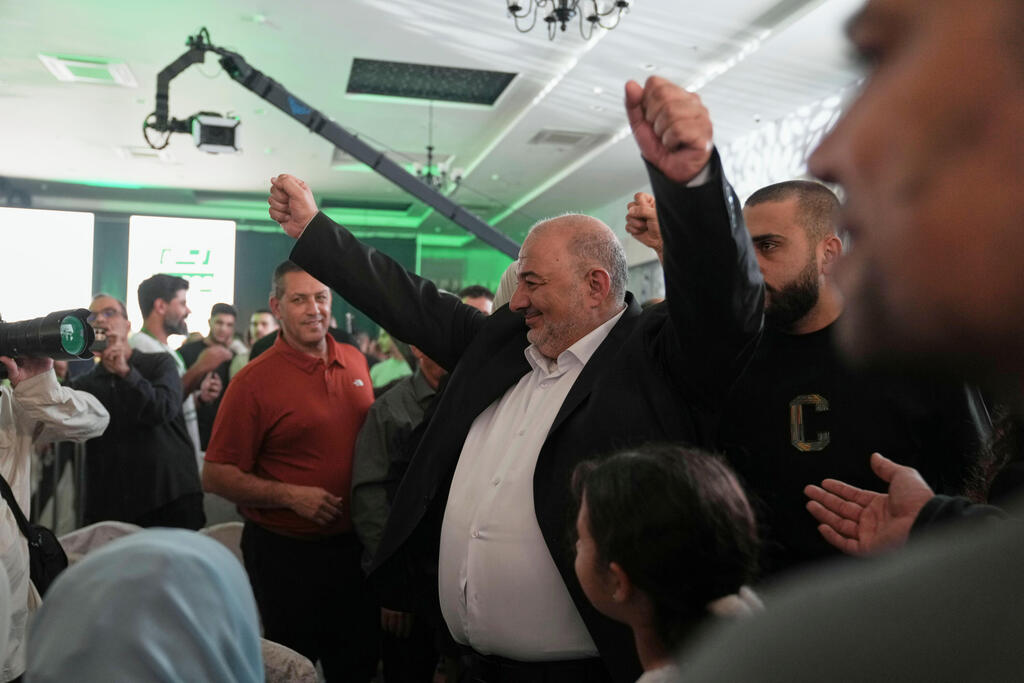
Ra'am chief Mansour Abbas and supporters celebrate following the release of exit polls at the party's election headquarters
(Photo: AP Photo/Mahmoud Illean)
Their water runs out, their food proves insufficient, and Hagar places her son beneath a bush. She moves away and waits for him to die, unwilling to witness the tragedy with her own eyes. Presumably, she cannot bear the sight of her son dying before her, crying out for help.
The biblical account then describes Hagar weeping. God hears the boy's voice, and an angel tells her: "Do not be afraid, for God has heard the voice of the boy where he is."
In other words, do not despair. Lift up your child, for he, too, will become a great nation.
The Bible concludes the account by describing how God indeed helps the boy. Ishmael grows, develops and becomes a warrior, "an archer."
What are we to make of this story? What does it tell us today?
On one hand, there is a problem in the relationship between Ishmael and Isaac that apparently cannot be resolved, at least not easily. After all, God agrees with Sarah and commands that the children be separated.
On the other hand, God also listens to the voice of Ishmael, wherever he may be, and blesses him with the promise that he will become a great nation.
Perhaps this is the essence of the matter: Ishmael has the right to grow and flourish, and God listens to his voice as well. But that does not necessarily mean that the two can work together.
Hundreds of thousands of Arab citizens cast their ballots this week, and their voices are being heard loud and clear, echoing throughout every home in Israel. They cannot be ignored.
As long as the State of Israel remains a democracy, it must listen to those voices, too.
At the same time, we cannot ignore the difficulty of growing together and governing the country in partnership when one side, at least in part, shares the views of our bitterest enemies.
This story will require Isaac to understand the fundamental differences between himself and his brother Ishmael, particularly in the ethical and moral values he will learn in his parents' home.
Yet he must also recognize that his brother, who does not necessarily always follow Abraham's path, has a voice of his own, and that God listens to him as well.
This week, we heard the voices of Ishmael's descendants reverberate across the world. We are now called upon to strengthen what unites us as a nation, so that we can hear those voices without bowing to them, and stand together in confronting the challenges ahead.