

There is good intent behind the government’s proposal for the so-called “Jewish Identity Realization Law,” but those who genuinely seek national unity must oppose it and focus instead on achieving its goals through consent and consensus. Judaism’s values must never be imposed by force.
The proposed legislation includes bans on disturbing Jews who pray or put on tefillin in public spaces or state-funded institutions. It also calls for mezuzot to be installed in public buildings. These aims may be worthy, but not through coercion.

Surveys conducted in Israel over the past decade show that more than 90% of Jewish children are circumcised; 30% of secular Israelis and over 80% of traditional Israelis fast on Yom Kippur; and 87% of secular Israelis and 97% of traditional Israelis participate in a Passover Seder.
What do all these have in common? None are mandated by Israeli law.
Now imagine: how many parents would refuse to circumcise their sons if it were legally required? How many cars would flood the streets on Yom Kippur if driving were outlawed that day? If the Knesset passed a law banning driving on Yom Kippur, it would become the most traffic-clogged day of the year.
State-backed religious coercion is not only harmful to human rights — it is also destructive to Judaism itself. Before October 7, Israel was already in turmoil, marked by deep social division that culminated in Yom Kippur confrontations in Tel Aviv. That tension reflected the broader national crisis triggered by the government’s attempt to overhaul the judiciary — moves driven, in part, by dissatisfaction with Supreme Court rulings on religion and state matters.
The core problem was the lack of any attempt to build a national consensus on issues of Jewish identity and religious life.

(Photo: Ungvar / Shutterstock)
While Israel’s Declaration of Independence defines the state as “Jewish and democratic,” no government has ever succeeded in passing a constitution or comprehensive law that defines what those terms truly mean. As a result, competing visions — from government and judiciary alike — have deepened the divide between Israel’s “Jewish” and “democratic” identities.
The October 7 attacks changed that reality. The massacre, in which about 1,200 civilians and soldiers were killed, prompted many Israelis on the left to reconnect with their Judaism, while some on the right began to recognize the damaging effects of religious coercion on both national unity and Judaism itself. That realization has only intensified amid Israel’s ongoing war with Iran.
 Alan PeledPhoto: Orel Cohen
In this context, Jewish unity is now more essential to the survival of the State of Israel and the Jewish people than at any point since the end of World War II.
There has been much debate recently about what it means for Israel to be a democratic state, yet no real effort to reach a consensus on what it means to be a Jewish state. If we truly seek a sustainable path forward — one that unites rather than divides — we must define “Jewish” in a way that protects both freedom of religion and freedom from religious coercion, while upholding human rights.
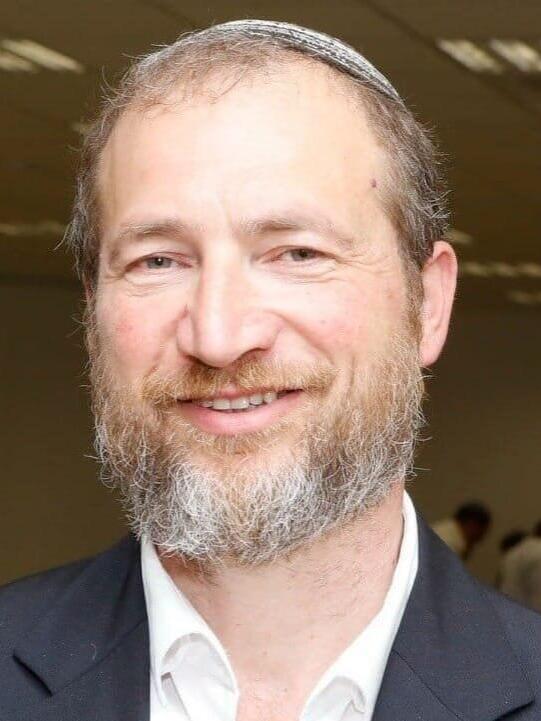 Rabbi Shmuel Slotki
This requires three steps:
- Drafting a broadly accepted national charter outlining the principles of a Jewish and democratic state.
- Eliminating state-sponsored religious coercion in all forms.
- Strengthening Jewish education across all school systems — formal and informal — by encouraging inclusivity, diversity, and mutual respect.
If we could agree on a shared definition of a Jewish and democratic state, one accepted by Israel’s moderate majority, we might finally build the foundation to bridge the deep polarization dividing our society. Laws like the proposed “Jewish Identity” bill will not unite the nation — they will only push more people away from Judaism.
As Rabbi Abraham Isaac Kook wrote in his commentary Olat Re’iyah: “True peace can come to the world only through the value of abundant peace — where all sides and all approaches are seen and understood, each having its own place, value, and purpose. Thus, Torah scholars increase peace in the world.”
If the Knesset were to embrace this vision, Israel would already be a far more united nation.
Alan Peled is chairman of the movement Judaism by Consent, and Rabbi Shmuel Slotki is its CEO. Rabbi Slotki, a reserve lieutenant colonel, took part in identifying victims in southern Israel following the October 7 terror attacks. Two of his sons, Noam and Yishai Slotki, were killed in combat that day