

The Iranian regime is facing a significant shock at this hour. The regime’s symbol, Ali Khamenei, has been eliminated, along with key figures in his inner circle. Khamenei was not only a religious symbol but also a national one, providing the regime with legitimacy among the Iranian public and extending that legitimacy into the cultural and national spheres.
The removal of the regime’s central symbol comes after two years in which it has experienced severe internal legitimacy crises, including its inability to protect citizens from bombardment and a crisis of confidence over its failure to provide basic civilian needs, along with the crackdown it has carried out in recent weeks. All of this further erodes the fragile ground on which the regime stands.
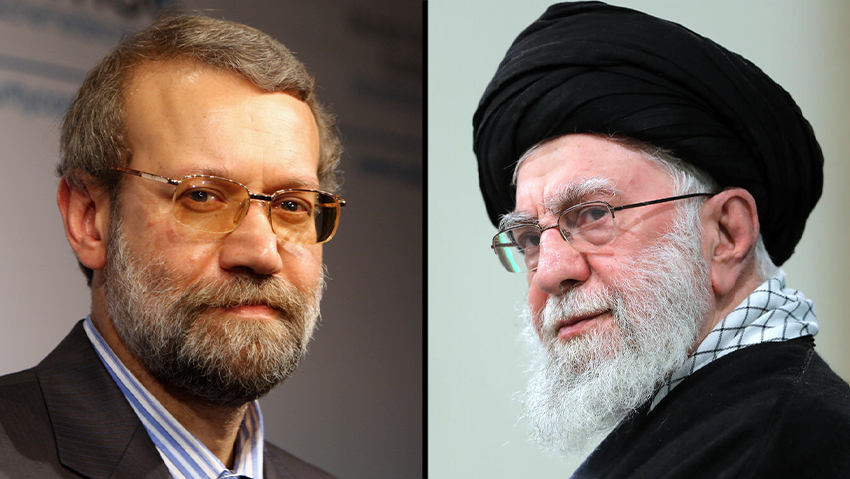
Ali Khamenei and Ali Larijani
(Photo: Office of the Iranian Supreme Leader/AP gettyimages)
The leadership understands the depth of the crisis it faces. Against this backdrop, Ali Larijani, secretary of Iran’s Supreme National Security Council, delivered a lengthy speech addressed directly to the public. His remarks reflect the regime’s deep fear that a power vacuum, coupled with American and Israeli attacks, could embolden protesters and opposition figures to demonstrate and even attempt a coup, forcing the regime to divert vast resources to suppress them.
Larijani’s speech seeks to preempt that possibility by shattering opposition hopes that U.S. and Israeli intervention could bring a better future for Iranian citizens. At the same time, he attempts to mobilize the public by invoking pre-revolutionary memory, reminding Iranians, without explicitly saying so, of the massive economic investments Iran has made in its regional proxies and the policies that led to sanctions.
He opened with a call for Iranians to set aside internal disputes and unite as a cohesive national front against foreign threats. Aware that such an appeal alone would not satisfy potential protesters’ frustration, Larijani turned to memories of pre-revolutionary humiliation that began in the 19th century, when foreign powers — Russia, Britain, France and later the United States — penetrated Iran, extracted its natural resources and rendered its leadership dependent, effectively turning the country into a client state.
That humiliation, combined with the shah’s authoritarian rule and U.S. involvement in Iran’s internal political arrangements, led to the unprecedented 1979 alliance between Islamists and communists, religious and secular forces. The unifying symbol in restoring Iranian pride and returning natural resources to the Iranian people was Ayatollah Ruhollah Khomeini.
Abandonment of religious arguments
Larijani largely abandoned religious arguments in favor of anti-colonial rhetoric, the same themes that once united Iranians under the banner of revolution and that helped sow seeds of hostility toward the United States and Israel. He argued that the American method has always been plunder, portraying President Donald Trump as a symbol of that plunder. As evidence, Larijani claimed that the alleged attempt to abduct Venezuelan President Nicolás Maduro was intended to allow Trump and the United States to seize Venezuela’s oil and loot its resources.
From Venezuela, he turned to Israel, arguing that its aggression stems from its small territory, lack of natural resources and limited population. He claimed Israel launched a campaign against Iran in order to seize its resources and manpower and position itself as an imperial power.
Between the lines, Larijani sought to convey a message to citizens: Even if the United States and Israel succeed in toppling the regime and installing a new order under a democratic Iranian leadership, that leadership would in practice be a puppet government serving American and Israeli interests. Those interests, he argued, would prevent the Iranian people from benefiting from their own natural resources.
In essence, Larijani’s message was this: You are protesting the economic hardship and heavy-handed rule you are experiencing. But if the United States and Israel control Iran, your economic situation will be no better. The country’s natural resources, from which you currently benefit, would be plundered by American and Israeli companies. Not only would living conditions deteriorate, he suggested, but national pride would also be shattered. The pre-revolutionary dream of restoring the glory days of the Persian Empire — a national ethos that united Iranians then and still resonates in Iranian culture and society — would be broken.
Larijani chose to focus on arguments rooted in that ethos of Persian imperial glory, including perceptions of cultural superiority and collective humiliation, knowing the unifying power of such foundational narratives. He continued by saying Iran does not seek war, while simultaneously using that ethos to frame civilian suffering from bombings, sanctions, poverty and the tensions of recent weeks during negotiations with the United States. According to his narrative, Washington will never agree to a deal that truly respects Iranian sovereignty.
Thus, he cast the conflict not only as a religious struggle but as a battle for Iran’s independence and national pride.
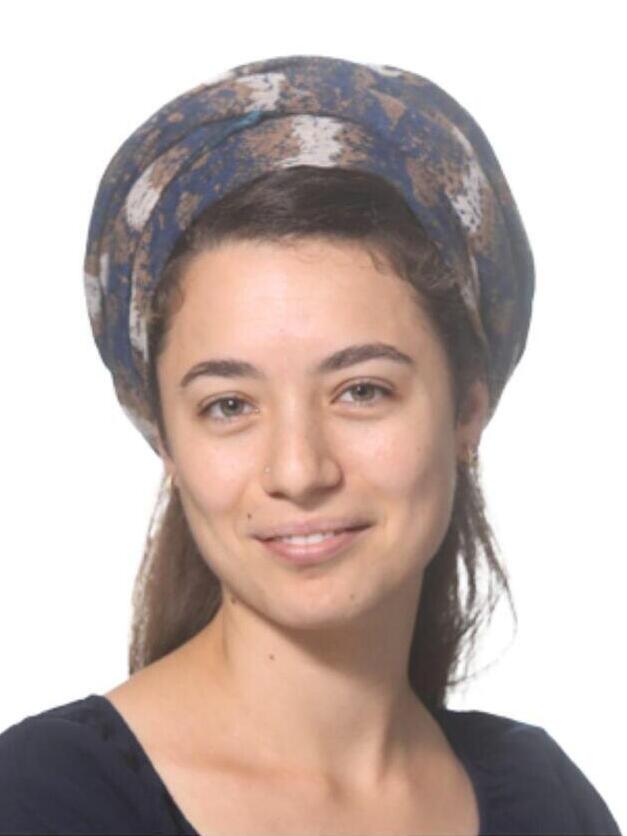 Sarah Lerech Zilberberg Photo: INSS
The speech is significant in preparing the Iranian public for a prolonged confrontation, for regime stabilization until a new unifying figure can replace Khamenei, and for recovery from civilian destruction caused by bombardment. Equally important, it aims to reinforce and even rebuild domestic legitimacy for the regime’s investments in arming Palestinians in the West Bank and Gaza, Hezbollah and its other proxy arms — funding that has drawn sharp criticism on the Iranian street, echoing a local version of an “Iran first” argument: Our economic situation is so dire, why are you investing millions abroad?
The regime’s cynical mobilization of a colonial narrative, intertwined with antisemitic themes common in Iranian propaganda, is likely to resonate with those who faithfully consume its messaging and may influence others to varying degrees. At the same time, many Iranians recognize the regime’s manipulation of national myths and view its messages with suspicion. Even if relative calm returns to the streets, it does not necessarily mean that those who took part in previous protests have been persuaded. It is reasonable to assume that many are afraid and waiting for another external development, such as Khamenei’s killing, to shift the balance.
The author is an Iran researcher and a member of Forum Dvora.