

While public and media attention remains focused on the Middle East, Ankara is quietly and systematically building a strategic axis of influence across Africa.
Through defense agreements, infrastructure projects, military bases and expanding religious and cultural influence, Turkish President Recep Tayyip Erdogan’s neo-Ottoman vision is taking shape across the continent. This emerging geopolitical reality, in which Turkey is steadily widening its presence, requires Israel to rethink its approach and adopt more creative solutions.
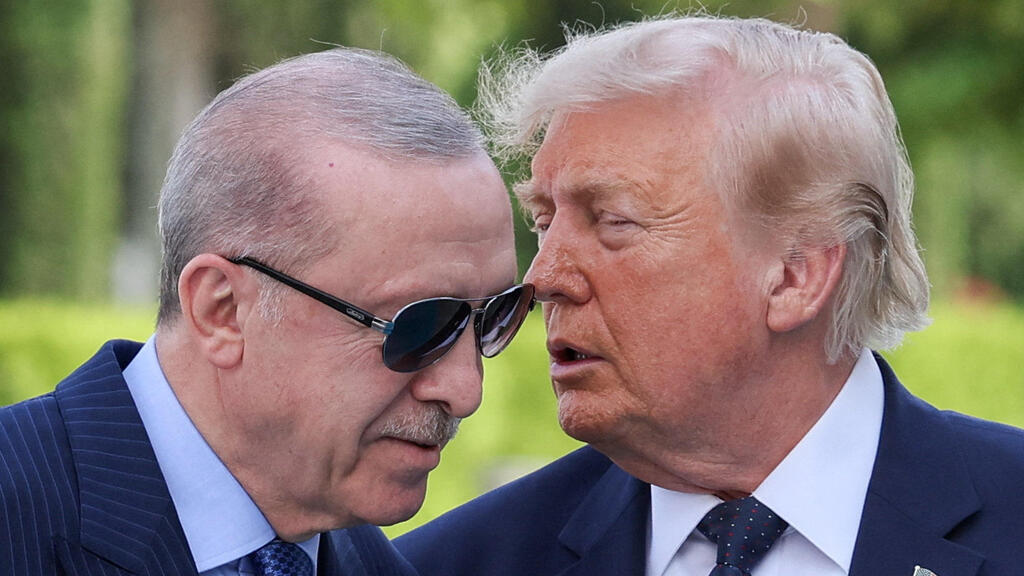
Turkish President Recep Tayyip Erdogan and US President Donald Trump
(Photo: REUTERS/Umit Bektas)
The NATO summit hosted by Erdoğan last week can be counted as another public-relations success in Turkey’s effort to position itself as a leading regional and international power.
Erdoğan adopted a conciliatory posture toward the other members of the alliance, presented Turkey as a valuable strategic asset to Western interests and received praise from his close ally, U.S. President Donald Trump, as well as NATO Secretary-General Mark Rutte.
As expected, the Turkish president also used the summit to criticize Israel, arguing that Israeli and Greek opposition to Turkey’s acquisition of F-35 fighter jets had “no place.”
He again presented the two-state solution as the only path to peace and called on the parties to reduce tensions in Gaza and Lebanon.
Days before the summit, Turkey’s foreign minister issued an especially inflammatory statement, declaring that “Israel has become a burden humanity can no longer bear.”
That rhetoric drew little meaningful criticism from NATO leaders, who preferred to avoid confrontation with the summit’s host.
At a time when diplomatic criticism of Jerusalem is growing, Western governments are increasingly choosing accommodation with Turkey for strategic reasons. Put plainly, Israel’s actions and its deteriorating relations with the international community are playing directly into Ankara’s hands.
Turkish messaging is now treated with tolerance even by Israel’s friends, as governments prioritize hard interests. This is also visible in Trump’s approach. He treats Erdoğan with considerable respect and sees him as a stabilizing regional actor, including in mediation efforts involving Iran, Syria and Lebanon.
Turkey’s double game
For these reasons, it is unsurprising that Erdoğan continues largely unhindered to play a double game designed to advance Turkey toward global leadership.
Those ambitions do not end in the Middle East. His neo-Ottoman vision is also taking root in Africa in ways that pose a growing challenge to Israel.
For the past two decades, Africa has served as fertile ground for Erdoğan’s ambitions, particularly in the Horn of Africa, North Africa, including Libya, and the Sahel.
Ankara’s courtship of the continent began in earnest in 2005, which the Turkish government declared the “Year of Africa.”
Since then, the relationship has passed several important milestones, including the African Union’s recognition of Turkey as a “strategic partner,” a series of joint summits and an extraordinary number of presidential visits that made Erdoğan one of the most frequent foreign leaders to travel across the continent.
The real turning point came in 2011, when Erdoğan visited Mogadishu, the capital of Somalia.
That visit laid the foundations for massive Turkish involvement that has since expanded across the humanitarian, economic and military spheres.
Turkey sees Somalia as a vital strategic asset. It serves as an anchor for projecting power, expanding economic influence and establishing a military presence in the Horn of Africa near the crucial shipping routes of the Red Sea and Gulf of Aden.
Turkish economic and infrastructure assistance has deepened Somalia’s dependence on Ankara and allowed the country to become a testing ground for Turkish ambitions.
Turkey now operates its largest overseas military base in Mogadishu, while the Turkish military provides direct aerial and military assistance in the local fight against growing terrorism.
This involvement is accompanied by major investment in natural resources, including special agreements for oil and gas exploration off Somalia’s coast.
Reports have also said Turkey is advancing plans for a space base and ballistic missile testing facility near the Indian Ocean coast in the Somali town of Warsheikh, at an estimated cost of about $350 million.
Hard power and soft power
Seen more broadly, expansion in Africa is a strategic objective for Erdoğan as he seeks to position Turkey as a regional power.
The strategy combines hard power, including military presence and extensive defense exports, with what has become known as “drone diplomacy.”
At the same time, Ankara is deploying soft power through an unprecedented network of embassies and air routes, while deepening cultural and religious influence.
This presence is growing as traditional powers such as France and the United States retreat from parts of the continent.
The vacuum allows Turkey to establish a diplomatic foothold that could increasingly challenge Israel, particularly given bloc politics within Africa and Ankara’s prominent standing in the African Union.
Israel still maintains productive relations with numerous African countries, but it currently lacks the presence, tools and resources required to counter Turkey’s strategic encirclement.
The Horn of Africa
The clearest current point of friction between Israel and Turkey in Africa lies in the Horn of Africa, amid Israel’s strengthening ties with Somaliland.
Ankara views this development as an attempt to undermine Turkish interests in what it considers its own strategic backyard, and it has responded angrily.
Turkey quickly worked to assemble a diplomatic front with Egypt, Djibouti and Somalia and further expanded its presence in Somalia.
Some have attempted to portray Israel’s engagement with Somaliland as a marginal diplomatic move. In reality, it is a decision of major geostrategic significance.
It is essential for improving Israel’s position in the Red Sea arena, particularly against the direct security threats posed by the Houthis and other Islamist terrorist organizations.
To realize the diplomatic, security and economic potential of the Horn of Africa and the wider continent, Israel should formulate a comprehensive strategic doctrine.
 Roy Binyamini
Such a plan must serve as a counterweight to the Turkish axis of influence, which operates in the ideological spirit of the Muslim Brotherhood.
Israel should emphasize its role as a stabilizing force and do so in close coordination with its Abraham Accords partners, above all the United Arab Emirates and Morocco, which already possess significant influence across Africa.
Historically, many African states have viewed Israel as a positive partner that engages them on equal terms and offers valuable experience in technology, water, agriculture and health.
Turning this human and technological advantage into an effective strategic foothold will require a national-level government decision and the allocation of resources capable of producing genuine change on the ground.
Strengthening bilateral ties with key African countries, while developing joint projects with Israel’s Gulf and Moroccan partners, would advance a shared strategic interest: establishing a moderate and stabilizing presence across the continent while showcasing Israel’s capabilities and initiatives.
Africa faces terrorism, poverty, climate stress and political instability. Israeli innovation and national power can and should offer a serious, competitive alternative to Turkey’s expanding influence.
The writer is a former department head at Israel’s National Security Council and an expert on the Middle East and Africa