

Yom Kippur begins this evening. A day of forgiveness. A day of soul-searching. A day when a person is supposed to stop for a moment, look into the broken mirror and ask himself: Where did I go wrong? What do I need to take responsibility for?
In Israel today, it seems those words have lost some of their meaning. Forgiveness has become a slogan. Responsibility has become a word that someone else is supposed to take. Sacrifice has become solely the duty of the citizens. National pain has become a political tool.
On Tuesday, while our country is dealing with an increasingly complicated security and political reality, the prime minister will once again board a plane and fly to New York for yet another speech from the UN podium. Another speech, another punch on the punch card of the subscription he seems to have taken out at the UN building. More declarations. More grand words for the world, all of them empty of content.
And I ask myself: What about the words we are waiting to hear here at home? I was wrong. I am responsible. I am sorry. Forgive me.
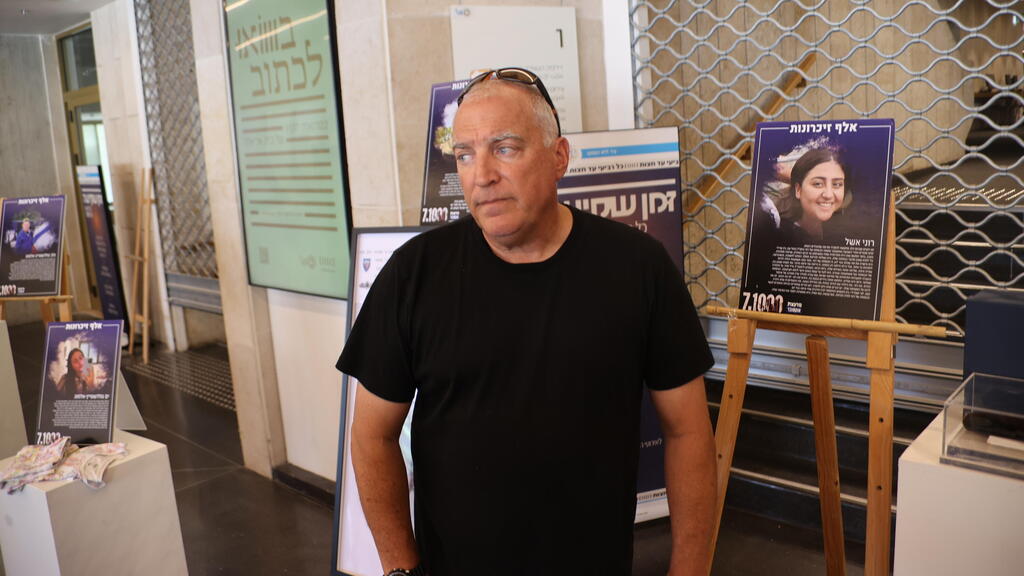
Eyal Eshel with a photo of his daughter, Roni, an IDF lookout who was killed on October 7
(Photo: Motti Kimchi)
Mr. Prime Minister, a country is not built on speeches. It is built on responsibility. Especially now, when the security threats have not disappeared, when the fear of further escalations and infiltrations hangs over us and when the political system is becoming increasingly turbulent and divided, the last thing we need is another cynical use of national pain for political survival.
We failed at the UN. We failed at Israeli public diplomacy. There is no need to travel again. There are moments when a leader needs to understand that his most important speech is not overseas. It is here. In front of the bereaved families. In front of the families of the hostages. In front of the soldiers. In front of the reservists, men and women. And in front of the citizens of Israel.
Above all, in front of the questions that still have not been answered.
Because after more than 2,000 fallen and murdered, after families have been shattered, after lives were overturned in a single moment, it is no longer enough to say, “I didn’t know,” “No one told me” and “Everyone is to blame.”
There comes a moment when a leader needs to stop explaining. To start taking responsibility, especially once he understands that he failed.
That is why, if there is one thing this country owes itself, it is a state commission of inquiry. Not a handpicked committee. Not an investigation shaped by political convenience. Not another attempt to postpone the reckoning until there is no one left to ask the questions.
Roni gave the state the one thing that can never be returned. And I, as her father, was left with the one thing that can never be repaired. And on this Yom Kippur, I want to ask her forgiveness.
A state commission of inquiry that examines everything. The political leadership. The security establishment. The decisions. The warnings. The conception. What was done and what was not done.
Without a real investigation, there is no real responsibility. Without responsibility, there is no forgiveness.
I think about Roni. About my daughter, 19 years and seven months old, who went up to the Nahal Oz operations room that morning to do her job.
Roni was an observer. She was among the eyes of the state. She was there to warn, identify, report and protect. She did her part. And in the end, she sacrificed her life.
This is exactly where the connection lies that we must never forget: Whoever demands sacrifice from citizens owes them responsibility.
Sacrifice does not absolve the state of responsibility. Quite the opposite. The more a citizen has sacrificed, the more accountability the state owes them.
Roni gave the state the one thing that can never be returned. And I, as her father, was left with the one thing that can never be repaired.
And on this Yom Kippur, I want to ask her forgiveness.
My Roni, forgive me for not being there. Forgive me for not making it to you. Forgive me for not managing to save you. Forgive me for not having the chance to reach you and say goodbye.
And perhaps more than anything, forgive me for still tormenting myself with the question of whether there was something, somehow, I could have done so that you would be here with us today.
I know I did not create the reality of that morning. I know I was not the one who was supposed to protect you. But I am your father. And a father’s heart does not operate according to reports, investigations or commissions.
It only asks, again and again: Where was I when my little girl needed me?
Perhaps that is why I am not prepared to give up on the demand for accountability.
Not for revenge. Not for politics.
For Roni.
For everyone who did not return.
For the families who were left behind.
And for this country.
Because someone who will not look the families who bore the price of failure in the eye cannot ask them to keep bearing the price of silence.
Before the citizens, and before heaven as well, one must be able to tell the truth.
October 7 happened on the watch of the country’s leadership. That is not a slogan. It is a chronological fact.
And whoever holds office when the state fails to protect its citizens cannot demand only sacrifice from the public. He also owes them responsibility.
Because Yom Kippur is not only a day when we ask God for forgiveness. It is a day when we need to be able to look the person we have hurt in the eye and say: I was wrong. I am responsible. I am sorry. Forgive me.
Anyone who asks us to sacrifice for the country must be the first to be willing to bear responsibility when the country fails.
That is why I am not asking for another speech. I am asking for truth. I am asking for an investigation. I am asking for responsibility.
And above all, I am asking that Yom Kippur not be turned into yet another backdrop for beautiful words.
Because forgiveness without responsibility is only a word. Sacrifice without responsibility from leaders is exploitation. And a speech without soul-searching is simply another speech.
And perhaps that is the biggest question of this Yom Kippur: not whether we know how to ask forgiveness, but whether we know how to take responsibility for what we have done.
Because God may be able to forgive someone who admits his sin. But an entire people cannot move forward without knowing who failed, how they failed and why.
For Roni.
For all the fallen and murdered.
And for an entire country that has been waiting for almost three years for someone to stop, look it in the eye and take responsibility.
And after everything, from me to you: Forgive me, my Roni.
Eyal Eshel is the father of lookout Roni Eshel, who fell at the Nahal Oz outpost on October 7