

At the end of the “With All Its Might” war, Amir Fardastan, a senior Iranian military official, acknowledged that his country had been stunned by Israel’s opening assault. However, he stressed that thanks to the leadership and wisdom of Iran’s supreme leader, Ali Khamenei, the country managed to recover from the surprise attack. “A shock blow was dealt to everyone, and the one who awakened us, who gave this tired body spirit, life and energy, and guided us with his wisdom, was the supreme leader and commander of the armed forces, Imam Khamenei,” he said. He added that during the war, President Donald Trump’s envoy, Steve Witkoff, called and asked Iran to agree to a ceasefire. “If Trump asked for a ceasefire, it was not because of his strength but because he was truly afraid,” the officer claimed.
Eight months after the war ended, the Islamic Republic now faces another military confrontation, broader and more consequential. The recent failure of negotiations between Iran and the United States can be attributed not only to gaps between the two sides’ positions, but also to a prevailing perception within the Iranian leadership. According to that view, just as Israel and the United States failed in June 2025 to achieve their central objective of toppling the Iranian regime, another American strike could cause significant damage and perhaps harm senior officials, yet would be unlikely to threaten the regime’s survival.
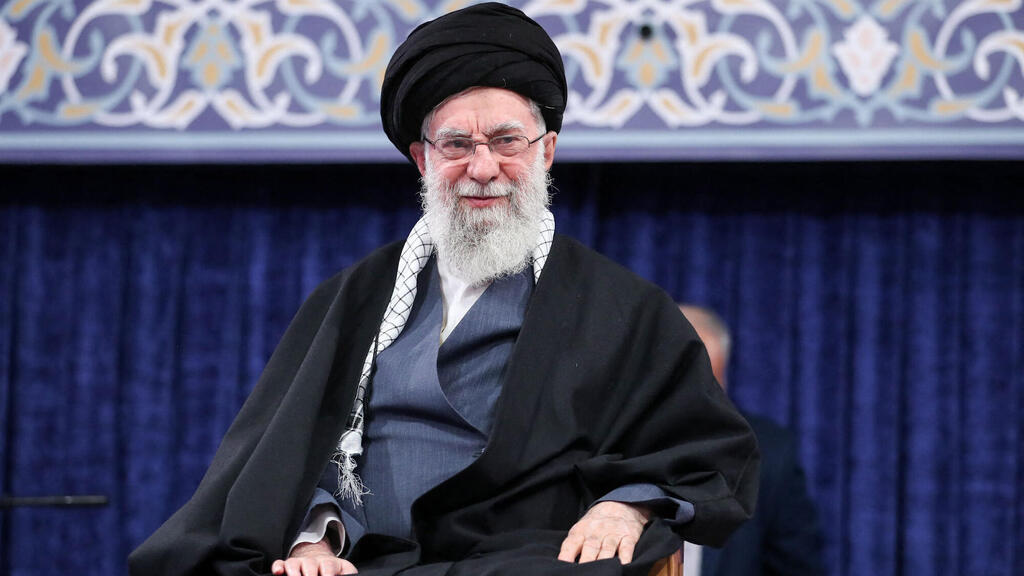
Ali Khamenei
(Photo: AFP PHOTO / HO / KHAMENEI.IR)
That perception prevented Iran from adopting a more conciliatory stance that might have averted the current attack. The war finds Iran in its most precarious condition since the 1979 Islamic Revolution. The wave of protests that erupted in late December 2025 was brutally suppressed, but the Islamic Republic’s underlying problems remain unresolved. The crisis of legitimacy and the economic crisis have only deepened.
It is difficult to assess the impact of the Israeli and U.S. strike on the regime’s stability, let alone on its survival. Even a significant aerial campaign is unlikely to collapse the Islamic Republic and establish a viable alternative without the active participation of millions of Iranian citizens. It remains unclear whether they would again risk their lives before concluding that a realistic prospect for positive change exists. However, if the strikes include the elimination of senior figures in Iran’s political and security leadership, thereby weakening the security forces’ ability to suppress internal challenges to regime stability should they arise, the likelihood of undermining the regime’s foundations would increase.
The key question: What is the primary objective of the combined Israeli and U.S. strike, and accordingly, what mechanism will enable the campaign’s conclusion.
At this early stage of the campaign, there are more questions than answers on four central issues.
First, what will be the campaign’s impact on regime stability in terms of its ability to survive, maintain internal cohesion and prevent angry Iranian citizens from exploiting the strikes to bring about its downfall.
Second, what will be the impact of the strikes on Iran’s strategic capabilities, chiefly its ballistic missile array, whose rehabilitation began immediately after the end of the “With All Its Might” war, and its nuclear program. Although the 12-day war significantly damaged the nuclear program, it left residual capabilities that could enable reconstruction if a decision is made.
Third, what will be the response policy of Iran and its proxies, particularly Hezbollah, toward Israel, U.S. forces in the Middle East and possibly toward its Arab Gulf neighbors, in light of Khamenei’s explicit warning to turn any military confrontation with the United States and Israel into a regional campaign.
Fourth, the key question: What is the primary objective of the combined Israeli and U.S. strike, and accordingly, what mechanism will enable the campaign’s conclusion.
After the 12-day war, a debate unfolded in Iran between more pragmatic circles, who argued that the country’s core challenges and the lessons of the war required a deep and substantive paradigm shift. At its center was recognition of the urgent need to address internal crises through far-reaching changes in domestic and foreign policy. By contrast, conservative and radical critics contended that the blows Iran had absorbed did not justify altering the Islamic Republic’s fundamental strategic objectives. That debate was decisively settled by Khamenei, who maintained that there was no substitute for the path of resistance and steadfastness against Israel and the United States.
 Dr. Raz Zimmt
 It is to be hoped that the current campaign will end in a way that does not require another round of fighting in a few months. It is doubtful that this objective can be achieved solely through significant damage to Iran’s military capabilities without undermining the regime’s foundations and dismantling its ability to function in a manner that would produce a strategic shift in Iranian policy.
Dr. Raz Zimmt is director of the Iran and the Shiite Axis Program at the Institute for National Security Studies, or INSS.
First published: 13:23, 02.28.26