

For years, a quiet but consequential shift has been unfolding between millions of Iranians who reject the Islamic Republic and the State of Israel. What once seemed politically unthinkable has become visible and, in many circles, normal: open solidarity, a shared rejection of political Islam, and a growing recognition that Tehran’s war with Israel is the regime’s obsession—not the Iranian people’s.
This relationship was not built on slogans or fleeting sympathy. It was deliberately built over years of consistent signaling from both sides. Sometimes the message was explicit; sometimes it was carefully implied. But the core idea was clear: if Iranians ever rose against the regime in a serious and sustained way, they would not rise alone. Those signals moved through opposition networks, Persian-language media, and voices close to Israeli security thinking, creating a real expectation that action would be met with action.
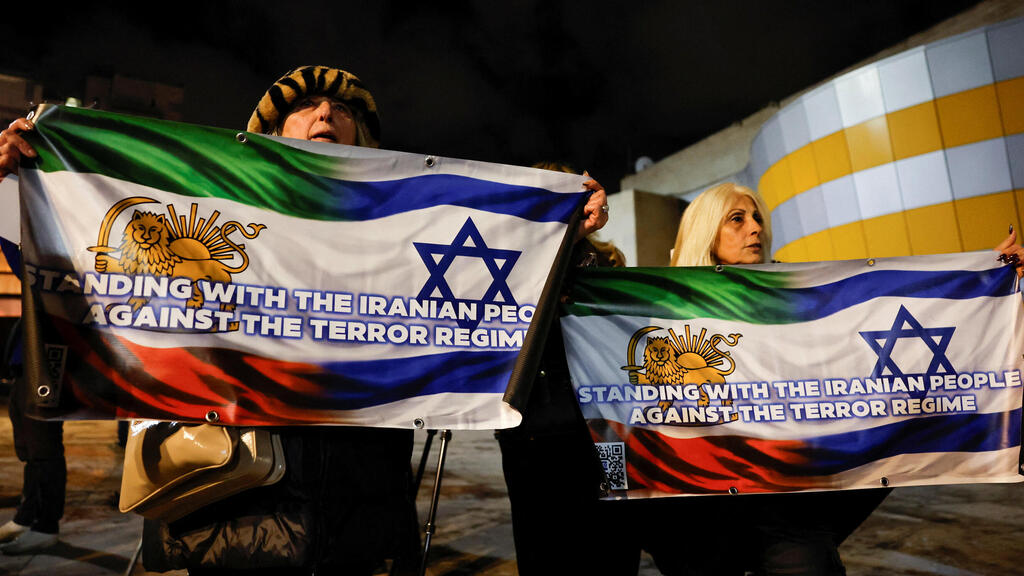
(Photo: REUTERS/Ammar Awad)
The depth of this alignment became impossible to ignore after October 7. At a moment when much of the world turned hostile or ambivalent, Iranians were among the rare communities that openly marched alongside Israelis in solidarity rallies, often carrying the Lion and Sun flag to separate Iran from the Islamic Republic. That action did not come out of nowhere.
The Crown Prince’s historic visit to Israel, along with the emerging concept of a “Cyrus Accord”, a vision for post–Islamic Republic realignment, laid the groundwork for it.
Today, that promise is colliding with bloodshed.
Iran is living through one of the most violent crackdowns in its modern history. What began as protests driven by economic collapse and decades of systemic mismanagement has evolved into a nationwide call for the end of the Islamic Republic regime. At least 12,000 protesters have been killed and the number is growing. For more than two weeks, Iranians have resisted in the streets, night after night, city after city, despite mass arrests, terror, and blackouts meant to hide the scale of the killing. Funerals turn into protests; protests turn into funerals. The regime is no longer pretending to govern. It is surviving through live ammunition, prison cells, and fear.
From inside Iran, one question now echoes with urgency and bitterness: Where is Israel?
This is not a request for sympathy statements. It is a demand for consistency. Iranians have shattered taboos, chanting openly against Khamenei, rejecting the regime’s ideology, and publicly separating “Iran” from “the Islamic Republic.” Many did so, believing what they had heard for years, and directly from Israeli Prime Minister Benjamin Netanyahu and other prominent Israeli politicians, such as former Prime Minister Naftali Bennet: you will not be left alone. If those words meant anything, they must mean something now.
And there is an uncomfortable truth many Iranians have reached in their bones: clenched fists do not defeat bullets and rifles. Courage matters. Numbers matter. But unarmed civilians cannot be expected to outlast a regime that has chosen massacre as policy. The longer this drags on without outside force, the higher the body count climbs, and the more likely it becomes that the regime crushes the uprising and then launches a ruthless campaign of revenge. Tens of thousands will die.
That is why the case for Israeli action is not only moral. It is strategic.
Israel’s confrontation with the Islamic Republic is structural, not episodic. The first round of direct war demonstrated Israel’s military edge and its ability to strike Iran’s strategic infrastructure. It also revealed a harder truth: partial action does not solve the problem. The regime survived, and survival is enough. As long as the Islamic Republic remains in power, it retains the capacity to rebuild missile production, restore command networks, and keep advancing the capabilities that threaten Israel and destabilize the region. There is no stable equilibrium here, only a cycle: strike, pause, rebuild, escalate.
What makes this moment different is the Islamic Republic’s vulnerability. A regime consumed by internal survival has far less capacity to absorb external shocks. Pressure now does not unify society around the flag; it accelerates the regime’s disintegration and empowers the Iranian people to reclaim their country.
Meanwhile, Washington is moving. President Trump is talking about taking action to punish the regime for killing protesters, signaling that the era of restraint is ending. If the United States is preparing to act, Israel should not stand aside. It should join that effort, or move immediately afterward, while the regime is exposed, overstretched, and under maximum stress.
Another confrontation over Iran’s missile and nuclear capabilities is coming regardless. Delay does not avoid war; it postpones it on worse terms. Waiting allows the regime to regroup, rebuild, and prepare for a deadlier future conflict. Acting now, ideally coordinated with, or immediately following, American moves, offers Israel its best chance to break the cycle that has poisoned the region for decades.
Israel does not need to own Iran’s uprising. It does not need to brand it or pretend to lead it. But it must recognize the convergence of interests: unavoidable security needs, a historic window of enemy weakness, and years of promises, spoken and implied, that are now being tested.
This window will not remain open. For Iranians facing bullets tonight, the question is painfully simple: If not now, when?
Saeed Ghasseminejad is a senior advisor at the Foundation for Defense of Democracies. Follow him on X: @SGhasseminejad
Navid Mohebbi is an independent Iran expert living in Washington, DC. Follow him on X: @navidmohebbi
First published: 10:48, 01.20.26