

One of the side effects of the recent wars concerns the question of the massive economic aid the United States provides Israel. At a time of unprecedented closeness with the White House, calls are growing, both there and here, to end the aid. What is interesting is that those who support such a move represent different, and even opposing, worldviews and interests.
The current scope of the aid, under an agreement signed during President Barack Obama’s tenure, is $3.8 billion a year, of which $3.3 billion is provided directly to Israel and spent according to its needs, while $500 million is dedicated to joint development of missile defense systems. Needless to say, it is hard to overstate the importance of this economic and security assistance.
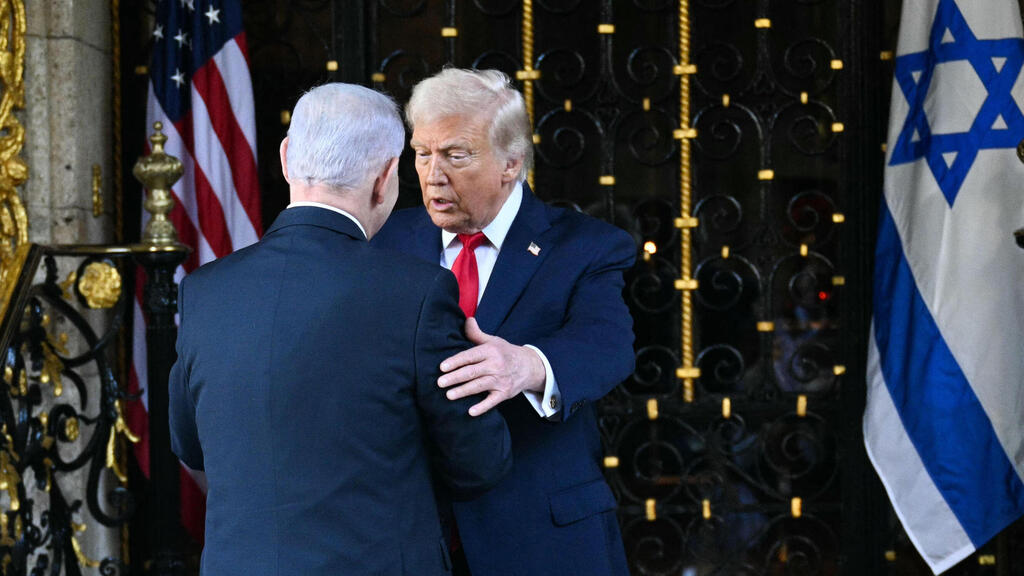
Prime Minister Benjamin Netanyahu and US President Donald Trump
(Photo: Jim WATSON / AFP)
But the fact that Israel has become a controversial issue on both the American left and right has, as noted, strengthened calls to cancel the aid among members of both U.S. parties.
Yet while opponents of the aid seek to weaken Israel, or distance themselves from it, Netanyahu also supports ending it. He said as much in an interview this week with “60 Minutes.” The prime minister explained that Israel is already strong enough economically and therefore should not be in the position of needing assistance. He, of course, wants to preserve the special relationship, but within a framework in which Israel uses its own money to buy its security needs from America and signs cooperation agreements instead of asking for support. What Netanyahu, who throughout his years in office has clashed with various U.S. administrations, did not say openly is that his desire to give up the aid is also meant to free Israel from a dependent position, as is evident even in its good relations with Trump.
Another interesting voice calling recently for the aid to be canceled is Rahm Emanuel, who may be the Democratic presidential candidate in the next election. Emanuel, a Jew with Israeli roots, is not seeking to prevent Israel from obtaining essential weapons. But he believes that if Israel buys them, rather than receives funding for them, opposition to Israel among Democrats would be blunted. Ending the aid, in his view, would also reduce hostility toward the United States among Israel’s opponents around the world.
But Emanuel’s central consideration is different: After all, the aid is also meant to allow the United States to influence Israeli policy. And because in recent decades “Israel is not the same Israel,” as he put it — meaning a right-wing country that rejects the two-state solution Democrats seek — it would be better to give up the effort to shape Israel’s path through free money.
And so, different trends are leading to a similar conclusion: It would be better to replace aid money with special relations based on deals and cooperation.
Netanyahu has supported canceling the aid for many years. In his view, such a step would not harm Israel’s technological edge, and the United States would continue selling certain products only to Israel. But his position also raises questions: If Israel’s economy is so prosperous that it can give up $3.8 billion in free money every year, why are these surpluses not reflected in the budget, and why do we, the citizens, hear only that there is no money? Moreover, the aid is also a symbol of America’s commitment, which could erode if the relationship is conducted solely through transactions.
And more than that: When one recalls that only because of the Americans did the war in Gaza end, while many in the government wanted to continue it, it becomes clear that dependence on Uncle Sam is sometimes actually an advantage.
In any case, the question of ending the aid is a critical issue that could affect Israel’s future character. That is why it deserves far greater attention in the public debate, especially during the election campaign.