

Israel's national agenda is crowded with critical issues: the open fronts in Gaza, Lebanon and Syria; the Iranians seeking revenge; Haredi separatism; internal polarization; the collapse of the rule of law in the West Bank; international sanctions; and more. There is no 'trivial' here; everything is 'essential.' Yet looming above them all is the greatest threat of all: the collapse of Israel's diplomatic standing around the world, particularly in the United States. The likelihood that a president hostile to Israel will occupy the White House in two years is not low, and the consequences could be catastrophic.
Israel needs leadership that will place the restoration of its international standing, particularly in the United States, at the top of the national agenda. Former U.S. Secretary of State Henry Kissinger is credited with saying that "Israel has no foreign policy, only domestic politics." The next leader must do precisely the opposite: navigate domestic politics while constantly assessing how political decisions will affect foreign policy.
Gallery
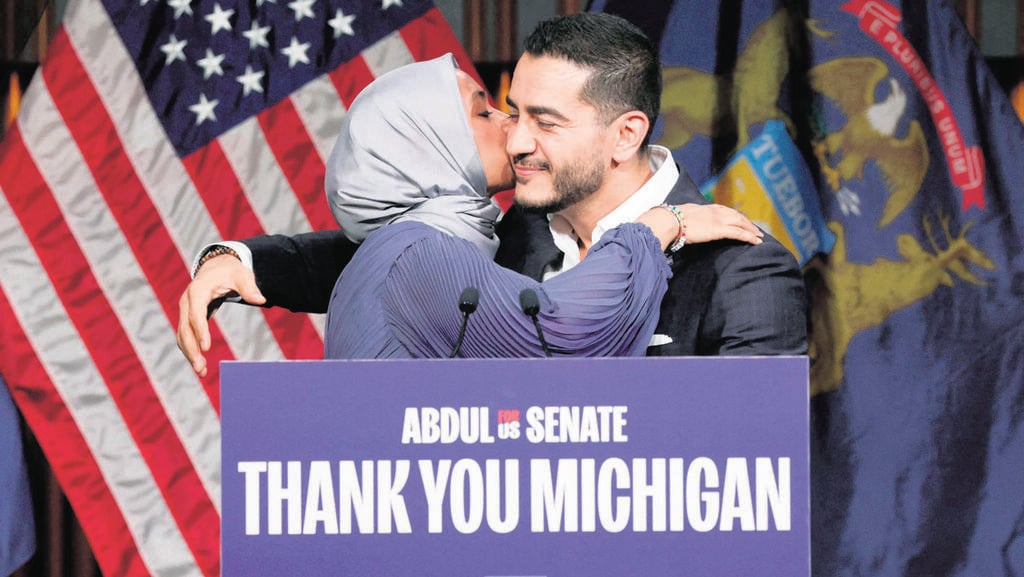
Abdul El-Sayed on election night: The probability that in two years a president hostile to Israel will be in the White House is not low
(Photo: Jeff Kowalsky/AFP)
This is not an obvious choice, because politics naturally gravitates toward the political and security issues that dominate the headlines. Conventional leadership risks being swept along by the daily succession of crises we have experienced for years. The urgent questions - what will be written into the coalition agreement, who will be appointed to which position, where IDF forces will be deployed, who will support which legislation and so on - may obscure the essential focus on what truly matters: the loss of Israel's legitimacy.
Israelis are unaware of the depth of the hole into which the country has fallen and the grave consequences that are approaching. Catastrophe, such as an American arms embargo on Israel or its disconnection from the international banking system, is knocking at the nation's door, demanding entry and threatening to take over our lives. The next prime minister must prevent this and mobilize all available political resources to that end. The hourglass has been turned over: We have two years to regain the legitimacy we have lost.
Not everything depends on us. Deep-rooted antisemitic sentiments that once remained hidden on the extremist fringes of Western public opinion have erupted into the open. Around the world, we are witnessing the weakening of liberalism, the hollowing out of the political center, the radicalization of public discourse, the loss of trust in institutions and growing challenges to the international order established after World War II. None of these developments bodes well for Jews or for Israel.
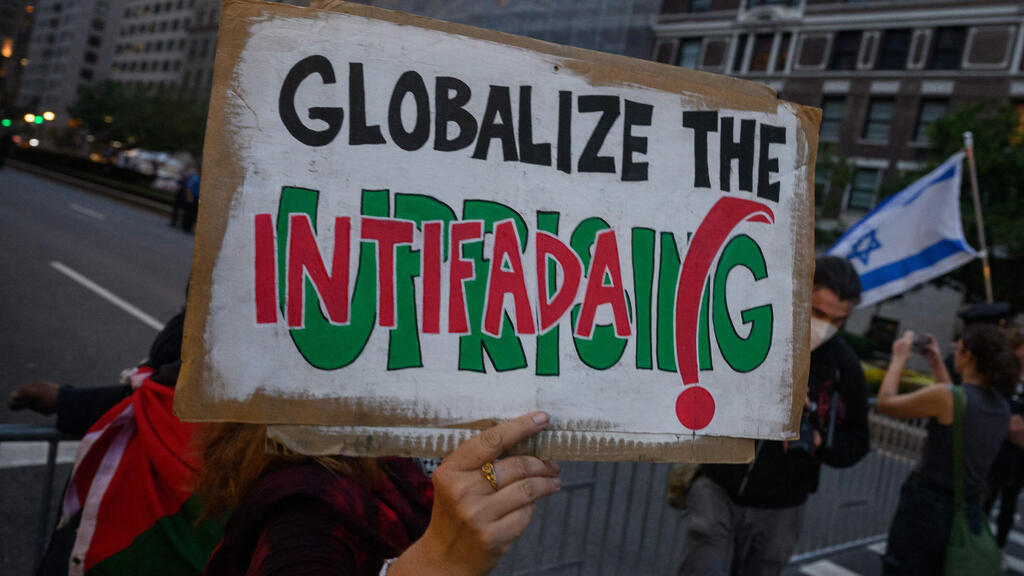
Anti-Israel sign in New York
(Photo: Alexi J. Rosenfeld / Getty Images North America / AFP)
Nevertheless, much depends on us. The situation is not hopeless. According to a recent CNN poll, 50% of Americans still support Israel. Our next leadership must act to stop the bleeding in public opinion and reverse the trend. If we understand that this is our overriding national interest, Israeli politics will align itself in ways that support that objective.
What measures follow from establishing this priority? Israel's far right cannot be part of the next government. Even if it remains a minority within a "broad Zionist government," its very participation in Israel's leadership would undermine the possibility of restoring our international standing.
Israel must come to its senses and regain control of the West Bank, even at the cost of confrontations with Jewish lawbreakers. The IDF's use of force across the various fronts must be measured. We must not act on tactical considerations, even when they are valid, if doing so undermines the strategic objective. We must work quickly to bring the various conflicts to an end, abandoning the illusion of "total victory" and replacing it with reasonable diplomatic arrangements. Bringing the Ra'am party into the coalition would expose the lie behind the characterization of Israel as an apartheid state.
Beyond all this, Israel's next leadership must lead us out of the postwar trauma that has left us believing that the answer to every challenge is the use of force. Israelis have indeed shifted to the right, but their leadership must pursue a realistic right-wing security policy, neither vengeful nor messianic.
The black curtain that descended upon us on October 7 removed any discussion of a national objective other than victory from the agenda for three years. Almost all the parties in the bloc seeking change ignore this challenge and offer no diplomatic vision. New leadership must look ahead, seeking to position Israel within a realistic and achievable diplomatic vision of the world, one that takes account of the conditions emerging on the other side of the Atlantic. Ignoring this would be a grave gamble with our future.
The author is president of the Jewish People Policy Institute (JPPI) and professor emeritus of law at Bar-Ilan University.