

Watching a Trump speech is no simple task. He rambles, talks mostly about himself, speaks in the vocabulary of a fourth grader and grades world leaders by a single criterion: Are they tough? It does not matter whether they promote peace or fund terror. The main thing is that they have to be tough.
It is shameless, childish, and even pathetic. One searches for a modern-day Charlie Chaplin to remake “The Great Dictator,” with a globe-shaped balloon and a strange man with egg-yolk hair kicking it in self-admiration. And then one remembers that this man personally holds decisions that could determine our fate: war with Iran, the future of Gaza, the possibility of a Palestinian state, the survival of Netanyahu’s governing bloc and all its domestic implications. For better or worse, he is the boss.
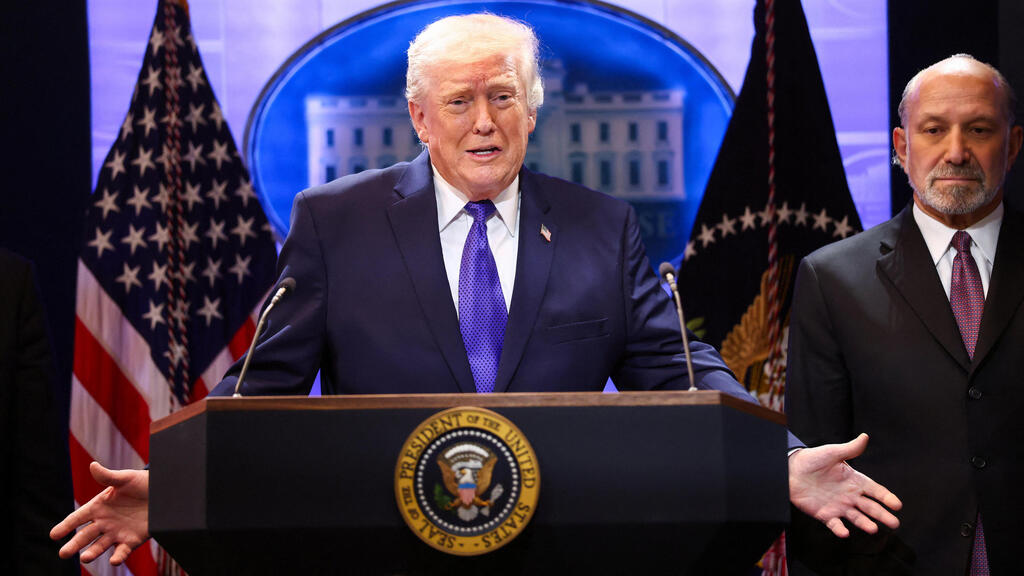
Like it or not, his the boss, US President Donald Trump
(Photo: Kevin Lamarque/ Reuters)
Strip away the bluster and a vision emerges. Trump is narrowing negotiations with Iran to one issue: nuclear weapons. The missile issue is off the table, or perhaps placed on the shoulders of Israel’s Air Force, should Trump opt for military action. The matter of Iran’s proxies is off the table. So is the regime’s legitimacy and its massacre of its own citizens.
On the surface, this creates a framework on which an agreement could be built. The details would need to allow Trump to claim he achieved far more than Barack Obama, while allowing Tehran to say it merely reaffirmed its public pledge not to develop nuclear weapons, a pledge widely viewed as false. Both sides would declare victory. Israel would have to contend with a missed opportunity, sanctions lifted and an adversary able to recover.
In his speech, Trump lavished praise on oil-rich Arab states. He needs their money for investment in the United States and for Gaza. Saudi Arabia, Qatar, Bahrain and others are pressing him to avoid military action against Iran. They have their reasons: They do not want to pay a physical or economic price. In Saudi Arabia’s case, cash flow is tight amid vast construction and investment plans. They are unconvinced by American operational plans. Nor are they eager to see a democratic regime rise in Iran, a model that could inspire change at home. Even if not stated openly, the trade-off hovers in the air: Gaza or Iran.
On Gaza, the Trump administration has a plan. Steve Witkoff and Jared Kushner are serious people. They have done the work. The plan runs counter to the Netanyahu government’s approach. It includes involvement by the Palestinian Authority and a 5,000-strong Palestinian policing force operating under its auspices. It envisions the participation of governments hostile to Israel in planning and executing Gaza’s rehabilitation, along with an Israeli withdrawal to or near the border line.
There is one condition: Hamas and other terrorist groups must be disarmed. The hope in Israel is that Hamas will refuse or deceive, prompting Trump to give a green light to renewed fighting. The Israeli government’s attitude toward the peace framework will likely be sour. Once again, Israel is betting on Hamas.
 Nahum BarneaPhoto: Avigail Uzi
New York Times columnist Thomas Friedman wrote this week that Netanyahu has outmaneuvered Trump on every front: Under the banner of confronting Iran, he is shaping facts on the ground in Gaza, entrenching apartheid in the West Bank and advancing authoritarian governance in Israel. Whether Netanyahu or Trump is leading in Gaza is debatable. On the West Bank, I fear Friedman may be right.
What is happening in the West Bank does not currently interest the Trump administration, but its long-term implications are heavy. On one hand, the IDF has dramatically reduced the terror threat. Central Command believes Ramadan, which began this week, could be quiet compared to previous years. The military now operates freely in all areas, in full security coordination with the Palestinian Authority.
On the other hand, without formal annexation, Israel is annexing in practice. The vision is to make Palestinian life so difficult that residents will be ready to leave. Much of the activity is illegal but directed from above, from the 15th floor of the Defense Ministry, the floor of Bezalel Smotrich. As Ehud Olmert recently wrote in Haaretz, this path could lead Israel to the International Criminal Court in The Hague. A grave danger. Unfortunately, it would not be the only one. We stand on the edge of a cliff, the government says, and now we take one step forward.