

The funeral ceremonies for Iran’s former leader, Ali Khamenei, are being put to effective use by the Iranian regime in an effort to demonstrate its victory and strength at the end of the campaign against the United States and Israel.
On the domestic front, Iran’s leadership is seeking to present the funeral processions as a show of force, evidence of the resilience of a surviving regime, its internal cohesion and public mobilization around feelings of solidarity and patriotism. Despite the expected claims by regime opponents, who have sought to play down the scale of public participation in the processions and portray those attending as a “captive audience” forced to come or induced by various benefits, the mass turnout at processions across the country cannot be ignored. It may serve as further evidence that even today the regime is able to maintain support among several million citizens who are loyal to it for ideological reasons or depend on it for their livelihood.
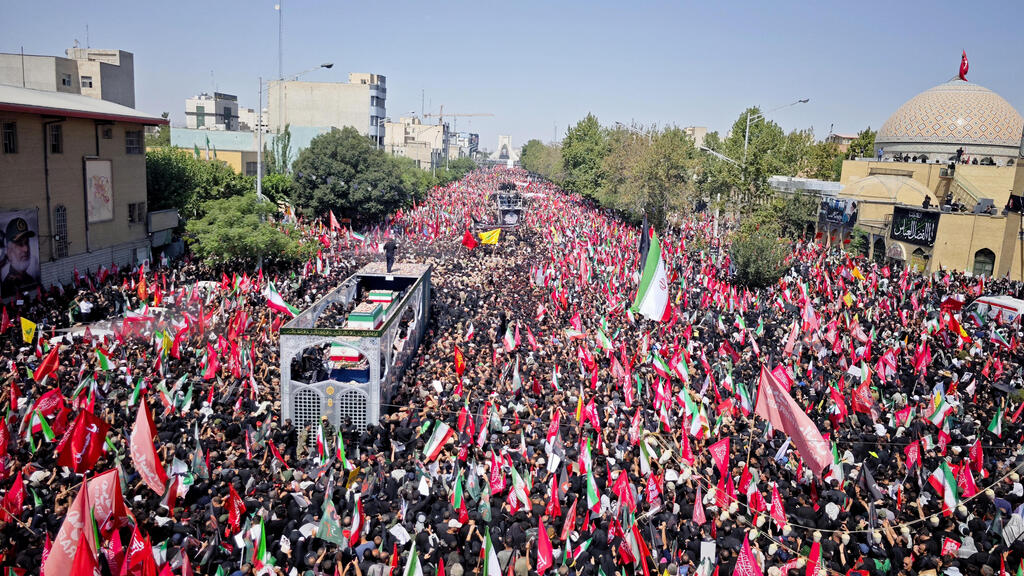
Ali Khamenei’s funeral procession
(Photo: Majid Saeedi/Getty Images)
However, even the broad participation cannot conceal several fundamental problems that cloud the regime’s ability to exploit the event for its own purposes. First is the absence of leader Mojtaba from the funeral ceremonies. Even if this can be explained by security considerations, the heir’s continued absence from public view is already raising questions and, over time, could cast doubt on his ability to enforce his rule and maintain an orderly decision-making process. A young Iranian woman gave voice to those doubts when she told a journalist during the ceremony she attended that she had expected Mojtaba to appear and address the public face-to-face.
Second, the absence of former presidents Mohammad Khatami, Hassan Rouhani and Mahmoud Ahmadinejad from the main ceremony in Tehran also prompted questions and even criticism, with some arguing that this was a moment for statesmanship. In an analysis published by one Iranian news website, the writer said the ceremony lacked an official photograph that should have included Iran’s three living former presidents and representatives of the two who are no longer alive — Rafsanjani’s son and Raisi’s widow.
On the sidelines of the funeral ceremonies, a series of meetings was held between senior regime officials, especially Majlis Speaker Mohammad Bagher Ghalibaf and Foreign Minister Abbas Araghchi, and representatives of delegations from the various components of the 'resistance front'
On the sidelines of the funeral ceremonies, a series of meetings was held between senior regime officials, especially Majlis Speaker Mohammad Bagher Ghalibaf and Foreign Minister Abbas Araghchi, and representatives of delegations from the various components of the “resistance front.” In meetings with representatives of the Palestinian movements, chiefly Hamas, and with representatives of Hezbollah, Amal and the Houthis, senior regime officials stressed the Islamic Republic’s continued support for the pro-Iranian axis in the region, its achievements in the war and the unity of the “resistance front.”
The Iranian officials again emphasized Tehran’s commitment to linking negotiations with the United States to the continuation of the cease-fire on the Lebanese front, as well as to raising developments in the Gaza Strip as part of the second stage of talks with Washington. These statements reflect the leadership’s growing confidence in its ability to translate the achievements of the campaign into the establishment of a regional order that recognizes Iran’s status, given its success in inflicting significant damage on its neighbors and on the global economy.
At the same time, it should be noted that even after Operation Roaring Lion, Iran still faces a series of challenges in the regional arena, including Israel’s continued presence in southern Lebanon, the memorandum of understanding between Israel and the Lebanese government and growing pressure in both Lebanon and Iraq to disarm the Shiite militias.
The real test still lies ahead for Iran’s new leadership. Despite the regime’s success in mobilizing mass attendance at the funeral of the “martyred leader,” that is not enough to provide solutions to the significant domestic and foreign challenges it faces at the end of the current campaign. This is especially true given the worsening economic crisis and growing reports of disagreements at the top of the Iranian leadership over the future course of the Islamic Republic in the postwar period.
- Dr. Raz Zimmt is director of the Iran and Shiite Axis Program at the Institute for National Security Studies.
First published: 09:56, 07.07.26