

There are three foundations to the Jewish ethos and the biblical commandment to bring captives home: our forefather Abraham, Moses our teacher and King David. Of Abraham it is said: “When Abram heard that his brother had been taken captive, he mobilized his trained men.” Immediately. Because the road to victory passes through values and is intertwined with them.
Of Moses it is said: “And Moses took the bones of Joseph with him.” Because the road to freedom, too, passes through strict adherence to values. And of King David, the Bible tells of a three-year famine that lasted until Saul and Jonathan were brought to burial. Then it is said: “And God responded to the land after that.” Cause and effect.

The ancient lesson learned 3,000 years ago teaches that bringing the fallen to burial in their homeland is a moral and national duty. This is not a matter of symbolism. It is a matter of repairing a moral wound. A society that returns its fallen from enemy territory is a more whole society, one that closes a circle of justice, identity, memory and national dignity. Because a society that repairs its relationship with its fallen repairs its relationship with itself.
It is troubling how something so self-evident has become something that must be fought for so fiercely.
Bringing captives home is not a political issue. Bringing back a soldier left on the battlefield is not a family’s mission. The road to victory passes through adherence to values, their preservation and their fulfillment. There is no contradiction between bringing hostages back from enemy captivity and defeating the enemy.
The range of operations carried out by the IDF and Shin Bet to locate Hadar in the tunnel of Hamas’ Yavneh Battalion in the Rafah Brigade became the Archimedean point that led to its collapse and defeat. We entered the tunnel to bring Hadar back, and the very act of capturing it led to the enemy’s defeat across the entire area. In this way, at the same time, we remained faithful to our values, Hadar returned to his land and the enemy was defeated. No area in the Gaza Strip was defeated as decisively as the Rafah area, and much can be learned from the campaign to return Hadar and its contribution to that unique victory.
Military power, however strong, is meaningless without values and in the absence of spirit. In every successful battle, it is the spirit that allows military power to be expressed. In the many operations to locate Hadar, all the principles of war were applied. But alongside them, it was the IDF’s values that brought Hadar back.
“Dedication to the mission and striving for victory” were the essence of the actions carried out in the “White Dror” tunnel. And above all, comradeship. Hundreds and thousands of soldiers who took part in the various circles of the operations to locate Hadar are living testimony to the comradeship of fighters and pure mutual responsibility.
No leadership was found to lead the obvious
“Without vision, a people loses restraint,” Proverbs says. I would add: without leadership as well. In the many years before Hadar was returned, no leadership was found to lead the obvious, the basic values. There was no spiritual leadership, no religious leadership, no cultural leadership, no military leadership, no diplomatic leadership and no political leadership.
So what was here? You were here. An “awakening from below” — a few who strive to do good, who adhere to values, who know there is no contradiction between achieving victory over the enemy and bringing the captives home. The awakening from below is what spurred action and created an awakening above.
When we crossed the fence into the Gaza Strip to search for Hadar, the divisive and polarizing discourse did not cross with us. There was brotherhood, comradeship and unity. As one person with one heart.
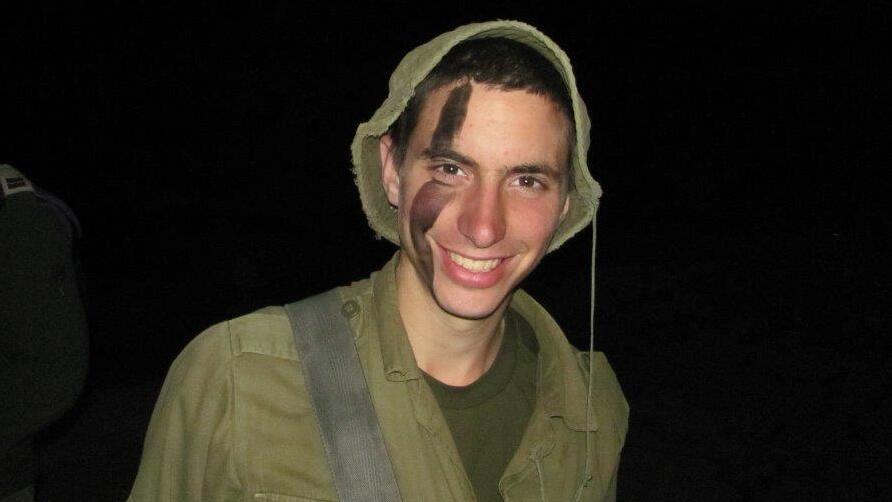
Hadar Goldin
(Photo: Courtesy of the family)
We are in the midst of the days of mourning for the destruction of the Temple, the Three Weeks between the 17th of Tammuz and Tisha B’Av. The sages’ statement is well known: “Because of baseless hatred, Jerusalem was destroyed.” To our sorrow and shame, agents of baseless hatred have embedded themselves and gained a foothold in centers of power, influence and decision-making in the State of Israel. This is a severe moral flaw that could bring us to the threshold of another catastrophe of destruction. And “once permission is given to the destroyer to destroy, it does not distinguish between the righteous and the wicked.” Woe to us if we fail to stop this deterioration.
Repairing the destruction and rebuilding will come through baseless love. We would do well to adopt Rabbi Kook’s approach, according to which it is better that we fail through baseless love than, God forbid, fail through baseless hatred.
We must learn to listen to one another more. Those who settle for the basic sense of hearing alone will be taken captive by every passing rumor. But those who rise to the level of listening will also be able to internalize the truth from whoever speaks it, without prejudice and without labeling in advance.
When public discourse fills with baseless hatred and becomes polarized, black and white, us and them, good and evil, one of the things that happens is the loss of the ability to be critical of yourself. The only criticism that remains is criticism of the other. And when there is no self-criticism, there is no ability to improve and move forward. Because you must always be right. But is there any human being who does not make mistakes? Greatness lies in doing, learning from mistakes and moving on as a better person.
The repair
Just as repentance begins with recognition and confession of sin, so too does the beginning of repair. It is the ability to admit a mistake and take responsibility. If there is difficulty doing that, the situation resembles a person who says, “I will sin and repent.” That reflects deep contempt for our basic moral system.
I too made mistakes and erred on the path to bringing Hadar back. Mistakes and errors emerged as the journey dragged on. But I always took responsibility for them, investigated, reflected and tried to correct them. We never despaired, never gave up and never let go of the mission.
For all those years, I avoided coming here for the memorial ceremony or on Memorial Day. The knowledge that the grave was empty was, for me, like a mirror reflecting failure. A systemic failure and a personal failure. Instead, I preferred to initiate another operation or intelligence move, to try another direction we had not yet tried and to do everything so we could succeed in bringing Hadar back.
Tractate Ta’anit teaches us that when the value of mutual responsibility strengthens among the people of Israel, rains of blessing are assured. A short time after Hadar returned to the soil of his homeland, the windows of heaven opened and rains of blessing fell across the western Negev. Those rains broke into the place where Hadar had been held in a Hamas tunnel and brought with them a surge of sand that partially sealed the cursed underground compound. The symbolism was of a tunnel whose purpose had ended and could now collapse into itself, under the force of rains that came because of the mutual responsibility of a large public that did all it could for its sisters and brothers in captivity.
Goldin family, you led a heroic and prolonged struggle to bring Hadar back. And in the spirit of the introduction to “Mesillat Yesharim,” a book Hadar so deeply embraced and turned into a road map for building his life, it seems to me that in the path you proposed for bringing him home, you too sought “not to teach people what they did not know, but to remind them of what they already knew.” You sought to remind us all of the simple things. The actions that are self-evident. Anyone who studies the ideas and plans you proposed over the years will also be able to draw a lesson or two about the way action is required today in the Gaza Strip.
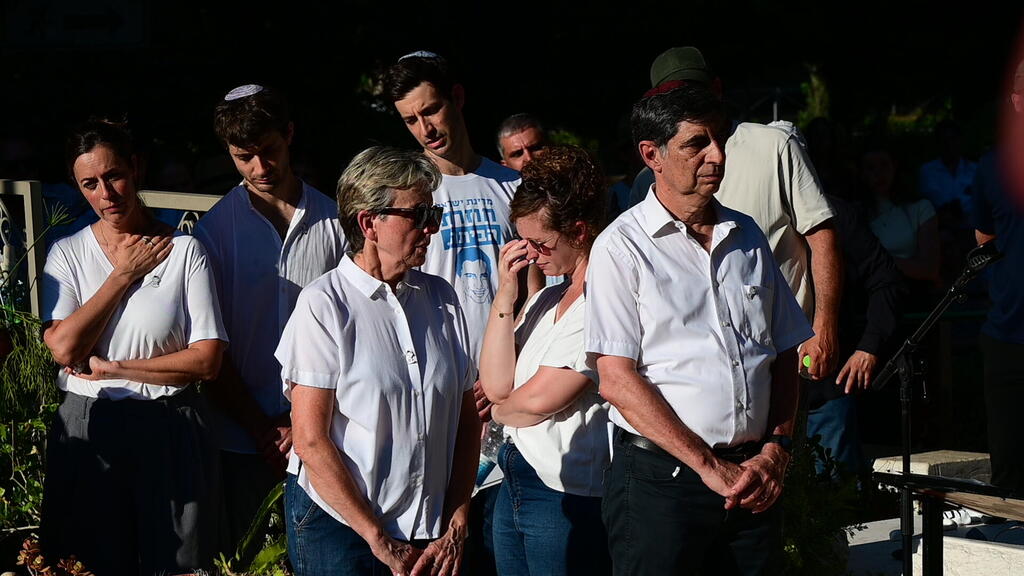
Memorial service for Hadar Goldin
(Photo: Yuval Chen)
In the years before the war of October 7, we carried out a series of operations aimed at locating the place where Hadar was being held, under the code name “Road Signs,” after Naomi Shemer’s song. Anyone who reads the words will understand why: “I am not alone on the road that leads to my home. There is one friend or two walking home with me.”
Thank you to all the soldiers and commanders who worked day and night, without regard for the calendar and with immense spirit and faith. Thank you to the women and men of the intelligence systems in Military Intelligence and the Shin Bet, the people of light who work in darkness, who broke records of creativity, perseverance and determination.
Thank you to everyone who did not give up, who was part of this, who prayed, who held a sign, who argued and tried to persuade others that this was the right thing, who stepped forward, who did not forget, who adhered to values. All of you brought Hadar back. Continue doing good. Hold the moral compass and lead the way, even when it is difficult. In the end, good will prevail.
And in the words of the poet Haim Hefer: “With the faith in my heart, with love without bounds, with the justice within me and with the greatest hopes, and with the morality in my soul, higher than all plots, today I swear. Even if the grueling journey is long and many fall behind, together we will continue walking on the road toward the light.”
I did not know Hadar before I received the mission to be part of the group that would fight to bring him back. But it seems to me, from what I managed to learn about him, that this is the spirit that would have stirred within him had he been present here.
First published: 12:23, 07.20.26