

U.S. President Donald Trump and Prime Minister Benjamin Netanyahu have made one of the most important decisions by democratic leaders in recent decades. They chose to go against the dominant political tendency in the modern West, that of risk elimination and consequent impotence, and initiate a pre-emptive war. For this, both men deserve praise and support, in spite of their flaws.
Trump, who unlike Netanyahu does not lead a people that understands it is fighting for its survival, deserves particular gratitude. If the March 1 poll conducted by Ipsos is to be believed, only 27% of Americans approve of U.S. involvement in the war.
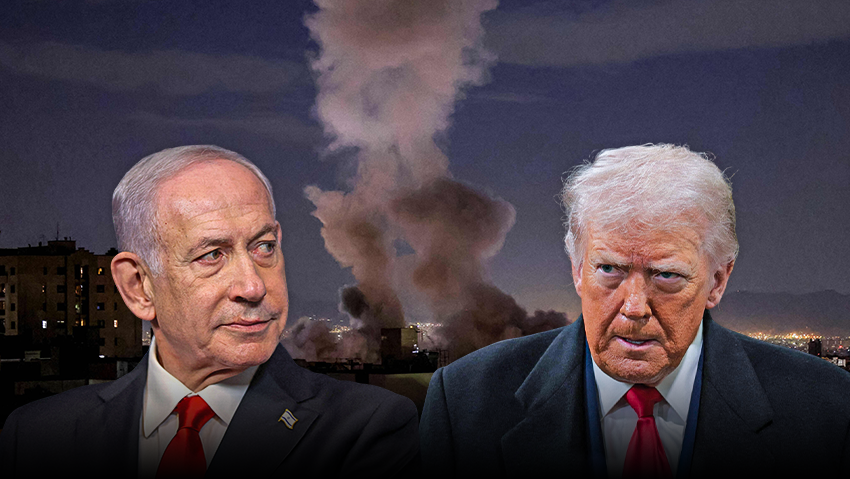
(Photo: ATTA KENARE / AFP, JOE RAEDLE / AFP, Anna Moneymaker/AFP)
Of course, any poll related to Donald Trump should be read with caution. The day before the Presidential election of 2024, Ipsos gave Kamala Harris a 2% lead among likely voters. Trump won the election with a 1.6% lead in the popular vote. Nonetheless, he leads a country divided, and one that was completely disinterested in foreign affairs, until the war. In December 2025, only 5% of Americans saw either foreign policy or war as the country’s most important problem, according to Gallup.
The president’s decision to go against Western impotence and American indifference is noteworthy, and separates him decisively from Barack Obama, Joe Biden and Kamala Harris, none of whom would ever have acted as he did. For once, Trump’s statement that “no president was willing to do what I am willing to do tonight” is unambiguously and indisputably true. As I had hoped in my article of 22 February, he chose war instead of shame.
Yet, President Trump strongly prefers quick operations without pain to Americans. In his reflections on the raid to capture Venezuelan president Nicolás Maduro, he deliberately stressed that “we had nobody killed… we lost no aircraft… everything came back.” Of course, it is impossible to conduct a war, as distinct from a raid, without losses. On the third day of the war with Iran, three United States Air Force F-15E Strike Eagle aircraft were shot down by the rather imperfectly organized Kuwaiti air defenses. The day before, three service personnel from an American supply unit were killed in Kuwait. A fourth has since died of wounds.
Trump, who has said publicly that “It’s all a deal. Life is a big deal,” is already speaking of striking “a deal that’s meaningful” to end the war. With the war not yet three days old, he suggested that it could come to a close after four or five additional weeks, a statement which will serve to increase public pressure on him to conclude the war quickly, rather than win it decisively. That would be a catastrophic error.
Israel’s extremely successful opening strike on February 28 has created an opportunity that will not recur. The regime is in disarray, and so are its friends. Vladimir Putin, the world’s foremost expert in cynical and immoral murder, has called the killing of Ali Khamenei “a murder committed in cynical violation of all norms of human morality and international law,” without taking any public action to help Iran.
If the Iranian regime survives, Putin will be very happy to sell it not only Verba (SA-29 Gizmo) shoulder-launched missiles, as he has apparently already agreed to do, but many other more dangerous weapons. China might also be on hand to sell CM-302 (YJ-12) supersonic anti-ship missiles, and not only these. Any significant improvement in the regime’s arsenal could make a future war much more dangerous and difficult.
Above all else, it ought to be remembered that ballistic missiles with nuclear warheads are, in their crude form, an extremely old technology, which therefore cannot be denied to Iran forever. The first Soviet missile of this kind, the R-5M (SS-3 Shyster) entered service in 1956, an extraordinary 70 years ago. A regime interested in possessing such technology will eventually develop it or else find willing vendors from whom to purchase it, unless it is obliterated and replaced by one that has a completely different worldview.
The only way to prevent a future catastrophe with Iran is to seize the existing opportunity and continue hitting the rabid regime until it collapses. This is eminently feasible. The Israeli Air Force alone destroyed 150 Iranian ballistic missiles and launchers, as well as 200 air defense systems, by the afternoon of the third day of the war. America, with its ability to strike much harder than any other country, can make sure that the Allied offensive achieves the complete destruction of Iran’s offensive and defensive missile arsenal within a matter of a few weeks.
Once the regime has been rendered toothless and defenseless, it will begin to disintegrate. That disintegration will most probably not be immediate, and further, more limited, strikes will be necessary to destroy ideologically irreconcilable military units which will seek to prevent the removal of Shia Islamism from power by the Iranian people.
The cheapest, the easiest solution might appear to be to avoid the effort described above, and simply to bring the war to a rapid conclusion by means of a deal. That would, in fact, be intolerably expensive. The U.S. military fights any war in a financially extravagant manner, for example by flying three B-1B Lancer bombers to attack Iran directly from their base in South Dakota, with the attendant grotesque expenditure of fuel and aircraft flight hours. A country whose national debt is growing at a rate of $76,978 per second cannot afford not to finish this war with a decisive, permanent victory.
The Allies should match their bold decision to initiate the war with a victory of a scale and nature that repays the risk, the losses and the expenditure. The cost of an incomplete victory would be intolerable.
- Dan Zamansky is a British-Israeli independent historian and author of The New World Crisis, a Substack analyzing contemporary global challenges.