


For all those asking — some in anger, others in astonishment — where are the masses who were supposed to flood Iran’s streets and topple the hated regime of the ayatollahs, I suggest reading the new book by historian, thinker, Middle East scholar and journalist Ian Buruma, Stay Alive: Berlin, 1939-1945. The book was published in English this month by Penguin.
Buruma, who comes from a mixed Christian-Maronite family on his father’s side and German-Jewish on his mother’s, describes with microscopic precision daily life in Nazi Berlin during World War II, up to its collapse and defeat. My personal conclusion from reading this compelling book is that public support among Berliners for the regime of Hitler, Goebbels, Goering, Himmler and Eichmann was relatively low from the outset of the war. It weakened further in its final year, but did not turn into active resistance, instead becoming a depressive apathy and resignation to fate. The Nazi regime did not fall under pressure from mass protests, and Allied bombing did not strengthen resistance. It may even have weakened it.
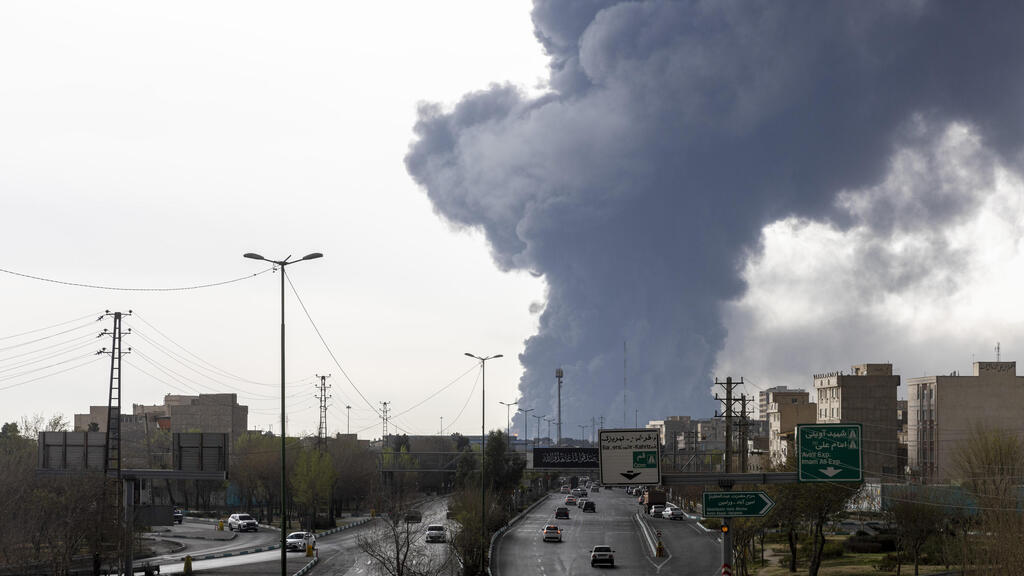
Smoke rises from oil facilities in Tehran following Israeli military strikes
(Photo: Majid Saeedi/Getty Images)
In late November 1944, when the Nazis’ impending defeat was already clear to all, Propaganda Minister Joseph Goebbels toured Berlin’s snow-covered, blocked streets and encountered an outpouring of sympathy and enthusiasm from passersby. After hugs and kisses, Buruma recounts, Goebbels wrote in his diary: 'The morale of the Berlin population is simply wonderful.' Three months later, in February 1945, '900 American heavy bombers ("Flying Fortresses"), escorted by 600 fighter planes, began dropping more than 2,260 tons of explosives on central Berlin.' The massive bombardment turned the city’s streets into rubble. Yet, to the disappointment of American squadron commanders, it did not push or mobilize the masses into revolt against the regime. Among other reasons, SS personnel and special repression units roamed both public and private spaces among the frightened population, searching for draft dodgers, deserters and especially regime opponents. Many Berliners cooperated with them, particularly after the failed attempt to assassinate Hitler in August 1944, which was followed by the execution of about 10,000 Germans.
The only signs of civilian resistance to the Nazi regime were a few 'No!' graffiti scrawled secretly on the walls of ruined buildings — 'a small gesture of disobedience,' Buruma notes. When the Soviet Red Army launched the 'final battle for Berlin' in April 1945, the Nazi regime still managed to field — for certain slaughter — 40,000 Wehrmacht soldiers and 70,000 'civilian volunteers.' There was no mass refusal to serve.
A great many books of political thought and history have been written on how and when fanatical totalitarian movements such as Nazism, Bolshevism and Khomeinism seize power. Far fewer works address the opposite question: how and under what circumstances they lose it. Buruma offers an instructive observation in this context: 'There are no examples in modern history of public morale being broken solely through terror bombing from the air.'
 Sever Plocker Photo: Yair Sagi
Based on similar historical lessons, some have advised the Israeli government to adopt a new tactic in the current war against Iran: to unilaterally halt airstrikes after the broad and successful campaign of assassinations targeting the regime’s leadership, and to focus on intercepting Iranian missile attacks on Israel. Clear skies over Tehran, proponents argued, would advance regime change. Continued bombing, they warned, would delay it and might even thwart it.
This recommendation was not presented to decision-makers at the governmental level and was not adopted — not only because Buruma’s new book had yet to be read. It is possible that US President Donald Trump, at the time of writing, has decided to put it to a practical test.