

Deterring the Houthis, an organization that combines advanced weaponry, extremist ideology and a base of operations in a failed state, was never going to be simple. But this challenge was often exaggerated, leading some to conclude that the group was immune to pressure. Yet today, there is reason to believe that the radical movement that seized Sanaa more than a decade ago has, at least to some extent, been deterred.
Deterrence is the ability of one actor to prevent another from taking a specific action by shaping that actor’s assessment of costs and benefits. In U.S. government parlance, it is defined as “the prevention of action by the existence of a credible threat of unacceptable counteraction and/or the belief that the cost of action outweighs the perceived benefits.”
Gallery
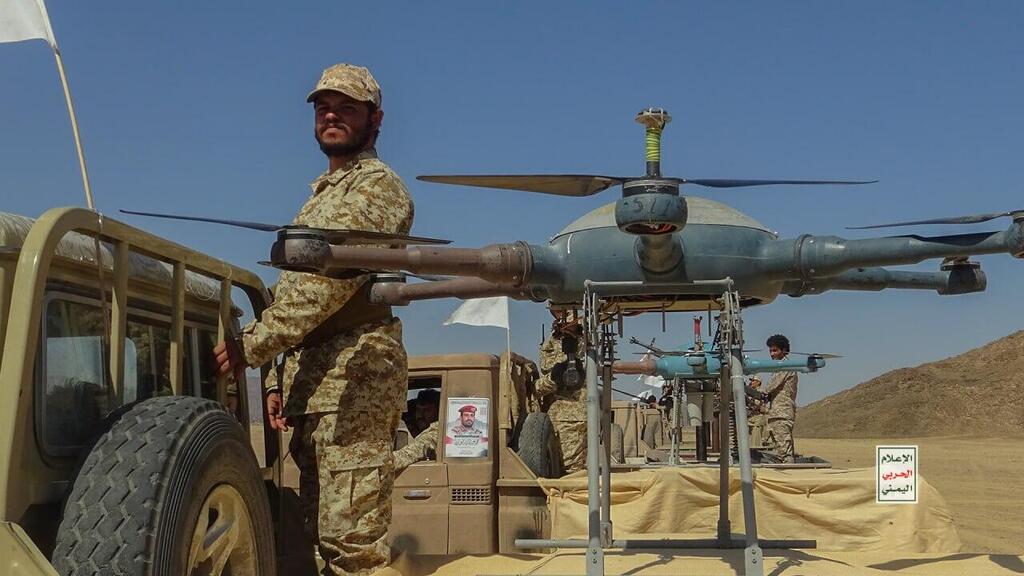
Members of the Iranian-backed Houthi militia display a drone during a training exercise in Yemen
Deterrence can be achieved in two primary ways: by convincing the adversary that the response will impose significant costs, which is deterrence by punishment, or by persuading the adversary that its intended action will yield limited results, which is deterrence by denial.
Assessing deterrence is notoriously difficult. Because it measures the changes of internal calculations of a threat actor, and because few outside that organization’s leadership have access to those calculations, its effects are rarely possible to reliably measure. The UK Ministry of Defence acknowledges this challenge in its report Deterrence: the Defence Contribution:
“Measuring the effect of deterrence empirically has proven elusive since deterrence was first codified. Aside from the difficulty of proving a negative, there are so many variable factors in deterrence, it is impossible to say that deterrence alone has caused an adversary to avoid a course of action.”
Israel’s assessment that Hamas was deterred days before its “Al-Aqsa Flood” attack on October 7, 2023, is a recent and tragic example of misjudging deterrence. That failure stemmed from multiple factors, including Hamas’ deliberate deception and the Israeli intelligence community’s entrenched conception of Hamas, which led it to overlook clear indicators of the group’s intentions. In response, some experts now argue that Israel should place less emphasis on deterrence and instead focus on targeting threat actors solely based on the risks posed by their capabilities.
Still, evaluating which threat actors have been deterred remains useful for understanding the urgency of a threat and determining how it should be prioritized. Although efforts to assess intentions are inherently imperfect, relying solely on capabilities carries its own significant pitfalls. Ideally, a calculated balance must be struck by factoring both intentions and capabilities into decisions about threat prioritization and the urgency of action to neutralize them.
Israeli retaliatory strikes on Houthi-controlled targets in Yemen


With respect to Yemen, the Houthis made their intentions toward Israel clear long before they began launching missiles and drones at it in 2023. In the early 2000s, the movement adopted “the scream,” a chant calling for “death to Israel” (and “death to America”). Their worldview, rooted in delusional beliefs about an all-encompassing American-Zionist plot targeting Yemen and the broader Muslim world, reinforces their perception of Israel as an existential threat.
Though they do not currently possess the capabilities to do so, there can be no doubt that the Houthis aspire to destroy Israel and are developing capabilities with that long-term objective in mind. This goal is a core component of their ideological identity and cannot be changed without altering the essence of the Houthi movement.
The Houthis initiated military strikes against Israel on October 19, 2023, less than two weeks after Israel’s deterrence had collapsed against Hamas. From that point on, they carried out drone and missile attacks against Israel and international shipping for nearly two years, fulfilling threats they had made years prior.
In Abdul Malik al-Houthi’s words from October 2023, these strikes were intended to show that “the Yemeni people are… ready to do everything they can to perform the sacred duty of standing with the Palestinian people.” The Houthis continued this campaign despite significant Israeli and international efforts to discourage the attacks and blunt their impact. Their persistence earned them the unofficial title of “the last man standing,” as Iran and other Iranian-aligned actors absorbed major blows that degraded their capabilities and deterred further action, leaving the Houthis as the only "Axis of Resistance" member still consistently engaging Israel.
Over the two years of Houthi attacks, only a small percentage of their projectiles reached their intended targets, and fewer caused casualties or damage. Nevertheless, the impact on maritime transport in the Red Sea is indisputable. Traffic through the area declined sharply once the Houthis turned it into an active conflict zone. This disruption carried economic consequences for regional states that rely on the Red Sea as a key maritime corridor, as well as for the global economy, which depends heavily on Red Sea and Suez Canal routes. Yet the international response initially amounted to a limited effort to safeguard global commerce as most shipping companies rerouted vessels along more circuitous and expensive paths around the Cape of Good Hope.

Houthi leader Abdul Malik al-Houthi
Following the announcement of the Israel-Hamas ceasefire in October 2025, newly appointed Houthi Chief of Staff Yusef al-Madani stated that the group would pause its attacks on Israel and international shipping. At a superficial level, the ceasefire offered a convenient and logical offramp for the Houthis, whose campaign began after Hamas initiated its war against Israel. However, taking this at face value risks overlooking the deeper motivations at play.
The decision to halt attacks was not the result of any formal obligation, since the Houthis were not bound by the ceasefire. Instead, the ceasefire provided a strategically useful opportunity to pause the long-term Houthi campaign against Israel and mitigate growing risks to the group’s survival.
Although the Houthi regime espouses an uncompromising ideological commitment to Israel’s destruction, it functions as a pragmatic organization. Despite holding basic aims and assumptions that differ significantly from those of Western observers, the group has demonstrated consistent rational behavior. This has been essential to its survival and expansion over the last twenty years.
Alongside other pressures, including tightened U.S. sanctions, Israeli strikes in response to the Houthi attacks targeted key Houthi infrastructure and accelerated an economic decline that could yet evolve into a full-scale crisis in northern Yemen. A secondary but significant factor is the impact of Israeli strikes that eliminated senior Houthi leaders; these losses likely disrupted operational activity and challenged the perception that the Houthis were both difficult to target effectively and largely immune to such strikes. This all led to the restoration of Israel’s deterrence vis-à-vis the Houthis that collapsed as Hamas fighters breached its border on the morning of October 7.
The regime’s growing economic pressures also help explain its rapid shift toward “diplomacy” with Saudi Arabia. The Houthis are now attempting to use the threat of renewed attacks to secure a deal that includes major financial concessions from their far wealthier northern neighbor. They had been facing a serious economic problem long before October 2023, and their attacks on Israel offered a temporary means of deflecting attention from these internal pressures. But Israeli strikes on key Houthi-run commercial arteries ultimately worsened the underlying crisis. These strikes threaten the stability of the Houthi-controlled economy and undermine the group’s ability to fund its war machine.
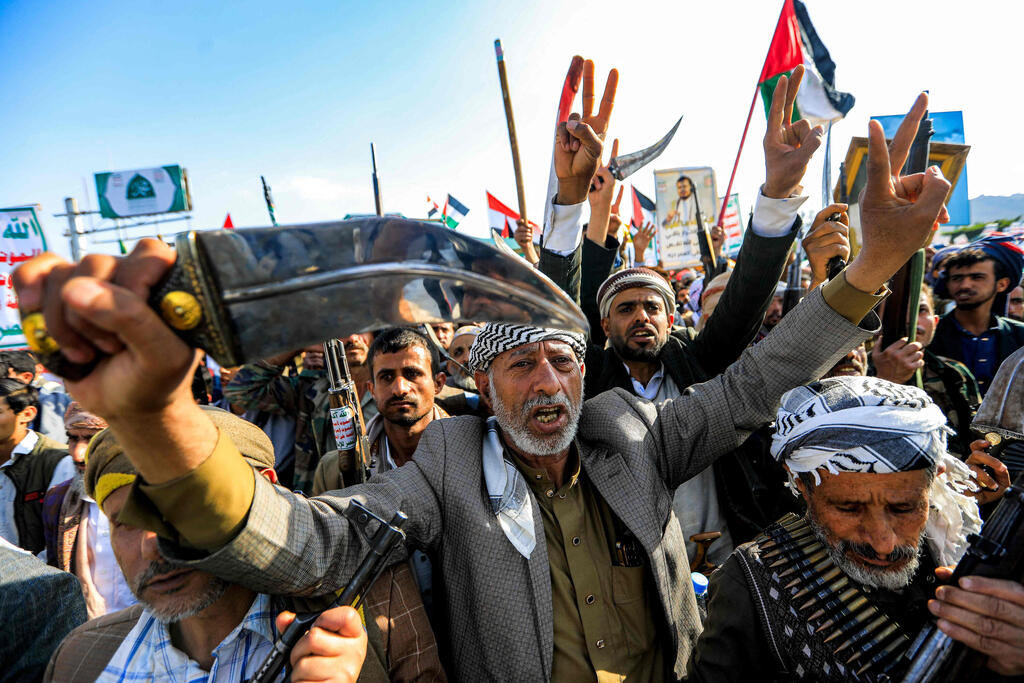
Armed Houthi supporters rally in Sanaa, Yemen, during a demonstration against the United States and Israel
(Photo: Mohammed HUWAIS / AFP)
Throughout the Israel-Hamas war, the Houthis continued launching attacks despite absorbing painful blows. The conclusion reached by some commentators that the Houthis could not be deterred overlooks the fact that the group, despite its unique and opaque nature, makes calculated decisions influenced by external conditions. Their persistence was driven both by a radical ideology that glorifies sacrifice as well as by the desire to avoid the reputational costs of appearing to capitulate. Such a retreat would have carried serious consequences inside Yemen: Rivals would exploit any perceived weakness, and supporters would be disillusioned if the regime failed to exhibit the same sabr (steadfastness in the face of painful losses) it demands from the families of Yemeni youths it has sent to die on the battlefield.
Almost all regimes, because they are fundamentally concerned with their own survival, can be deterred. The Houthis are no different. For ideologically driven organizations, deterrence often takes the form of a strategic decision that it is more advantageous to postpone the fight to a later date.
This analysis suggests that the Houthis have not abandoned their aim of destroying Israel and retain the capability to continue launching missile and drone attacks. Instead, the substantial costs they absorbed and the limited gains they achieved pushed them to postpone the conflict, with the Israel-Hamas ceasefire providing a convenient off-ramp.
Despite their radical ideology, advanced weapons and “little to lose”, the Houthis proved vulnerable both to pressures that threatened their vital interests, which is deterrence by punishment, and to their own limited ability to inflict meaningful damage, which is deterrence by denial. Had their attacks proven more successful and the response to them been more muted, it seems plausible or even likely that Houthi attacks on Israel would have continued even after an Israel-Hamas ceasefire was declared.
Yet as long as the Houthi regime remains in power, the threat of renewed attacks persists and could materialize when a moment of opportunity arises. For now, the group may be content to focus on enhancing its capabilities in preparation for the next round, as Abdul Malik has claimed, or it may pursue alternative ways to target Israel or Jewish people that are more difficult to attribute and respond to. But because deterrence exists primarily in the minds of decision-makers, it can evaporate as quickly as a leader abruptly changes his mind.
Sanaa’s decision to pull back from a conflict with Israel, even though the issue is central to its ideology, deserves close examination. Understanding the group’s calculations can enhance efforts to dissuade future attacks and identify early indicators that deterrence is eroding.
- Ari Heistein is a research fellow at the Jerusalem Institute for Strategy and Security and a consultant on defense technology.