

Forty-seven years after a malevolent regime rose in Iran to threaten world peace, the world’s most powerful nation has set out to break it. Israel shares that objective, and Israeli citizens are once again being called upon to demonstrate resilience until it is achieved.
Statements by the U.S. president and Israel’s prime minister leave no room for doubt: this time they intend to go all the way, and if Iran’s courageous citizens rise up and act, the outcome will be positive.
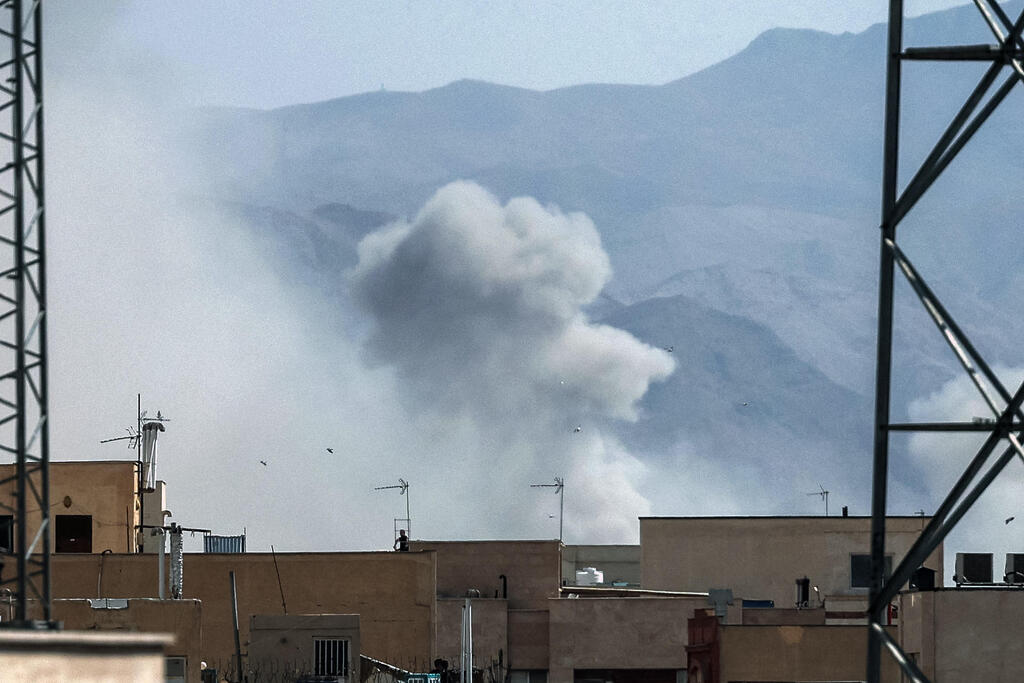
(Photo: AFP)
Iran could have prevented the American strike in only one way: by agreeing to three core U.S. demands on its nuclear program. The first was the removal of all enriched material it has accumulated in recent years from Iranian territory. It was offered full financial compensation in return, but was required to relinquish control of the material. The second demand was the dismantling of all infrastructure enabling uranium enrichment.
This refers to the three facilities where the process has been carried out using tens of thousands of centrifuges — Fordow, Natanz and Isfahan — as well as new complexes now under construction as more fortified alternatives to those bombed in June, and plants producing centrifuges and other relevant components. The third demand was that the agreement remain in force without time limits. As President Donald Trump emphasized in conversations with regional leaders: “President Obama did not understand that agreements between nations are not made for years — but for hundreds of years.”
Iran’s Supreme Leader Ayatollah Ali Khamenei rejected those conditions outright. Years ago, he concluded that the United States was determined to topple the Iranian regime at any cost. In light of that assessment, Khamenei instructed his negotiators to oppose any substantive concessions. He preferred to absorb what he viewed as relatively tolerable damage to Iran’s governmental and military systems rather than accept a humiliation that over time could endanger his rule.
Iran harbored no illusions about the scope of the expected campaign. It observed the U.S. military deploying forces in the Middle East on a scale not seen in more than two decades. Its working assumption is that the American administration is limited in its ability to sustain a prolonged campaign. Accordingly, Iran is preparing to absorb the strikes, preserve its basic functional capabilities, attempt to inflict maximum damage on U.S. forces in the region and hold out until Trump loses focus and shifts his attention elsewhere.
The Houthis did so successfully during Operation Rough Rider, authorized by Trump about a year ago. They demonstrated resilience through several weeks of intensive strikes until the United States declared what critics called a symbolic victory and brought the episode to a close.
The challenge now facing the United States is to undermine that survival strategy at its core — not merely to conduct an operation, but to shape a revolution. That is the vision demanded by the gravity of the moment: sustained, uninterrupted action on an unprecedented scale in order to bring about the regime’s collapse. It is presented as the only appropriate response to the Iranian threat that has developed steadily since 1979.
The Islamic takeover of Iran that year is widely regarded as one of the most consequential events of the past 50 years. Its global repercussions rival other dramatic milestones of the period: the dissolution of the Soviet Union in 1991, the Sept. 11, 2001, terrorist attacks in the United States and the rise of the internet in the 1990s. For decades, millions of people have paid a heavy price as a result of the rise of the zealous Shiite regime in Tehran. Instability in the Middle East, ongoing harm to the global economy and Iran’s contribution to the growth of terrorist organizations on nearly every continent are only some examples.
The unprecedented weakness of the Iranian regime has created possibilities that as recently as two years ago seemed unimaginable.
First published: 04:58, 03.01.26