

The ceasefire in the war with Iran, alongside tense exchanges between Washington and Tehran, has created significant uncertainty about what comes next. Many have cautioned against definitive conclusions, calling for patience, especially in a confrontation with a regime that has proven resilient and shows no clear sign of changing course.
Despite the significant and unprecedented military achievements by Israel and the United States, the current picture remains mixed, with no decisive outcome. The battered Iranian regime is still standing and projecting confidence, a posture some attribute to the growing influence of the Revolutionary Guards within Tehran’s internal power structure.
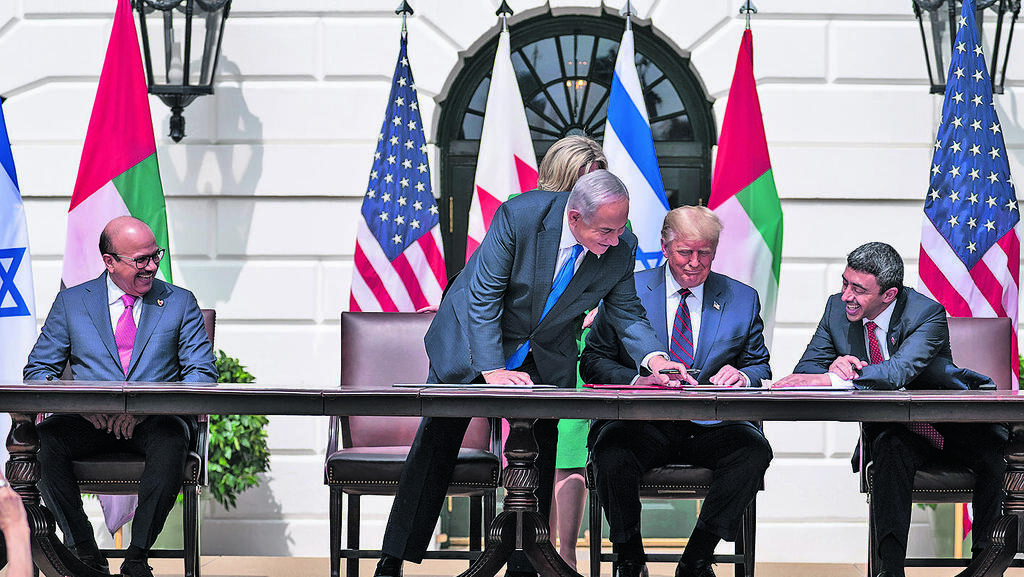
The Abraham Accords signing ceremony
(Photo: Alex Brandon/ AP)
This interim phase of a fragile ceasefire, with all sides awaiting signals from the White House on the next steps, is pushing the Middle East into a period of recalibration. It is also becoming a battle over narratives, as governments prepare their domestic audiences for what may come next.
For Israel, however, this moment presents not only uncertainty but also opportunity. Beyond improving military readiness and planning future operations, it offers a chance to advance initiatives that could help shape a more stable regional order, one in which Israeli strength and deterrence are viewed as an asset rather than a threat.
The recent round of fighting has made the shared interest of Gulf states in countering the Iranian-led axis more tangible. The regime’s continued hostility may only increase the urgency among affected countries to develop a credible and coordinated long-term response.
Throughout the war, Gulf states faced sustained Iranian missile and drone attacks, which continued into the ceasefire period, in what appeared to be an effort to deter them and pressure them to push for an end to hostilities. Iran has also taken a confrontational approach, reportedly demanding compensation from countries including Saudi Arabia, the United Arab Emirates, Bahrain, Qatar and Jordan for allowing attacks to be launched from their territory.
While Gulf states condemned Iran’s aggression, their responses have not been uniform. Qatar emphasized diplomacy and support for negotiations, including direct engagement with Iranian officials. In contrast, the United Arab Emirates and Bahrain adopted a sharper tone, delivering forceful messages that reflected deep concern over Tehran’s actions. Coordination between the two was evident in a recent meeting between UAE President Mohammed bin Zayed and Bahrain’s King Hamad bin Isa Al Khalifa, where they discussed strengthening cooperation in response to Iran.
Saudi Arabia, for its part, appears to be positioning itself as a leading regional actor. Alongside concerns over potential disruptions in the Strait of Hormuz, Riyadh recently announced the restoration of full capacity in its strategic east-west oil pipeline, reaching about 7 million barrels per day.
Returning to the Abraham Accords
Against this backdrop, the current moment presents an opportunity for Israel to renew and expand regional cooperation. The firm stance taken by the UAE and Bahrain, in particular, creates a foundation for advancing joint efforts to address shared threats while also opening new avenues for cooperation.
Naturally, such efforts could be framed within the Abraham Accords, which have demonstrated resilience despite the turbulence of the past two and a half years, including growing criticism of Israel in parts of the Arab world. The present moment allows for both declarative and practical steps to strengthen this framework.
At the declarative level, the United States and its Abraham Accords partners could formulate a joint statement outlining a vision for regional stability, economic growth, interfaith tolerance and the containment of extremist influences, whether from the Iranian-led Shiite axis or Sunni jihadist movements.
On the operational level, Israel could leverage its experience to assist regional partners in strengthening civilian defense systems, including air defense capabilities and protection of critical infrastructure.
Connectivity is another key area. In light of ongoing Iranian pressure in the Strait of Hormuz, Israel could work with moderate regional actors to advance alternative trade corridors and infrastructure projects that reduce dependence on vulnerable routes.
 Roy Binyamini
In the fight against terrorism, enhanced coordination against Iran’s network, including the Revolutionary Guards, Hezbollah and the Houthis, would be essential. This effort should be complemented by measures to counter the resurgence of Sunni Islamist groups, such as global jihad organizations and the Muslim Brotherhood.
Finally, expanding the circle of normalization to include additional partners would accelerate regional integration and serve as a counterweight to the Iranian-led axis, while helping shape the emerging regional order.
Beyond military power
Ultimately, military strength and deterrence alone will not be sufficient in the confrontation with Iran. The current moment calls for creative strategic thinking and long-term planning regarding the desired regional architecture.
After a series of challenges, this is also a window of opportunity for Israel to improve its regional and international standing and to build on the vision of peace, prosperity and stability embodied in the Abraham Accords.
The writer is a former department head at the National Security Council and an expert on the Middle East and Africa.