

No nuclear agreement exists in isolation. It must serve Israel’s long-term security and uphold the commitment to preventing nuclear proliferation across the Middle East.
That was the position set out by former U.S. President Joe Biden in 2022, reaffirming Washington’s longstanding approach: Saudi Arabia could advance a civilian nuclear program only as part of a broader agreement that included normalization with Israel.
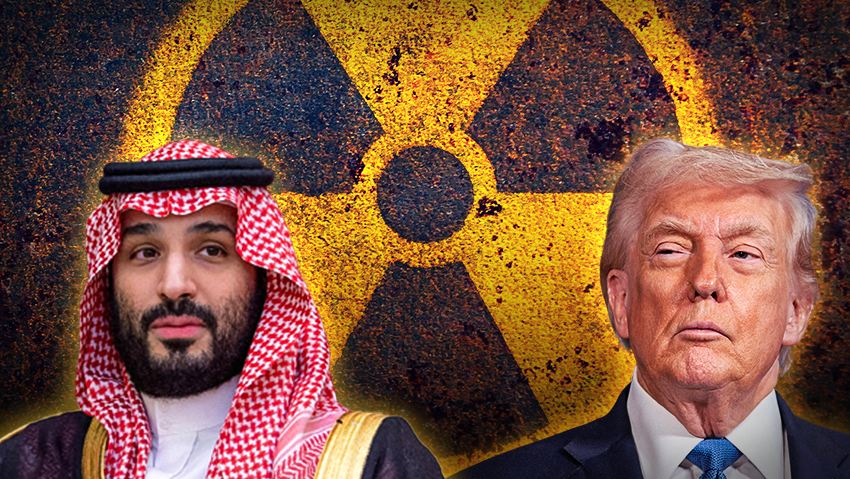
Saudi Crown Prince Mohammed bin Salman secured a long-sought bilateral civilian nuclear agreement with the United States
(Photo: Hamed Jafarnejad/ISNA/WANA (West Asia News Agency) via REUTERS, REUTERS / Jonathan Ernst, shutterstockBandar Algaloud/Courtesy of Saudi Royal Court/Handout via REUTERS)
It was a policy rooted deeply in the American establishment, one that was not supposed to shift with every change in the political weather.
Then came Donald Trump.
The U.S. president is now moving to reshape the regional order by granting Saudi Crown Prince Mohammed bin Salman what he has long sought: a bilateral civilian nuclear agreement with the United States.
The emerging deal appears to avoid several fundamental conditions that had previously been considered essential. These include Saudi Arabia joining the International Atomic Energy Agency’s enhanced monitoring framework, known as the Additional Protocol, and committing not to enrich uranium on its own territory.
It also appears to lack a mechanism guaranteeing full American control over the process after the agreement’s initial term expires, a safeguard sometimes described as a “black box.”
Most significantly for Israel, the agreement does not appear to formally link the nuclear package to Saudi participation in the Abraham Accords. Trump has spoken publicly about normalization, but presidential remarks are not a substitute for binding commitments.
The shift in U.S. policy on such a sensitive and complex issue fits neatly with bin Salman’s effort to separate two tracks that were once intertwined.
On one track, Riyadh seeks unrestricted access to advanced nuclear technology. On the other, it is prepared to discuss normalization with Israel, but only alongside progress toward the establishment of a Palestinian state.
The result may become yet another Middle Eastern farce left behind by Trump after he leaves office, while repairing the damage will be difficult, painful and prolonged.
Israel’s problems, however, do not end there.
The prospective Saudi nuclear agreement joins a growing list of regional challenges that PM Netanyahu, once presented as a leader in a class of his own, may leave behind.
As with other policies pursued by his government, the cumulative damage could be broad, interconnected and long-lasting.
Israel’s apparent failure to publicly challenge the agreement is particularly troubling. It raises questions about Jerusalem’s ability to influence U.S. policy and suggests to regional governments that the road to Washington no longer passes through Jerusalem.
That trend may accelerate after the U.S. midterm elections, particularly as the Democratic Party continues moving in directions that could prove increasingly challenging for Israel.
By failing to condition a civilian nuclear agreement on normalization, Washington has also weakened Israel’s opening position in any future negotiations with its neighbors.
This is especially damaging as Israel seeks to redefine the international debate over the Palestinian issue after the October 7 massacre and remove the establishment of a Palestinian state from any current global agenda.
Any move to halt the agreement is now likely to hinge on Washington’s interpretation of its commitments to Riyadh, as well as on whether congressional approval is deemed necessary. Trump is expected to favor the narrowest interpretation available, one that would enable him to circumvent Capitol Hill, even if the transfer of nuclear technology is involved.
Either way, Netanyahu’s legacy across a long line of strategic fronts is beginning to resemble a catastrophe.
 Avi KaloPhoto: Aloni Mor
Israel might once have accepted a Saudi civilian nuclear program as the price of normalization. The costs would have been high, but the return would at least have been strategically meaningful.
Now, Israel may receive neither normalization nor meaningful safeguards.
Loosening restrictions on access to nuclear technology without robust oversight also risks opening a regional Pandora’s box.
Once Riyadh crosses the nuclear threshold, other major powers in the region, including Egypt, Turkey and certainly Iran, are unlikely to remain passive. Tehran, for its part, may simply abandon any remaining pretense surrounding its own ambitions.
A Middle Eastern nuclear arms race is no longer merely a theoretical scenario. It is becoming a possible direct consequence of impulsive, short-sighted leadership in both Jerusalem and Washington.
And in the final stretch of their time in power, those leaders may leave Israel less secure than they found it.