

As the global community turns its eyes toward next month’s high-stakes summit between U.S. President Donald Trump and Chinese President Xi Jinping, the air is thick not just with the scent of a possible trade deal, but with the smoke of a Middle Eastern tinderbox.
For years, the U.S.-China rivalry was defined by semiconductors, deficits and soybean quotas. Today, increasingly being redefined by oil tankers in the Strait of Hormuz and the shadow of a looming conflict with Iran.
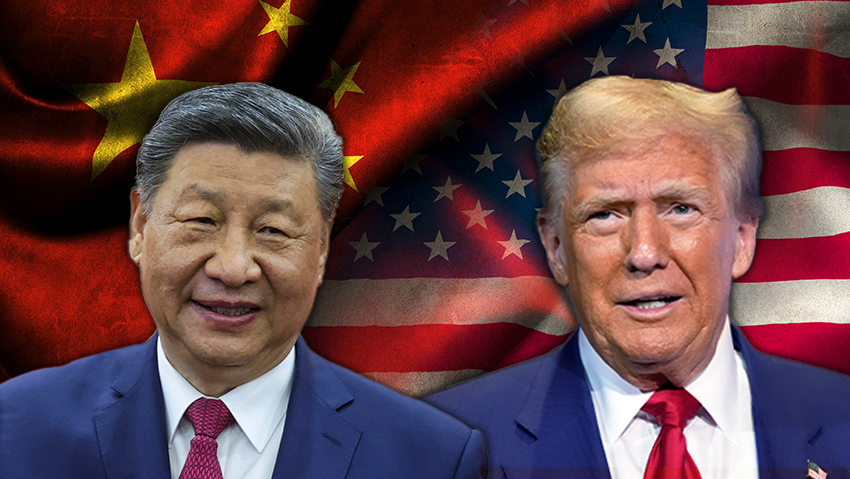
Chinese President Xi Jinping, US President Donald Trump
(Photo: Shutterstock, AFP / JOHN HAMILTON / US DEPARTMENT OF DEFENSE, AP PhotoAlex Brandon8)
This summit is not merely a diplomatic meeting; it is a high-stakes poker game where the "cards" held by both leaders are linked by a complex web of energy security, military posturing and economic survival.
For Trump, the escalating pressure on Iran is not an isolated foreign policy objective; it is a primary bargaining chip against Beijing. The logic is transactional and brutal: by squeezing Tehran, the U.S. directly impacts China’s economic stability.
According to recent data, China’s energy industry is domestically robust but still dangerously exposed to global price shocks. While China maintains strategic oil reserves estimated to last at least 100 days, the cracks are beginning to show. Fuel prices in China have surged, and transportation costs have jumped by 10%.
Trump understands that while Iranian oil accounts for only about 13% of China’s imports, the entire Persian Gulf region provides nearly half of China’s imported oil and a sixth of its gas. By enforcing a strict blockade or threatening the stability of the Strait of Hormuz, Trump isn’t just targeting the mullahs; he is putting a chokehold on the "World’s Factory."
His motive is clear: force Xi Jinping to use China’s significant diplomatic and economic leverage over Tehran to secure a new nuclear deal, or face an energy-driven economic slowdown that could hurt the Communist Party’s domestic standing.
The U.S. enters the summit with a hand designed to project "peace through strength."
1. Energy independence: Unlike the 1970s, the U.S. is now a net exporter of energy. This allows Trump to weaponize oil sanctions without crippling the American economy, a luxury Xi does not have.
2. The blue shift alliances: Washington is successfully expanding its "loyalty network," working on strengthening ties with India, Japan and Australia (the Quad) to contain Chinese maritime expansion.
3. The dollar and tariffs: The Greenback remains the world’s reserve currency, and Trump’s willingness to use aggressive tariffs serves as a constant reminder of China’s dependence on the American consumer market.
4. Military projection: The deployment of carrier strike groups to the Middle East and the South China Sea serves a dual purpose: it signals to Iran that the U.S. is ready for kinetic action, and it reminds China that its "Belt and Road" maritime routes exist only at the sufferance of U.S. naval hegemony.
President Xi, however, is far from empty-handed. Beijing’s cards are designed to hit the U.S. where it hurts most: the supply chain and the wallet.
1. The manufacturing chokehold: China controls the production of essential goods. If Xi decides to slow production or restrict exports, he can export inflation directly to the U.S., potentially hurting Trump’s base ahead of the midterms.
2. Rare earth metals: China dominates the global supply of minerals essential for everything from iPhones to F-35 fighter jets. A "surgical" export ban would be a devastating blow to U.S. tech and defense sectors.
3. Influence operations: Through its vast digital and economic networks, China exerts "soft power" pressure on U.S. corporations and regional allies, making a unified anti-China front difficult to maintain.
4. The Russian pivot: While many suggest China can simply replace Iranian energy with Russian oil, the reality is more complex. Infrastructure—pipelines and specialized refineries—takes years to build. Russia cannot currently fill the 50% void that a Gulf-wide conflict would create for Beijing.
While Iran is the immediate crisis, Taiwan remains the "eternal" flashpoint. The summit will inevitably grapple with the possibility of a maritime blockade. If the U.S. can threaten to close the Strait of Hormuz to Chinese tankers, China can equally threaten to disrupt the Taiwan Strait, through which a massive portion of global trade passes.
 Amir Gal Or Photo: Alex Bronstein
The nightmare scenario for global markets is a "dual-theater" blockade: an Iranian-led closure of Hormuz in the West, and a Chinese-led "quarantine" of Taiwan in the East. This would not just raise prices; it would effectively end globalization as we know it.
As the two leaders prepare to meet, three scenarios emerge:
Scenario A: The grand bargain (The "big win"): Trump agrees to ease certain tech tariffs and provide "security guarantees" regarding Taiwan’s status quo and one China. In exchange, Xi agrees to drastically cut Iranian oil imports and publicly pressures Tehran to return to the negotiating table. Both leaders claim victory: Trump as the "Peacemaker" and Xi as the "Stabilizer" of the global economy.
Scenario B: The cold stalemate: No major breakthroughs are reached. China continues to "gray market" Iranian oil to keep its economy afloat, and the U.S. maintains its sanctions regime. The rhetoric remains heated, but both sides agree to a "truce on escalation" to prevent an all-out military conflict. This is regarded by many most likely outcome, preserving the status quo while the world remains on edge.
Scenario C: The great decoupling (escalation): The summit ends early or in visible acrimony. Trump moves to enforce a total naval blockade of Iranian exports, and Xi responds by restricting rare earth exports and increasing military maneuvers near Taiwan. The global economy enters a tailspin as the two superpowers begin a formal process of economic "decoupling," forcing the rest of the world to choose sides in a new Cold War.
In conclusion, the upcoming summit is more than a meeting of two men; it is a collision of two world powers' worldviews. Trump sees the world as a series of deals to be won through leverage, with Iran serving as the ultimate pressure point. Xi sees the world as a long-term struggle for sovereignty and energy security.
Whether they find common ground or retreat further into their respective corners will depend on how they play their "cards." For the rest of the world—and especially for us here in the Middle East the stakes could not be higher. If the "Grand Transaction" fails, the path to war in both the Middle East and the Pacific becomes realistic.
- The writer is the founder and chairman of Infinity AI Funds, president of the Israel-China Chamber of Commerce and author of Working with the Chinese