

At the Shalom Hartman Institute, a forum meets every week to discuss how to confront the deep divisions within Israeli society. At the heart of these discussions is a question: Can recognizing the feelings and fears of Israel's different communities help reduce their mutual hostility?
This approach does not require anyone to abandon their ideology or compromise their values. It frees us from endless arguments over "who is right" and allows us to address the deeper force driving us: the mutual fear between Israel's different communities. Every fear contains a kernel of truth, but when it goes unrecognized, it leads to blame, alienation and fragmentation.
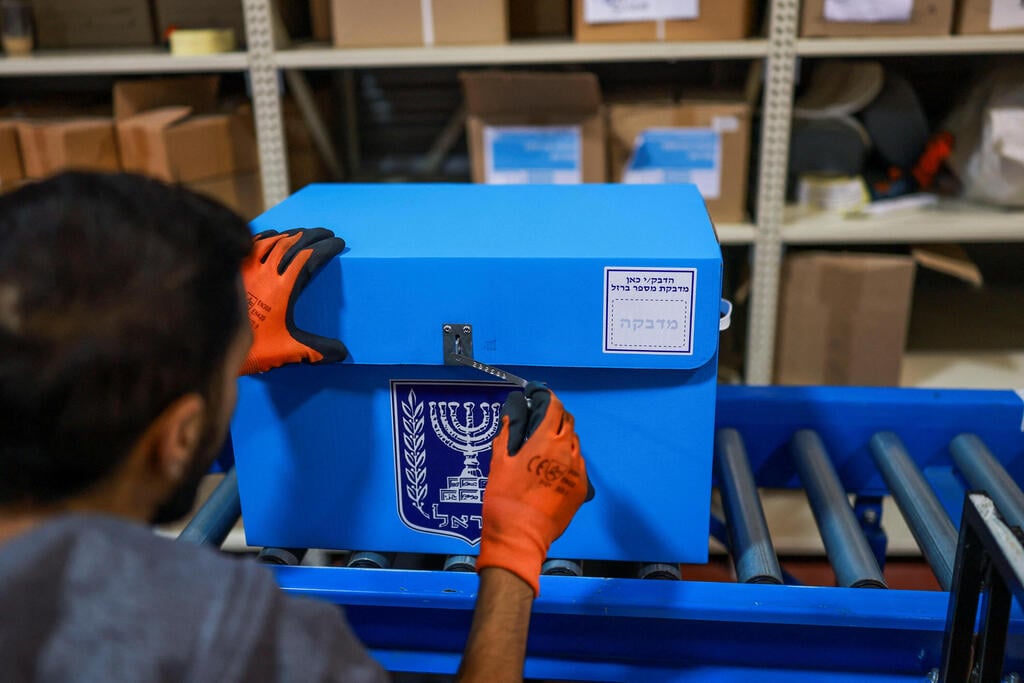
Preparations for Israel's election
(Photo: REUTERS/Ronen Zvulun)
One example is Prof. Oz Almog's study of religious Zionism. Alongside his praise for the community, he describes it as "the engine that will bring about the destruction of the state." How can such a sweeping generalization be made about a diverse community of approximately one million citizens? How can we speak of an "alliance of those who serve" when a community that has paid an unbearably heavy price in the war is condemned as a force leading the country toward destruction? What must the families waiting anxiously at home feel?
To begin healing these divisions, we must understand what each community truly fears.
What frightens the Haredi community?
Haredi Jews fear both secular Israelis and the religious Zionist community. From their perspective, Zionism has deepened the secularization that threatens their community, while military service and mandatory core curriculum studies are perceived as attempts at religious conversion. Religious Zionism, which combines Torah study and military service, is seen as a dangerous bridge that normalizes leaving the Haredi world. In their eyes, military encounters and core curriculum studies could lead to spiritual abandonment of their faith.
What frightens the secular-liberal camp?
In their view, the state that emerged from a rebellion against Orthodox Judaism now faces an existential threat. While the broader public has taken responsibility for security, settlement and the economy, the Haredi community is perceived as refusing to shoulder its share of the burden.
There is also fear of religious Zionism. Despite their cooperation in army tanks, hospitals and the high-tech industry, secular Israelis worry that religious ideology will lead to endless war and extinguish any prospect of peace. What religious Zionists regard as "holy fire" is seen by secular liberals as "strange fire," while demands for changes to the judicial system are perceived as undermining the state's very foundations.
They argue that religious Zionism, which once embraced the "philosophy of the hyphen" connecting its religious and Zionist identities, has changed direction and is no longer safeguarding the delicate balance between Israel's Jewish and democratic character.
What frightens religious Zionism?
Religious Zionists have been partners in the Zionist enterprise for more than a century, yet they feel that the liberal camp, with the backing of the courts and the media, is attempting to delegitimize their worldview.
From their perspective, the Oslo Accords and Israel's disengagement from Gaza were carried out without broad national consensus and led to grave disasters, culminating in the October 7 massacre. In their view, adopting the positions of the opposing camp and establishing a Palestinian state would bring about the end of the Zionist enterprise.
Furthermore, the relentless attempts to portray them as messianic and extremist nationalists appear to them as efforts to exclude them from Israeli public discourse.
The conduct of the Haredi community also generates fears among religious Zionists. The Haredi unwillingness to adapt to the modern world cannot continue indefinitely, while the conservative principle that "anything new is forbidden by the Torah" threatens to make Judaism irrelevant.
Their greatest concern is that religious Zionists, who share the country's economic and security burdens with the broader public, will lose their motivation, placing the state itself at serious risk. From their perspective, the Haredi community's refusal to participate in carrying these burdens is accelerating the disintegration of Israeli society.
The test facing tomorrow's leadership
The challenge confronting Israel's leaders is how to address these existential fears. It is a complex and critical task, particularly on the eve of the election and, even more importantly, the day afterward.
The obvious question is whether a government will emerge that adopts the model proposed by Dr. Tal Becker, placing consideration for the feelings of the opposing side at the top of its priorities as a central principle in healing Israel's divisions.
 Moti Sklar
Achieving this requires a measure of hope, alongside leaders who will not allow fear and hatred to dominate public discourse. Worthy leadership would regard reaching out to the other side as an ideal, do everything possible to avoid offending its deepest convictions, and embrace a model built on compromise, respect for beliefs and broad agreements.
This means we should evaluate our elected representatives not only by the substance of their statements but also by the way they speak and the empathy they show toward their opponents. Internal unity must become the central consideration when voting. A broad-based, sensitive government could calm tensions, prevent sweeping unilateral changes and reduce the flames of fear.
Moti Sklar is a research fellow at the Shalom Hartman Institute.