

On the eve of Rosh Hashanah, the election polls told us that Israel’s rival political camps were running neck and neck. A tie? I asked myself. How can there be a tie after everything that has happened here in recent years?
A tie after cemeteries filled with the graves of civilians and soldiers killed while Benjamin Netanyahu’s government was in power? A tie after we were exposed to the detailed warnings the prime minister received about what Yahya Sinwar was preparing to do, as described by Shlomi Eldar and Ruth Yuval?
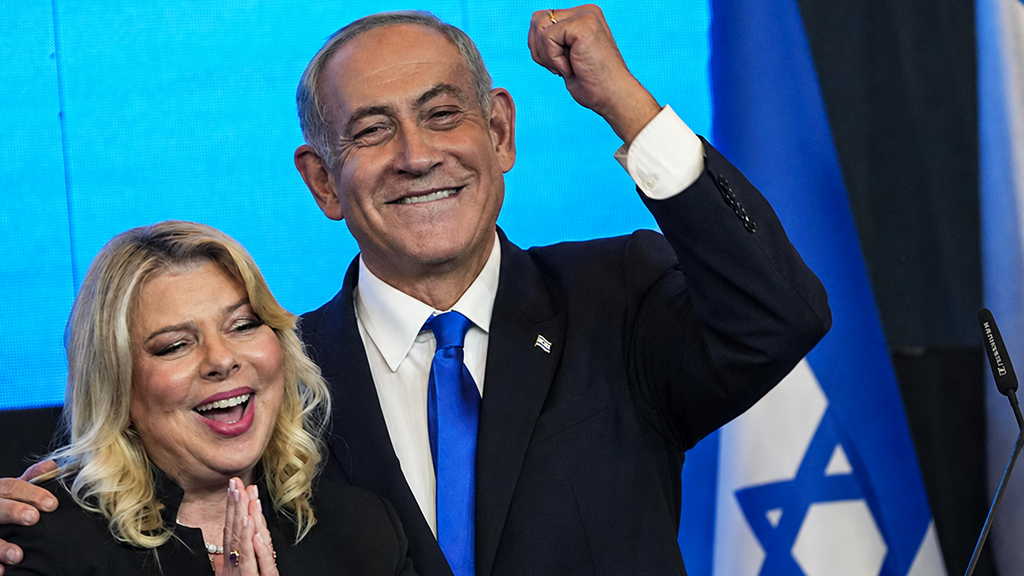
(Photo: AP)
The old Jewish expression for catastrophe says, “While one was still speaking, another came.” That was how I felt reading Dana Spector’s harrowing account in Yedioth Ahronoth’s 7 Days supplement of Noa Hovera, whose husband Ido was killed on October 7 at Kibbutz Sufa, and of the book she later wrote about her experience. It was chilling.
After many years covering election campaigns, I have learned that when the polls point persistently to a dead heat, sometimes it is not only the polling that has lost its way. The voters may have lost theirs as well.
So I will say something that is not based on science or polling models: I believe the coming election will end in a decisive defeat for those who brought us to the brink. Write that down.
Victories are not a strategy
In Khan Younis, Hamas commanders and terrorists have been killed in recent days. The IDF has also completed the destruction of Hezbollah command infrastructure on the Ali Taher Ridge.
Netanyahu and his son Yair rush to be photographed around these achievements. The publicity machine is working. Topaz Luk is doing his part, with help from the IDF Spokesperson’s Unit. Why? Because that is how the machine works. Benjamin and Yair at the wheel.
But if you are at the wheel, perhaps you could also tell us where you intend to drive. What is supposed to happen in these areas after the killings and destruction? What political or security arrangement do you envision?
Those are not abstract questions. They matter to the parents whose children are once again being called up for military service. A military achievement is not a substitute for an answer about what comes next.
Churchill and the art of fearlessness
“It is fortunate for mankind that men cannot, as a rule, foresee or predict to any large extent the course of events. Otherwise life would be unbearable.” That observation by Winston Churchill appears in Erik Larson’s fascinating book The Splendid and the Vile, which focuses on Churchill’s first year as Britain’s wartime prime minister.
The book’s detail is extraordinary and meticulously documented. At its heart is the story of how Churchill taught his country what Larson describes as an “art of fearlessness.”
Read it, and you may understand why I find Netanyahu’s occasional comparison of himself to an “Israeli Churchill” so audacious. The distance between them is immense.
What we asked for at the New Year table
At the dinner marking the arrival of the new year, we ate pomegranates, dipped apples in honey and asked, believers and nonbelievers alike, for an answer to our prayers. May we finally hear good news.
And I found myself thinking of a difficult poem by Tehila Hakimi, with its relentless confrontation between existence, death and life, between graves, earth and all the space consumed by loss.
After everything we have endured, perhaps one of the most important things we can wish for ourselves, and for one another, is compassion. Not only victory. Not only justice as each camp defines it. Compassion. We have needed far too much of it, and shown far too little.
Before Yom Kippur, a word about regret
And with Yom Kippur approaching, another thought. In his poem “Regret,” Yehezkel Rachamim warns against allowing remorse to consume us over lost days, wrong turns, hidden happiness, failures, missed possibilities and all the moments in which we surrendered ourselves to regret.
There is something especially fitting in those words now. A country cannot live forever inside regret. But neither can it move forward by refusing to confront what produced that regret in the first place.
There must be a way to remember without being paralyzed, to demand accountability without surrendering to hatred, and to choose a different path without pretending the past did not happen.
So for the year ahead, for all of you, I wish only good things.