

This is no longer just another escalation. This is a turning point. The war with Iran is not only shaking the Middle East, but it is also bringing it back to the fundamental question that has defined it since the Arab Spring: Which camp do you belong to?
For more than a decade, two clear axes operated in the region. On one side were Saudi Arabia, the United Arab Emirates, Egypt and Jordan, countries seeking stability and gradually moving closer to the West and Israel. On the other was Turkey, with a different, often opposing, worldview.
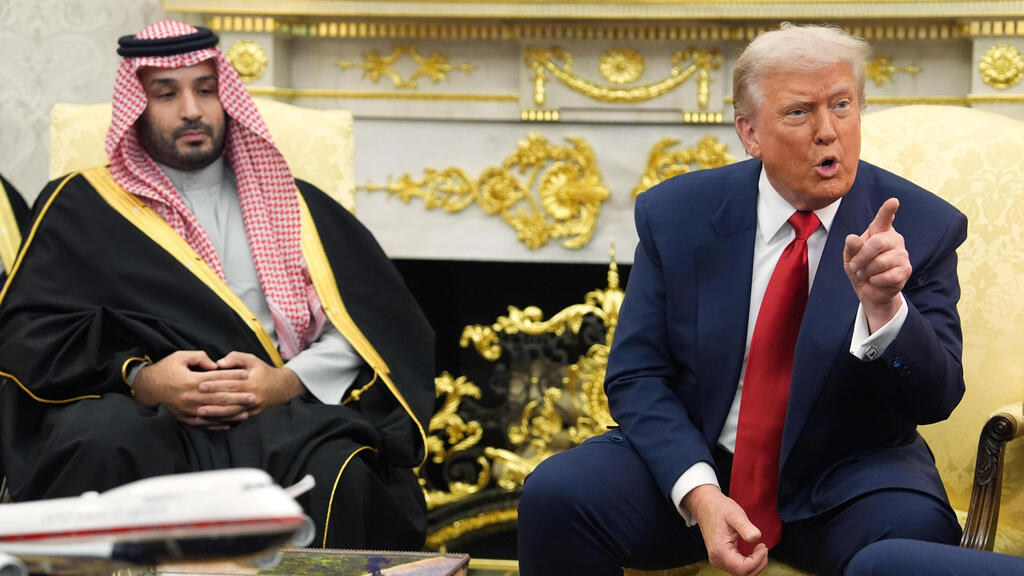
Mohammed bin Salman and Donald Trump
(Photo: AP/ Evan Vucci)
The Abraham Accords in 2020 created a sense that the direction was clear. The first camp was strengthening, normalization was expanding and the region was converging around it. But that is not what happened.
Iran’s 2019 attack on Saudi Arabia, and the lack of a meaningful U.S. response, undermined trust. The events of October 7 made ties with Israel politically more complex. On the ground, cracks were already visible. In Yemen, Sudan and in the recognition of Somaliland, Saudi Arabia and the UAE were no longer aligned. Then came the war with Iran.
Over the past year, Israel has proven itself as a regional power, not only in words but in action. The question now is whether it is also ready to be a regional partner, not only defending itself but also providing security to others.
On paper, this should be a unifying moment: a shared threat, a clear enemy, a need for defense. In practice, something else is happening. Alliances are being tested, and many are failing.
Pakistan is not defending Saudi Arabia. China is not proving to be a reliable anchor for its partners in times of crisis. The region is beginning to understand that promises are not security. Within this reality, the camps are beginning to take shape again.
Turkey and Qatar are accusing Israel. Saudi Arabia is speaking of Iran as a force trying to impose reality by force and warning that escalation will be met with escalation. This is not just a gap in messaging. It is a struggle over direction.
Everything now converges on one player: Saudi Arabia.
If Saudi Arabia chooses to move closer to Israel, it could reshape the Middle East. If it continues to sit in the middle, everything will remain stuck. But that choice also depends on Israel.
 Shiri Fein Grossman
Over the past year, Israel has proven itself as a regional power, not only in words but in action. The question now is whether it is ready to be a regional partner, not only defending itself but also providing security to others.
In the Middle East, power is measured by the ability to protect, not only to deter.
At the same time, the reality is complex. Public opinion in the Arab world, the Palestinian issue and fears of an overly strong Israel all remain.
So despite the opportunity, nothing is guaranteed. In the end, everything depends on how this war ends.
If it ends with a clear demonstration of strength, countries will begin choosing sides. If it ends in uncertainty, they will continue to hesitate.
The Middle East is no longer in balance. It is entering a phase of decision.
And this time, the choice is being made under fire.
The writer is a former senior official at Israel’s National Security Council, an expert on normalization processes and a member of the Dvora Forum.