


In his last moments on earth, the Torah emphasizes that Moses "Walked." His final instructions for the people include two of the final commandments of the Torah: the commandments of Hakhel, which is to gather the nation on the seventh year and read them the Torah, and the commandment for every Jew to actually write or participate in writing a Torah scroll.
Despite the portion being the shortest in the entire Torah, there are many lessons in the portion about leadership and the preservation of a nation.
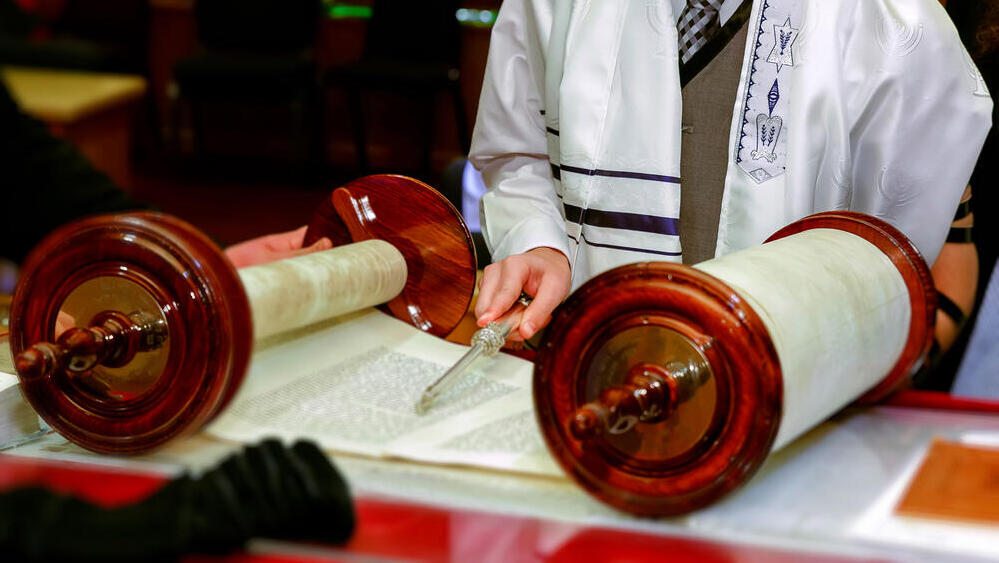
(Photo: Shutterstock)
Let’s start with the first word. What is the significance of the words "He went"?
Well, Moses led the people out of Egypt and through the desert for 40 years. He had one dream, one aspiration, and that was to enter the land of Israel.
That request was denied. Moses was told that he would not be entering the land.
Moses begged God on multiple occasions, something that in all other cases received a positive response, but God said no over and over.
There is endless literature addressing the obvious question of why Moses was not allowed into Israel.
One thing is for sure, and that is the devastation Moses felt about this decree.
In addition to his personal plea, I believe Moses tried a new tactic in this portion.
Right at the beginning of the portion, Moses reminds the nation that God isn’t letting him into Israel.
The verse reads, “Moses went and spoke these things to all Israel. He said to them: I am now one hundred and twenty years old, I can no longer be active. Moreover, Hashem has said to me, "You shall not go across yonder Jordan."
Why is Moses mentioning this again?
I believe this is his final attempt to convince God.
I’d like to suggest that Moses mentions it again in the hopes that the nation responds by saying, “That’s not fair. After everything you’ve done for us to bring us to the land of Israel, you’re not allowed to join? That’s wrong.”
Perhaps Moses thought to himself, “If I can’t convince God to let me in, maybe His children, the nation of Israel, could.”
Once Moses fully internalized that his wish would not be granted, he did what a good leader who is not driven by ego would do: he continued to walk forward, to instruct the people about the future.
This word “He went” is significant. It’s teaching us that Judaism is about movement. It’s never about standing still, even when you don’t get what you want and you feel hopeless. Keep walking is the message Moses is teaching us in his last moments.
I once heard a beautiful story about a great rabbi. One of the rabbi’s students came to the yeshiva on a bicycle. When the rabbi saw the bicycle, he commented that there is much to learn about life from a bicycle.
He explained that when you are moving up in life, it is always a struggle. If things are too easy, you might be going downhill. But most importantly, like a bicycle, when you stand still in life, you fall.
So Moses, despite the personal devastation of not entering the land, continues to walk, to move forward.
There is one very obvious hidden message here as well.
Moses, the greatest prophet of all time, the greatest leader the world has ever known, the most righteous man in history, God is rejecting his plea to enter the land. All Moses wants to do is set foot in the land of Israel, but he is prevented from doing so.
Given the ease of coming to the land of Israel today, you have to ask yourself, if Moses wanted it this badly and he was rejected, who am I to say no to the gift of Israel?
Today, when Jews can return home with relative ease, and the great Moses was unable to do so, perhaps the Torah is teaching us that as Jews, we need to appreciate the gift that God has given us, and take advantage of the fact that after thousands of years in the exile, the Jewish people have come home and can live in their own land, the land of Israel. Just sayin.
Back to the lessons of leadership.
If Moses was driven by ego, something the Torah explicitly says he was not, he would spend the last moments of his life getting comfortable, getting all his affairs in order, and mourning the decree that was given that he couldn’t enter the land.
Moses was not driven by ego. Moses was driven by the desire to lead the Jewish people, and he therefore kept going until his final breath. He kept peddling the bicycle and didn’t stop for a second.
Not only does Moses not spend his last moments thinking about himself, but he plants the seeds for the successful future of the Jewish people.
He does that in multiple ways.
First, he tells the nation that upon entering the land, God will help defeat the nations. Moses tells the nation not to fear because God is with them. Sort of like a pep talk. Moses is telling the nation, “You got this”.
That message is one for generations.
“You will face challenges. God might even hide from you. You will surely feel hopeless at times. But don’t worry, you will persevere, you will survive, you will win.”
Moses then appoints Joshua as his successor. In front of the whole nation, Moses instructs Joshua to bring the people into the land, something that again requires extreme humility.
To Joshua, Moses also says not to fear, for God is with him.
Moses then writes the Torah down and gives it to the Levites to preserve it.
Then Moses goes into the two commandments mentioned above, to gather the nation and read the Torah, and for every individual to write Torah themselves.
So why these two commandments? Out of the 613, why does Moses choose these two as the final ones? Why not tell them not to murder, or to give charity? Or to keep the sabbath? Or kosher.
Why are these two commandments the final ones that Moses chooses to emphasize at the end of his life?
Given what we said above, that Moses was concerned with the continuity of the Jewish people, the answer is obvious.
Moses was reminding us that Judaism is a religion that is unique in that it focuses on both the individual and the collective.
Judaism teaches us that every one of us matters, that on the day we were born, God decided the world was imperfect without us.
In his final moments, Moses reminds the people that every one of them is significant and no one should think that because they’re just one person, that they can’t make a difference.
He teaches us this lesson by instructing every single Jew to write Torah themselves. He reminds us that the Torah isn’t just a guide for the nation, but it’s also a guide for the individual.
Then Moses continues and reminds us that Judaism isn’t only about the individual. He instructs the nation to gather together every seven years to read the Torah together.
While every individual is important, Moses reminds us in his final moments, the collective, the entire nation, is equally important.
Some societies focus solely on the individual, and there are others that focus on the collective. Moses reminds us that Judaism values them both, the individual and the collective.
Perhaps this idea is the reason we read this portion between Rosh Hashanah and Yom Kippur. It’s to remind us that as we repent and pray about the year to come, we should be repenting and praying not only as individuals but as a nation.
Again, this is uniquely Jewish. The prayers on the high holidays are a clear mix of individual prayers and prayers about the collective, the nation as a whole.
I think this is a message that is easy to relate to today. We each have our own challenges, but the Jewish people face challenges today that we haven’t faced in many decades.
Moses is teaching us here that we are greater than the sum of our parts, that the Jewish people possess a supernatural strength when we are united.
But then there is one more lesson that is incredibly fundamental to leadership, and again, it is uniquely Jewish.
If you pay close attention to the words Moses tells Joshua vs. the words God tells Joshua, you’ll notice that they are almost identical besides one word.
Moses says to Joshua: “Be strong and courageous, for you must go with this people into the land that the Lord swore to their ancestors to give them, and you must divide it among them as their inheritance.”
God says to Joshua: “Be strong and courageous, for you will bring the Israelites into the land I promised them on oath, and I Myself will be with you.”
Did you notice it? Moses says, “Go with…” and God says, “Bring”.
Rabbi Sacks points out that these are two types of leadership.
When Moses instructs Joshua, he says that he should go with them into Israel. In other words, he should lead by consensus. Get everyone on board.
God, on the other hand, says to bring them into Israel, which implies authority and not consensus.
We learn here about the two types of leaders.
However, there is something strange going on here. Till now, Moseshas led the people. He didn’t ask them what they wanted. In fact, he often ignored what they said they wanted. He was given authority by God to lead the nation, and that’s what he did; he led with authority. Now he’s telling Joshua not to lead with authority but rather to gain consensus?
God, on the other hand, is now telling Joshua to lead with authority and bring the nation in, which implies that he should lead even without consensus.
But we know that when God created the world, he consulted with the angels so as not to make them jealous that he was creating an entire world for humans.
“Now this is a strange comment from Rashi, considering what we learned elsewhere about the leadership styles, respectively, of God and Moses.
Listen first to the comment of Rashi on the words of God immediately before the creation of humanity: “Let Us make man in our image after our likeness”
Who are the “Us”? To whom is God speaking and why?
Rashi says:
From here, we learn the humility of God. Since man was created in the image of the angels, they might become jealous of him. He, therefore, consulted them.
Similarly, when He judges Kings, He consults His heavenly court . . . Though they [the angels] did not help in his creation and [the wording of the verse] may allow the heretics to rebel, [nevertheless,] Scripture does not refrain from teaching courtesy and the attribute of humility, that the greater should consult and ask permission of the smaller.
This is a remarkable statement. Rashi is saying that, before creating man, God consulted with the angels. He did so not because He needed their help: clearly, He did not.
Nor was it because He needed their advice: He had already resolved to create humankind.
It was to show them respect, to pre-empt their jealousy of man, to avoid their resentment at not being consulted on so fateful a decision, and to show us – the readers – the fundamental truth that greatness goes hand in hand with humility.
So it was God who acted according to the advice Moses gave Joshua: “Make sure that others are with you. Consult. Take their advice.”
Moses, who led with authority till now, is telling Joshua to lead by consensus, and Go, who led by consensus,u now telling Joshua to lead by authority.
What is going on here?
Maybe the answer is found in the idea we mentioned above.
Moses and God are teaching Joshua that a good leader has to possess the unique ability to listen to the people and lead with consensus when possible, but sometimes, the people don’t know what they want, and a leader has to make a decision matter how unpopular it may be.
Both Hashem and Moses are now telling Joshua, “Till now you saw me lead owaye w, ay but now is the time to show you that sometimes you need to lead the other way.”
It’s one thing when the nation was in the desert, being led to their destination. It’s another whole thing when the nation is to enter its land, establish a society with an army, a government, an economy, etc.
Now, as the nation becomes a true society, the Torah is teaching us that true leadership is the ability to balance the two forces, the need for consensus and the ability to lead even when there is no consensus.
Once again, this is a uniquely Jewish concept. The Torah here teaches us that to build a successful society, the leader needs to listen to the people when relevant but also to lead with authority when necessary.
To lead without consensus is to bring the people into tlandla even if individuals push back, because as a collective, that’s what’s best. On the other hand, to lead with consensus is to go in together with full support from the individuals.
Joshua is being taught here to learn the art of doing both.
With that in mind, it is clear why Moses chooses to focus on these two commandments specifically and why the Torah chooses the words it chooses.
As we enter the land, the Torah is reminding us that hateveryy one of us counts, but that, as a collective, that is where we shine.
I think this lesson goes even deeper when you think about the very last commandment in the Torah, the commandment for every Jew to write their own Torah scroll.
Rabbi Sacks explains, “By now, Moses had given 612 commands to the Israelites. But there was one further instruction he still had to give, the last of his life, the final mitzva in the Torah.
‘Now therefore write this song and teach it to the people of Israel. Put it in their mouths, that this song may be My witness against the people of Israel.’”
 Hillel Fuld Photo: Courtesy
Being as it’s the last mitzvah, clearly there’s a very important lesson to be learned. What is that lesson?
I believe the answer is that the Torah is the bridge between every Jew as an individual and the Jewish people as a nation.
“There is something poetic in the fact that Moses left this law until the last. For it was as if he were saying to the next generation, and all future generations: Do not think it is enough to be able to say, ‘My ancestors received the Torah from Moses.’ You must take it and make it new in every generation.
And so Jews did.
So there is immense power in the idea that, as Moses reached the end of his life, and the Torah the end of its narrative, the final imperative should be a command to continue to write and study the Torah, teaching it to the people and “putting it in their mouths” so that it would not abandon them, nor they, it. God’s word would live within them, giving them life.”
The Torah is the life of the Jewish people. Throughout our history, the Torah has preserved us as a people.
As Rabbi Sacks points out, the five Books of Moses end with the letter Lamed and the Torah begins with the letter Bet.
Lamed and Bet spelled Lev, which means heart, because the Torah is the heart of our existence.
“So long as the Jewish people never stop learning, the Jewish heart will never stop beating. Never have people loved a book more. Never has a book sustained a people longer or lifted it higher.”
This is a lesson we all need to internalize today as we battle the forces of darkness who try to extinguish our light.
The best way to battle their darkness is to increase the brightness of our light, to hold onto our torah, our tradition, both as individuals and as a nation, and that way, we can ensure that the heart of the Jewish people continues to beat.
Shabbat shalom.