

The belongings of Jewish victims still crowd the Bondi beachfront. Blood has not yet faded from Australia’s white sand, staining it like an Andres Amador installation gone horribly wrong. And across the Jewish world, the dominant emotion is not shock. It is something colder and more unsettling.
It is the feeling of being exposed and unseen at the same time.
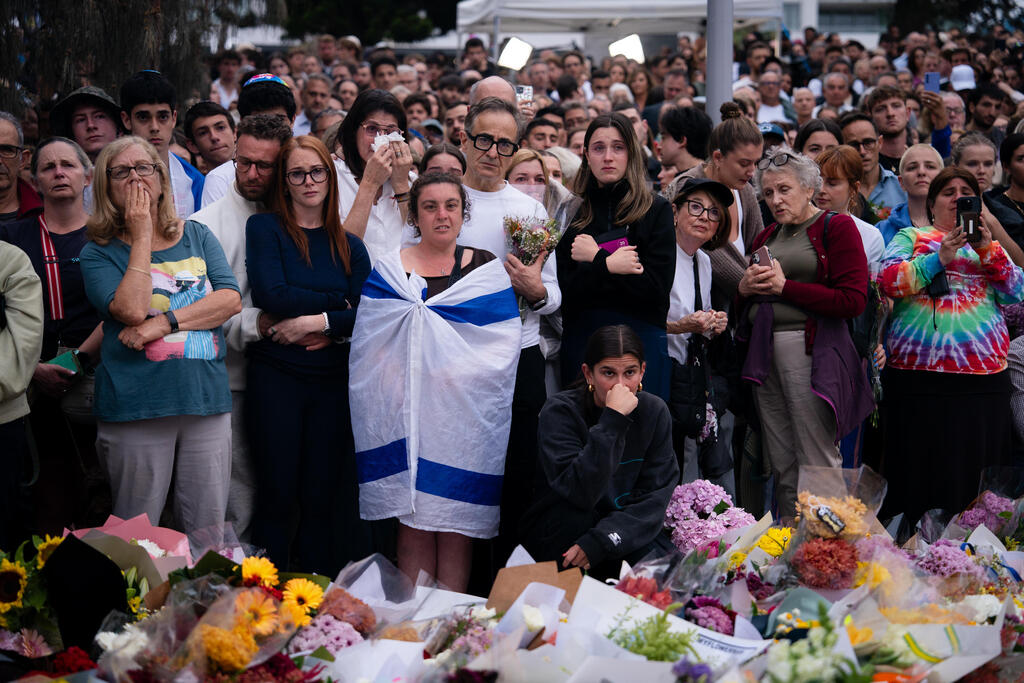
(Photo: Audrey Richardson/Getty Images)
The questions that flood our consciousness are no longer How could this have happened? or What led to this hatred? Those answers, tragically, are familiar. The harder question is this: What does a Jewish future look like in Western democracies where we are visible enough to be targeted, but apparently invisible when it comes to protection?
As a father, I feel a nearly physical ache when I think about ten-year-old Matilda. I think about what her final moments might have been like. I think about what her parents will carry for the rest of their lives. There is no language adequate to that grief.
But layered atop that grief is something else. A quiet realization that settles in the chest. That when Jews are attacked in public spaces in liberal democracies, the reaction is often procedural rather than moral. Condemnations are issued. Vigils are held. And then the world moves on, leaving Jewish families to absorb the costs alone.
And yet I find myself thinking as well about the terrorists. About the father and son bond that connected them so tightly, fused by shared grievance, radical ideology, and a warped sense of purpose. A bond strong enough to pull them together into a death spiral that ended in mass murder.
This is the unbearable duality of our moment.
On one side, Jewish fathers instinctively shielding the bodies of their children. Reflexes shaped by generations of transmitted values about love, lineage, and responsibility. The most basic promise of parenthood. I will protect you.
On the other side, radicalized fathers passing down a grotesque inversion of that same instinct. Teaching not protection but annihilation. Not moral restraint but sanctified violence. Research on political extremism consistently shows that radical ideology is rarely adopted in isolation. It is often inherited through family narratives of humiliation, grievance, and moral absolutism. Hatred, like love, is learned close to home.
That symmetry is deeply unsettling. The same biological bond, pointed in opposite moral directions.
Which raises an uncomfortable question for those of us raising Jewish children in the West. What do we do when the societies we live in affirm our inclusion rhetorically, but fail us materially when it matters most?
Fathers matter more than we like to admit. Decades of social science research show that fathers play an outsized role in shaping a child’s sense of moral agency, emotional regulation, and susceptibility to ideological extremism. Children do not merely inherit beliefs. They inherit frameworks for interpreting threat, belonging, and justice.
We often think of fatherhood in terms of strength and confidence. Of projecting certainty so our sons feel anchored. But certainty without humility is dangerous. Research on healthy father son relationships suggests that moral credibility comes not from infallibility, but from accountability. From modeling self reflection. From showing that conviction and doubt can coexist.
Jewish tradition understood this long before modern psychology. The Torah does not portray fathers as flawless patriarchs. It portrays them as transmitters of identity and memory. “And you shall teach them diligently to your children.” Not indoctrinate, but teach. Children learn far more from what fathers do than from what they say. Abraham is chosen not because he is powerful, but because he will command his children to pursue righteousness and justice.
As a Jewish father with a Jewish son who is still too young to understand what happened at Bondi Beach, I ask myself what I will say when he is old enough to ask.
I imagine telling him that being Jewish means choosing life even when others worship death. That our history is heavy, but it is also a record of moral stubbornness. That we do not disappear when the world grows hostile. But I also imagine telling him something harder. That there will be moments when he feels unseen. When institutions that speak fluently about inclusion struggle to recognize Jewish vulnerability. When the burden of vigilance quietly shifts onto us.
My immediate reaction is anger. Justified, combustible anger. The question is not whether that anger is warranted. It is how it should be carried.
My instinctive response is to be Jewish more loudly and more visibly. To refuse erasure. But the protector in me also hesitates. Does visibility without protection make my son safer, or simply more exposed? I do not know. None of us do.
What I cannot escape is the resemblance between the closeness of the terrorist father and son and the closeness of Jewish fathers and children at Bondi Beach and beyond. The same intensity of attachment. The same willingness to sacrifice. One pointed toward life, the other toward destruction.
That resemblance forces a deeper reckoning. Not only about antisemitism or security failures, but about what kind of moral inheritance we pass down when the world feels indifferent to our safety.
The future of Jewish life in Western democracies may hinge less on public statements than on what fathers teach their sons at kitchen tables and bedtime, in moments of fear and in moments of pride. On whether we raise them to understand that Jewish identity is not something to hide, nor something to define themselves against others by, but something to carry with responsibility. We will teach them how to name danger without surrendering to it, how to insist on dignity without abandoning empathy, and how to stand visibly Jewish while still standing up for other people. That is how values endure when protection falters.
That burden should not be ours alone. But until it is shared, it is one we cannot afford to pass on improperly.
Coby Schoffman is a Los Angeles–based serial social entrepreneur and the founder of The Nation Foundation (TNF), which operates project zones across East Africa. The views expressed are his own and do not reflect those of any affiliated organization.